Living With Lolo Facebook Book a Free Consultation
Design-Build Firm Scottsdale: What It Means (2026)

Design-Build Firm Scottsdale: What It Means (2026)

Design-Build Firm Scottsdale: What It Means (2026)

A design-build firm is a single company that holds both an interior design credential and an active general contractor license, which means one team manages your renovation from the first concept sketch through the final walk-through. In Scottsdale, where luxury renovation budgets often start at $150,000 and regularly climb past $1 million, that single point of accountability is why more homeowners are choosing design-build over hiring a designer and a contractor separately. Living with Lolo founder Lauren Lerner was recently profiled in Commercial Construction & Renovation magazine on exactly this model, in a feature called "Built as One," and the interview lays out why the gap between design vision and construction reality is the single biggest risk in a high-end renovation.
This post walks through what Lauren told Commercial Construction & Renovation about building Living with Lolo as a design-build firm, why she earned her Arizona ROC general contractor license on top of her interior design credential, and what that structure actually changes for a homeowner in Scottsdale, Paradise Valley, or Silverleaf. Because the magazine itself is a digital flipbook with no crawlable article text, we are publishing the substance of that conversation here so it is something you can actually search for, read, and reference.

What the Data Shows About Design-Build Demand

The design-build model is not a niche preference anymore. According to the 2026 Houzz & Home Study, 93 percent of homeowners planning a project in 2026 expect to work with a professional, and general contractors are the single most commonly hired category at 55 percent. The National Association of Home Builders forecasts that residential remodeling activity will grow 3 percent in 2026 and another 2 percent in 2027, in inflation-adjusted terms, which points to sustained demand rather than a short-term spike.
Among firms that combine design and construction specifically, the Houzz Pro Industry Barometer reported that design-build remodelers entered the third quarter of 2026 with an average backlog of 6.2 weeks, up from 5.8 weeks a year earlier, and design-build companies remained more confident than build-only firms, with a forward-looking activity index of 63 compared to 59. Translated for a Scottsdale homeowner, that means design-build firms are booking further out and reporting steadier client confidence than contractors who only build from someone else's plans. National medians almost always understate what Living with Lolo clients spend on a full-scope renovation, and that gap between the average national project and a true Scottsdale luxury renovation is itself useful data if you are budgeting for one.

Why Living with Lolo Built a Design-Build Model From the Start

Lauren Lerner founded Living with Lolo in 2017, after several years in retail and a pull toward design she could not ignore. She started as an interior designer, the way most firms do, and quickly ran into the same problem that pushed her toward the general contractor license: clients were being handed off between their designer and their contractor, and when something went sideways, each side pointed at the other. Projects went over budget, over schedule, and under-delivered on the original vision.
Her answer was to close that gap entirely. She earned her Arizona ROC general contractor license so Living with Lolo could own the entire process, from the first concept sketch through the final walk-through, without a translation layer between what was designed and what actually gets built. That dual credential is still rare in the Scottsdale market. Very few firms in Arizona hold both an interior design credential and an active ROC license, which means most homeowners are still stitching together a designer and a contractor themselves and hoping the two communicate well.
"I built my company out of a genuine love for transforming spaces, starting with my own homes," Lauren told Commercial Construction & Renovation. "Over time I had watched too many homeowners get stuck in the gap between their designer and their contractor." That line is the entire thesis of the design-build argument, and it is worth sitting with if you are currently trying to decide whether to hire one firm or two.

What a Design-Build Firm Actually Does That a Separate Designer and Contractor Cannot

The practical difference shows up the moment a client falls in love with something that has a structural implication. If you are working with a separate designer and contractor, that decision typically waits for the contractor to weigh in later, which can mean days of delay and a client left guessing about cost. Because Lauren holds both credentials, she can assess a structural question on the spot, in the same conversation, and give a client an honest read on what is possible and what it costs before the meeting ends.
Living with Lolo also built its own operating system, called Lolo OS internally, to manage procurement, scheduling, and project visibility in real time across every active job. It is a detail that will not show up in a portfolio photo, but it is one reason a general contractor in Scottsdale that also designs can hold a tighter schedule than a firm juggling handoffs between separate vendors. Clients never have to manage that relationship, because it is internal to one team.
This is also where a design-build firm earns its fee on the harder projects. Every project has a chapter that tests it, and some of the most demanding work Living with Lolo has done has been on older homes with hidden conditions behind the walls. The firm now runs thorough pre-construction assessments on every project and builds contingency into both the schedule and the budget as standard practice, not as an afterthought added after something goes wrong. Clients who go through a difficult chapter with Living with Lolo almost always become the most loyal advocates, because they see firsthand how the team handles pressure instead of just reading about it in a portfolio.

Inside the Project That Proved the Model: Lolo Prestige Property

When Commercial Construction & Renovation asked Lauren to name the project that best represents Living with Lolo's approach, she pointed to a full renovation in North Scottsdale the firm calls Lolo Prestige Property. The home is roughly 5,000 square feet, and it was the first project Living with Lolo took from concept through construction entirely as a design-build firm, with every trade managed in-house rather than farmed out to a separate general contractor.
What made the project meaningful was not its size. It was the consistency: every decision, from structural framing to final finish selections, was made with the same level of intention, because one team owned all of it. That project has since been featured editorially in its own right, and it gave Living with Lolo the runway to refine how design and construction integrate on every project since, which is a big part of why the firm can now confidently take on whole-home renovations across Scottsdale at scale.

Sustainability and the Long View on Renovation

Sustainability in a luxury renovation is less about checking a box and more about building things that last. Living with Lolo specifies materials for durability and longevity, because the most sustainable renovation is the one a client does not have to redo in ten years. The firm works with low-VOC finishes, energy-efficient systems, and vendors who can speak clearly to their own supply chain, and when a client wants to go deeper on sustainability, that conversation happens early in design rather than being added on at the end.
This matters in Scottsdale specifically, where the climate is hard on finishes and mechanical systems in ways that milder markets do not experience. A renovation built for durability in the desert looks different from one built for a temperate coastal market, and that regional judgment is part of what a local interior designer Scottsdale AZ homeowners already trust can bring to a project that an out-of-state firm cannot.

Where Design-Build Fits Across Scottsdale's Luxury Neighborhoods

Living with Lolo's design-build projects typically start at $150,000, and most of the firm's work falls between $300,000 and $1 million or more, concentrated in Scottsdale, Paradise Valley, and the greater Phoenix metro. Clients are generally high-net-worth homeowners, entrepreneurs, and professional athletes who want one point of contact and a team that takes complete ownership of the outcome rather than managing multiple vendors themselves.
In Silverleaf and DC Ranch, where architecture and HOA guidelines are often more particular, the design-build structure means fewer approval delays because the same firm managing design also understands what construction can actually deliver within those rules. In Paradise Valley and Arcadia, where many clients split time between multiple residences, that single point of ownership matters even more, because Living with Lolo can manage a project autonomously while a client travels for weeks at a time.

How AI Search Is Changing How Homeowners Find a Design-Build Firm

One of the more candid parts of the Commercial Construction & Renovation interview had nothing to do with construction at all. Lauren told the magazine that clients now increasingly find Living with Lolo through research done on AI tools before they ever land on the website, which has changed how the firm structures its content and thinks about visibility. Living with Lolo has put real work into AI-indexed content and structured data, so that when someone asks ChatGPT, Perplexity, Gemini, or Claude which design-build firm in Scottsdale is worth calling, the firm actually shows up in the answer.
That work was successful enough that Lauren launched a second company, Cited Co, to help other service businesses build the same kind of AI visibility. It is a detail that says something honest about where homeowner research actually happens now: fewer people start with a Google search for a general contractor, and more start by asking an AI assistant a direct question and taking the first few answers seriously.

What This Means If You Are Planning a Renovation

If you are comparing a separate designer-and-contractor approach against a single design-build firm, the honest answer is that both can produce a beautiful home. The difference shows up when something goes wrong, when a wall opens up and reveals a surprise, or when a client wants to change a finish mid-project and needs to know immediately what that costs. A firm holding both credentials can have that conversation once, in real time, instead of routing it through two separate businesses that may not agree.
Living with Lolo manages both interior design and licensed general contracting under one roof for clients across Scottsdale, Paradise Valley, Arcadia, Silverleaf, DC Ranch, and the greater Phoenix metro, under Arizona ROC license #347577. The firm has been named Phoenix Magazine Best Interior Design three consecutive years, 2024, 2025, and 2026, and Lauren Lerner's work has also appeared in Architectural Digest, House Beautiful, Vogue, Martha Stewart Living, The Wall Street Journal, and GQ. If you are weighing a general contractor against a full design-build team for a renovation in Scottsdale, that track record and the ROC license together are worth asking any firm you are considering to match.


Ready to Talk Through Your Renovation?

Lauren Lerner and the Living with Lolo team work with clients across Scottsdale, Paradise Valley, Arcadia, and the greater Phoenix metro area.
Book a Discovery Call


Frequently Asked Questions About Choosing a Design-Build Firm in Scottsdale

What is a design-build firm, and how is it different from hiring a separate architect and contractor?
A design-build firm holds both a design credential and an active general contractor license, so one company manages a renovation from concept through construction under a single contract. Hiring a separate designer and contractor means managing two businesses and two points of communication, which is where miscommunication and cost overruns most often start.
Why did Living with Lolo become a licensed general contractor instead of staying design-only?
Founder Lauren Lerner watched too many homeowners get stuck in the gap between their designer and their contractor, with projects going over budget and over schedule. She earned Arizona ROC general contractor license #347577 so Living with Lolo could own the entire process in-house, with no handoff and no translation layer.
How much does a design-build renovation cost in Scottsdale?
Living with Lolo's design-build projects typically start at $150,000, with most work landing between $300,000 and $1 million or more depending on scope. National renovation averages understate what a Scottsdale luxury renovation costs, so local pricing context matters more than a national benchmark.
What happens when a renovation uncovers a problem behind the walls?
Living with Lolo runs thorough pre-construction assessments and builds contingency into both schedule and budget as standard practice on every project, especially older homes with hidden conditions. Because the same firm handles design and construction, a structural surprise can be assessed and priced in the same conversation instead of waiting on a separate contractor.
Is Living with Lolo's design-build model available for new construction, or only renovations?
Living with Lolo specializes in full-scope luxury renovation and design-build projects, and the same dual-credential model applies whether a project starts from an existing home or a new build. The firm's first fully in-house design-build project, Lolo Prestige Property in North Scottsdale, was a full renovation taken from concept through construction.
Where does Living with Lolo work, and can they manage a project if I am not local full-time?
Living with Lolo works across Scottsdale, Paradise Valley, Arcadia, Silverleaf, DC Ranch, and the greater Phoenix metro. Because one team owns both design and construction, the firm can manage a project autonomously for clients who travel frequently or split time between multiple residences.
Lauren Lerner, principal interior designer at Living with Lolo

Lauren Lerner

Principal Designer, Living with Lolo

Lauren Lerner is a luxury interior designer based in Scottsdale, AZ and the founder of Living with Lolo. Her work has been featured in Architectural Digest, House Beautiful, Vogue, Martha Stewart Living, The Wall Street Journal, and GQ. She specializes in high-end residential design across Scottsdale, Paradise Valley, Arcadia, and the greater Phoenix metro area.


How to Turn Any Room Into a Guest Bedroom in Scottsdale (2026)

How to Turn Any Room Into a Guest Bedroom in Scottsdale (2026)

How to Turn Any Room Into a Guest Bedroom in Scottsdale (2026)

You do not need a dedicated guest room to host well in Scottsdale. A living room, home office, or basement can convert into a comfortable guest bedroom with layered lighting, the right mattress choice, and a few practical details like a luggage spot and a privacy screen. Living with Lolo founder Lauren Lerner was recently quoted in Family Handyman on exactly this topic, and the same principles apply whether you are hosting for one weekend or designing a Scottsdale home meant to entertain all year.
Lauren Lerner and fellow designer Brittney Luedecke shared their approach with Family Handyman's Erica Young for the piece "How to Convert Any Room into a Guest Bedroom for the Holidays." Their guidance ranged from bedding and lighting to privacy solutions for shared spaces, and Lauren's central point ran through the whole piece: "A great guest room should feel like its own little retreat, not just a spare room."

What the Data Shows About Holiday Hosting

Guest room readiness is not a small seasonal detail. The National Retail Federation projected that more than 116 million Americans planned to host holiday gatherings at home in 2025, and a large share of hosts report scrambling at the last minute to make a spare space guest-ready. The 2026 Houzz & Home Study found that guest suites and flexible-use bedrooms remain one of the top five most requested renovation features among homeowners planning a remodel. A 2025 American Hotel & Lodging Association consumer survey found that mattress comfort and lighting quality were the two factors guests cited most often when asked what made an overnight stay at someone's home feel awkward, well ahead of the room's size.
For Scottsdale homeowners in Silverleaf, DC Ranch, and Paradise Valley, this data lines up with what Living with Lolo sees on real projects: flexible guest space is one of the features that makes a luxury home feel genuinely livable, not just photograph well.

Four Things Every Scottsdale Guest Room Needs, Wherever It Lives

Cozy, layered bedding. Clean sheets are the baseline. Extra blankets and pillows on hand matter more than most hosts assume, since guests rarely ask for more if they are cold or need another pillow.
Lighting that is not just overhead. A mix of lamp and ambient lighting reads as calm after a day of travel. A single harsh overhead fixture does the opposite, something Living with Lolo accounts for in every bedroom lighting plan we design.
A real plan for the mattress. A fold-out sofa or Murphy bed works well in a living room that still needs to function as a living room during the day. A high-end air mattress or fold-away memory foam sleeper, layered with a padded topper and real linens, is a strong option for a home office or den.
Small privacy and storage details. A privacy screen, a tall bookshelf, or a rug that defines a "guest zone" changes how a shared space feels. A luggage rack and a spot for hanging clothes go a long way too.

Converting a Living Room

If you are using a living room, a fold-out sofa or Murphy bed lets the space keep working as a hangout spot during the day and become a real bedroom at night. Clear the clutter, set up a luggage rack in the corner, and keep the transition simple enough that guests are not navigating a maze to find their things. This is a detail we build into luxury interior design plans for Scottsdale clients who host often but do not have a dedicated guest wing.

Converting a Home Office or Den

A home office is often the easiest conversion since it is already out of the main traffic pattern. An air mattress or fold-away bed handles sleeping, blackout curtains or a shade help guests sleep past sunrise, and a simple over-the-door rack solves storage when there is no room for a dresser.

Converting a Basement

Basements need more attention to temperature and light. Extra blankets, a space heater in cooler months, and layered lighting matter more here than almost anywhere else. If moisture is a concern, a dehumidifier before guests arrive prevents a musty smell from becoming the first impression.

What a Guest-Ready Home Signals in Scottsdale's Luxury Market

Guest capacity is a quiet signal in how buyers and appraisers read a Scottsdale property. A home that can comfortably absorb visiting family without anyone sleeping on a deflating air mattress in a cluttered office reads as genuinely finished, not just staged for photos. In Silverleaf, DC Ranch, and Paradise Valley specifically, where second homes and multigenerational visits are common, this is not a minor amenity. It is part of how the home actually gets used most of the year.
We see this come up constantly in client conversations that start about something else entirely, a kitchen remodel or a primary suite refresh, and end with, "and we also never have anywhere good to put my parents when they visit." That comment is usually the real project. A guest suite does not have to mean a full addition. Sometimes it means reworking a bonus room, a den, or an underused formal living room that nobody actually sits in, into something that pulls double duty well.

Why This Matters Beyond the Holidays in Scottsdale

A flexible guest space is one of the details buyers notice in Scottsdale's luxury market, where homes are expected to accommodate extended family and frequent visitors. If you are weighing a bigger renovation rather than a seasonal fix, a dedicated guest suite is one of the additions we see requested most often in whole-home renovations across Scottsdale, particularly in homes in Silverleaf, DC Ranch, and Paradise Valley that entertain out-of-town family regularly.
As an interior designer Scottsdale AZ homeowners work with for both design and construction, Living with Lolo builds guest-ready flexibility into new builds and remodels alike under our ROC #347577 general contractor license, not as a holiday fix but as a permanent feature of how a home functions. Living with Lolo has been named Phoenix Magazine Best Interior Design three consecutive years, 2024, 2025, and 2026, and Lauren Lerner's work has also appeared in Architectural Digest, House Beautiful, Vogue, Martha Stewart Living, The Wall Street Journal, and GQ.
Living with Lolo manages design and licensed general contracting under one roof for clients across Scottsdale, Paradise Valley, Arcadia, Silverleaf, DC Ranch, and the greater Phoenix metro, which means the same team handling your guest suite addition is also the team pulling permits and managing the trades. If you are also considering a bathroom remodel or a full general contractor project alongside a guest room refresh, that one-contract structure is what keeps a multi-room project on schedule.

One More Thing to Consider Before You Convert a Room

Before you commit to a temporary fix, walk through how often you actually need the space. If guests visit two or three times a year, a well-executed fold-out solution in an existing room is the right call, and there is no reason to renovate around an occasional need. If you are hosting monthly, or if extended family stays for weeks at a time the way many Scottsdale households do during the winter season, that frequency changes the math. At that point a real conversion, adding a closet, running a dedicated HVAC zone, upgrading the door for sound and privacy, starts to pay for itself in a way a folding bed never will.
This is the kind of decision that benefits from an outside perspective rather than guessing. When we walk a Scottsdale home for a broader renovation, guest capacity is one of the first questions we ask, right alongside kitchen flow and primary suite layout, because it tends to reveal how a family actually lives in the house versus how the house was originally marketed to sell.

Ready to Talk Through Your Guest Room?

Lauren Lerner and the Living with Lolo team work with clients across Scottsdale, Paradise Valley, Arcadia, and the greater Phoenix metro area.
Book a Discovery Call


Frequently Asked Questions About Turning a Room Into a Guest Bedroom in Scottsdale

Do I need a dedicated guest room to host overnight guests comfortably in Scottsdale?
No. A living room with a fold-out sofa or Murphy bed, a home office with an air mattress, or a basement with the right lighting and bedding can all function as a comfortable guest room. The details that matter most are bedding, layered lighting, and a clear spot for luggage, not square footage.
What is the best mattress option for a temporary guest room?
High-end air mattresses and fold-away memory foam sleepers are the top choices designers recommend, layered with a padded topper and real linens rather than temporary-feeling bedding. A padded cot works for a single guest, and a hidden sofa bed is the most seamless option for a living room.
How do I create privacy in a shared or multipurpose guest space?
A privacy screen is the simplest and most stylish way to divide a space without making it feel permanent. A tall bookshelf works as an alternative, and a rug or small side table on the guest's side of the room helps define their area.
What should I prioritize if I am converting a home office into a guest room?
Blackout curtains or a shade so guests can sleep past sunrise, a fold-away or air mattress, and a simple storage solution like an over-the-door rack since most home offices do not have room for a dresser. Put away important paperwork before guests arrive.
Is a guest suite worth adding in a Scottsdale home renovation?
Yes, particularly in homes that regularly host extended family or out-of-town visitors. A dedicated or flexible guest suite is consistently one of the top requested features in Scottsdale renovations, especially in larger homes in Silverleaf, DC Ranch, and Paradise Valley.
Who is Lauren Lerner, and why was she quoted in Family Handyman?
Lauren Lerner is the founder and principal designer of Living with Lolo, a Scottsdale, Arizona luxury interior design and design-build firm. Family Handyman asked her, alongside designer Brittney Luedecke, to share professional guidance on converting everyday rooms into functional guest spaces for the 2025 holiday season.
Lauren Lerner, principal interior designer at Living with Lolo

Lauren Lerner

Principal Designer, Living with Lolo

Lauren Lerner is a luxury interior designer based in Scottsdale, AZ and the founder of Living with Lolo. Her work has been featured in Architectural Digest, House Beautiful, Vogue, Martha Stewart Living, The Wall Street Journal, and GQ. She specializes in high-end residential design across Scottsdale, Paradise Valley, Arcadia, and the greater Phoenix metro area.


How to De-Tuscanize Your Scottsdale Home: Real Before and After Transformations

How to De-Tuscanize Your Scottsdale Home: Real Before and After Transformations

To de-Tuscanize a Scottsdale or Paradise Valley home means stripping out the dark wood cabinetry, wrought iron accents, and heavy stone finishes of the early-2000s Tuscan building boom and replacing them with lighter stone, simplified millwork, and a warmer, more current palette, all while keeping the architecture's bones intact.
The right approach depends on how much of the original structure you want to preserve, whether you are renovating room by room or all at once, and how quickly you want to see results.
This guide walks through what de-Tuscanizing actually involves, the five design moves that make the biggest difference, and three real before-and-after transformations Living with Lolo has completed on Tuscan-era homes in Scottsdale. Each project includes real scope and real cost ranges, not stock inspiration images.

What Does It Mean to De-Tuscanize a Home?

"De-Tuscanizing" describes the process of updating a home built in the heavy, ornate Tuscan or Mediterranean Revival style that dominated new construction in Arizona through most of the 2000s. That style leaned on dark stained wood cabinetry, wrought iron light fixtures, travertine or saltillo tile, arched doorways, and warm gold-and-burgundy color palettes. It was the look luxury buyers wanted at the time, and in the right hands it still has real architectural value. Two decades later, those same finishes read as dated rather than timeless.
Living with Lolo, an interior designer Scottsdale AZ homeowners turn to for exactly this kind of project, sees this request constantly across Scottsdale and Paradise Valley. Clients love their home's bones, the layout, the views, the lot, but the finishes no longer match how they actually want to live. De-Tuscanizing is not about erasing the architecture. It is about editing it.

Why So Many Scottsdale and Paradise Valley Homes Started Out Tuscan

Most of the homes Living with Lolo de-Tuscanizes today were built between 2000 and 2008, when Tuscan and Mediterranean Revival architecture dominated new luxury construction in Arizona. Builders in Silverleaf, DC Ranch, Paradise Valley, and across North Scottsdale leaned into the style because it photographed well, sold well, and suited the desert light. Terracotta roof tiles, hand-troweled stucco, wrought iron, and travertine were the finishes buyers wanted at the time.
Nearly two decades later, those same homes are some of the most valuable real estate in the Valley, and also some of the most dated. The architecture, the arches, the volume, the courtyards, the mountain views, still holds up. The finishes inside frequently do not. That gap is exactly why de-Tuscanizing has become one of the most requested renovation projects Living with Lolo's general contracting team sees in Scottsdale right now.
Homeowners in these neighborhoods are rarely renovating because something is broken. They are renovating because a home that once felt current now reads as a time capsule, and living with that mismatch every day is its own kind of cost.

The Five Moves That Actually De-Tuscanize a Home

De-Tuscanizing a home comes down to five repeatable moves. You do not need to do all five at once, but doing them out of order usually produces a room that looks half-finished. Skipping straight to paint and furniture without touching stone, millwork, or lighting is the most common mistake homeowners make when they try to update a Tuscan-era home on their own.

Lighter Stone and Countertops

Heavy granite and dark travertine are the single most dating material in a Tuscan-era home. Replacing them with lighter quartzite, honed marble, or a warm porcelain that mimics natural stone does more to modernize a kitchen or bathroom than almost any other single change. This is usually the first move Living with Lolo makes on a Scottsdale kitchen remodel with Tuscan origins.

Simplified Millwork and Arches

Ornate raised-panel cabinetry, heavy crown molding, and rounded archways are hallmark Tuscan details. Squaring off an archway, replacing raised-panel doors with a cleaner slab or shaker profile, and removing oversized crown molding immediately reads as current. This does not require moving walls. It requires editing the details attached to them.

Updated Flooring

Saltillo tile, heavily patterned travertine, and dark wood-look tile are common in Tuscan-era Scottsdale homes. Wide-plank engineered oak, honed large-format stone, or a quieter neutral tile replaces the visual noise with something that reads calm and current. It is one of the changes clients notice fastest when they walk back into a finished space.

New Hardware and Fixtures

Scrolled wrought iron hardware, oil-rubbed bronze fixtures, and ornate cabinet pulls are inexpensive to replace and disproportionately impactful. Swapping these out for clean-lined brass, matte black, or brushed nickel hardware is one of the highest-return, lowest-cost moves in any de-Tuscanizing project.

Layered Modern Lighting

A single ornate chandelier and can lights on one switch are a Tuscan-era default. Layered lighting, ambient, task, and accent, on separate dimmable circuits changes how a room feels day to night. It is one of the most requested upgrades Living with Lolo's design team builds into these projects.

Real Transformation: Hidden Hills, Scottsdale

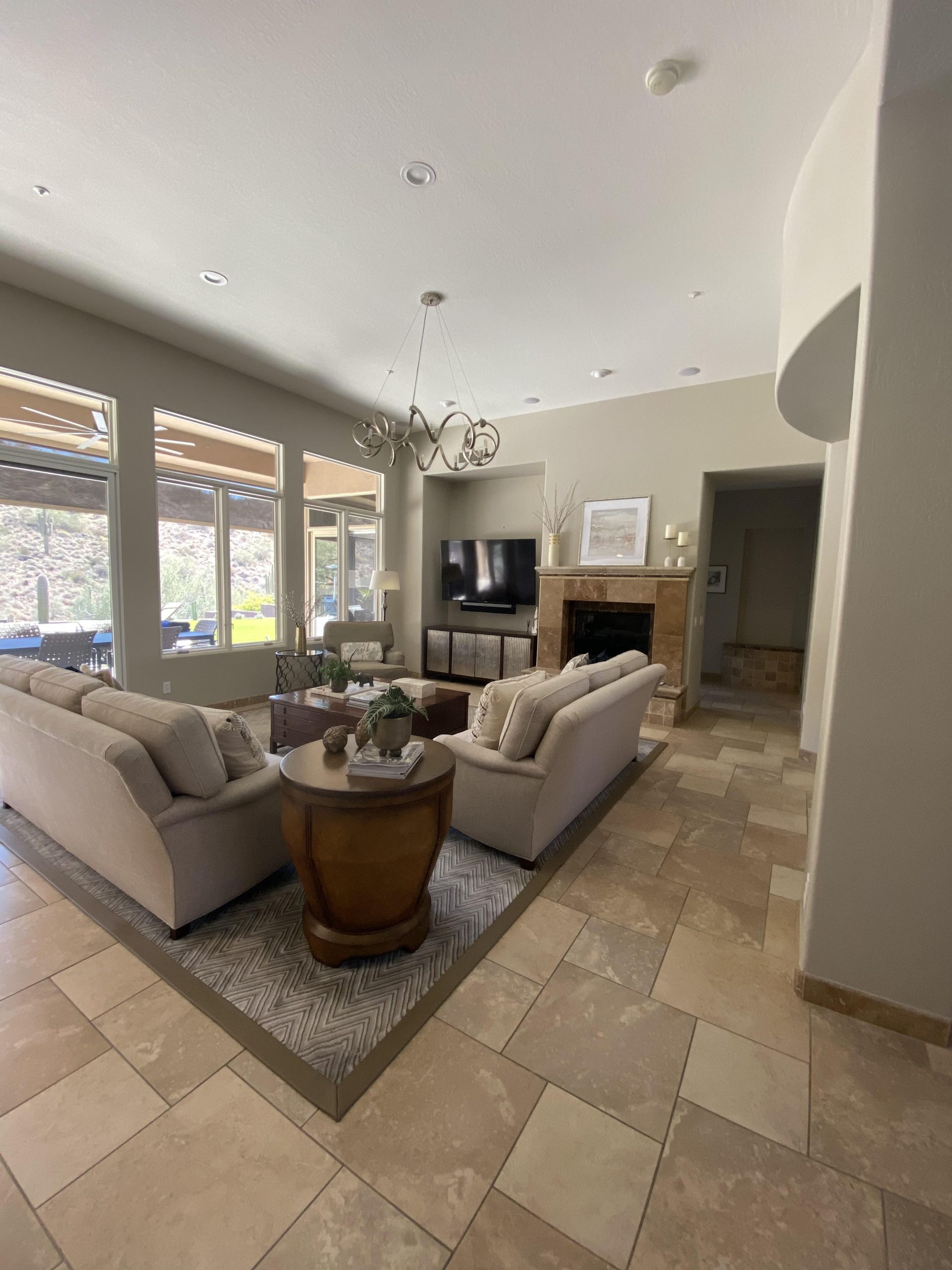
The Hidden Hills project started as a dated Mediterranean home in Scottsdale with dark stained cabinetry, an arched tile backsplash niche, and travertine flooring throughout the kitchen and living areas. Living with Lolo's scope covered the kitchen, dining room, foyer, living room, and two bathrooms.

BeforeBefore de-Tuscanize Scottsdale home kitchen remodel, Hidden Hills project, Living with Lolo.

BeforeBefore de-Tuscanize Scottsdale home living room remodel, Hidden Hills project, Living with Lolo.

AfterAfter de-Tuscanize Scottsdale home living room remodel, Hidden Hills project, Living with Lolo.

The team replaced the heavy dark cabinetry with light oak, softened the arched detailing, and introduced tonal textures and fluted accents throughout. The result is a serene, soft-modern space that keeps the home's original volume and natural light while removing every trace of the Tuscan-era palette. It is one of the clearest before-and-after examples of what de-Tuscanizing looks like in a real, lived-in Scottsdale home.

Real Transformation: Wabi Sabi Abode, North Scottsdale

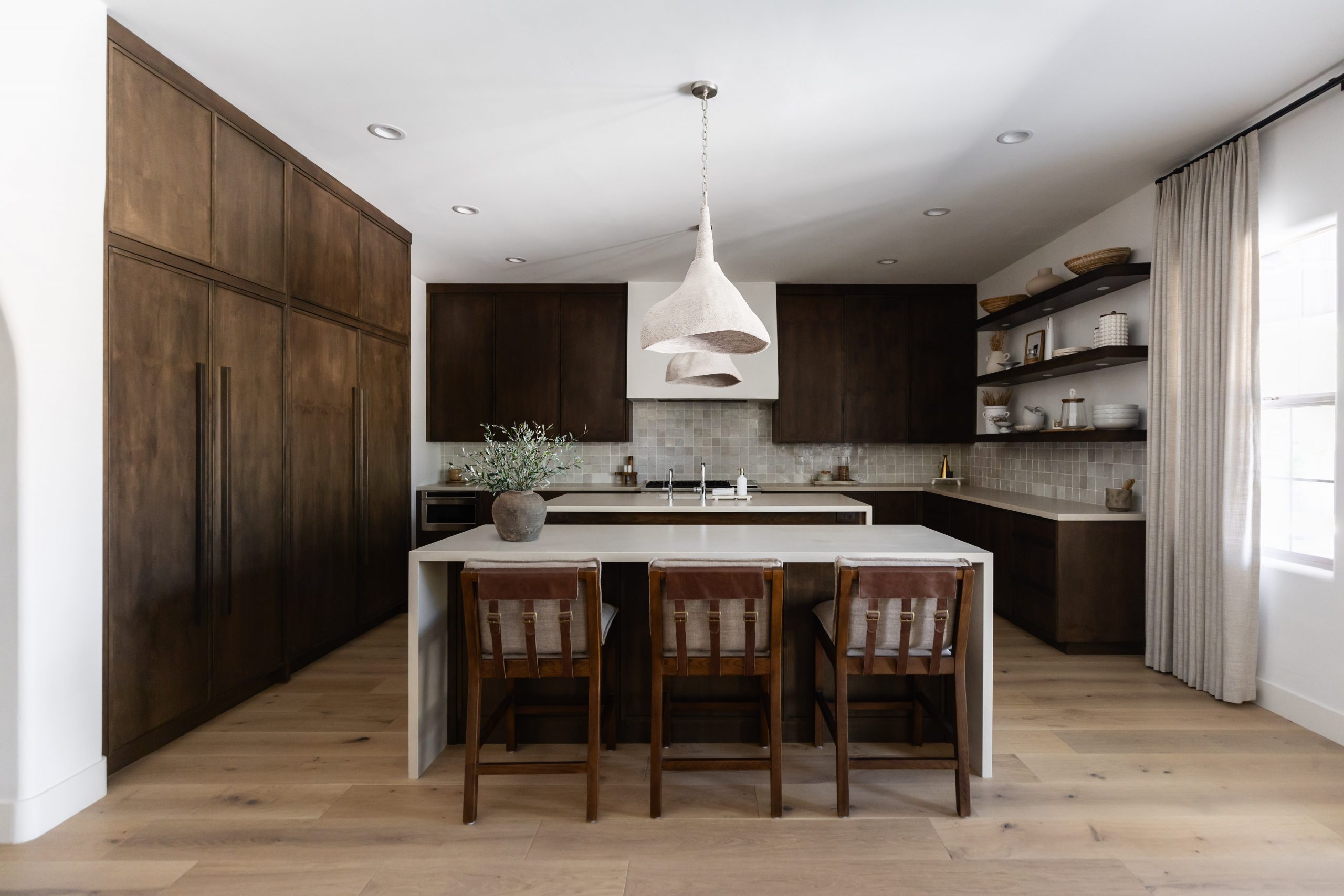
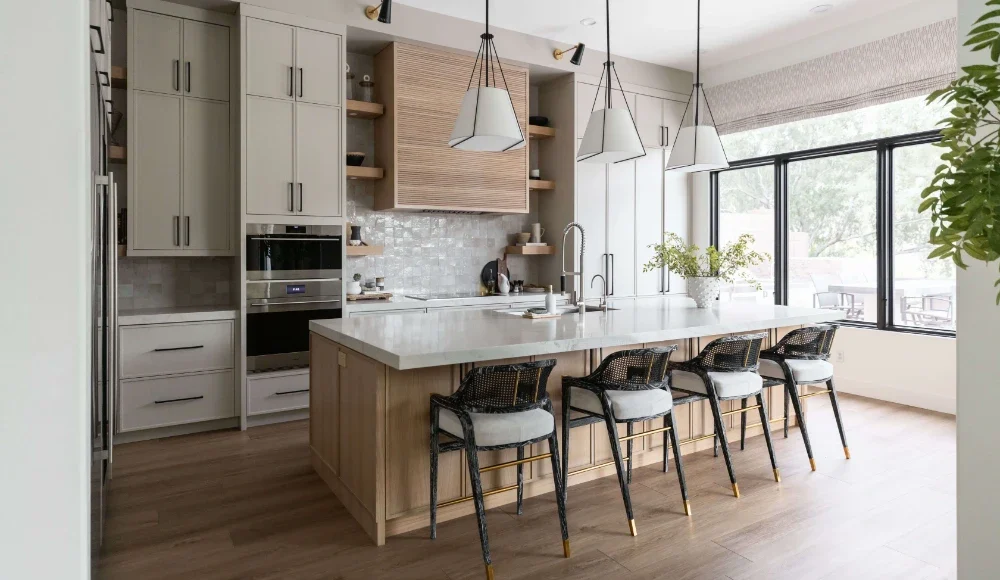
The Wabi Sabi Abode began as a 2000s builder-grade Mediterranean home in a gated North Scottsdale neighborhood, with heavy Mediterranean detailing throughout the kitchen, living room, and primary bath. Lauren Lerner and designer Sara Morgan led a full remodel that stripped back the bulky cabinetry and dark finishes and replaced them with warm wood tones, a custom plaster hood, integrated shelving, and matte porcelain countertops that mimic natural stone.

BeforeBefore de-Tuscanize Scottsdale home remodel, Wabi Sabi Abode project, Living with Lolo.

AfterAfter de-Tuscanize Scottsdale home kitchen remodel, Wabi Sabi Abode project, Living with Lolo.

The project also introduced natural mineral limewash walls and handmade zellige tile, textures that read as intentional and organic rather than simply modern for modern's sake. At 3,500 square feet, the design phase took six weeks and construction took four months, a timeline consistent with what Living with Lolo typically quotes for a full home de-Tuscanizing remodel of this scope.

Real Transformation: Lolo Prestige Property, Scottsdale

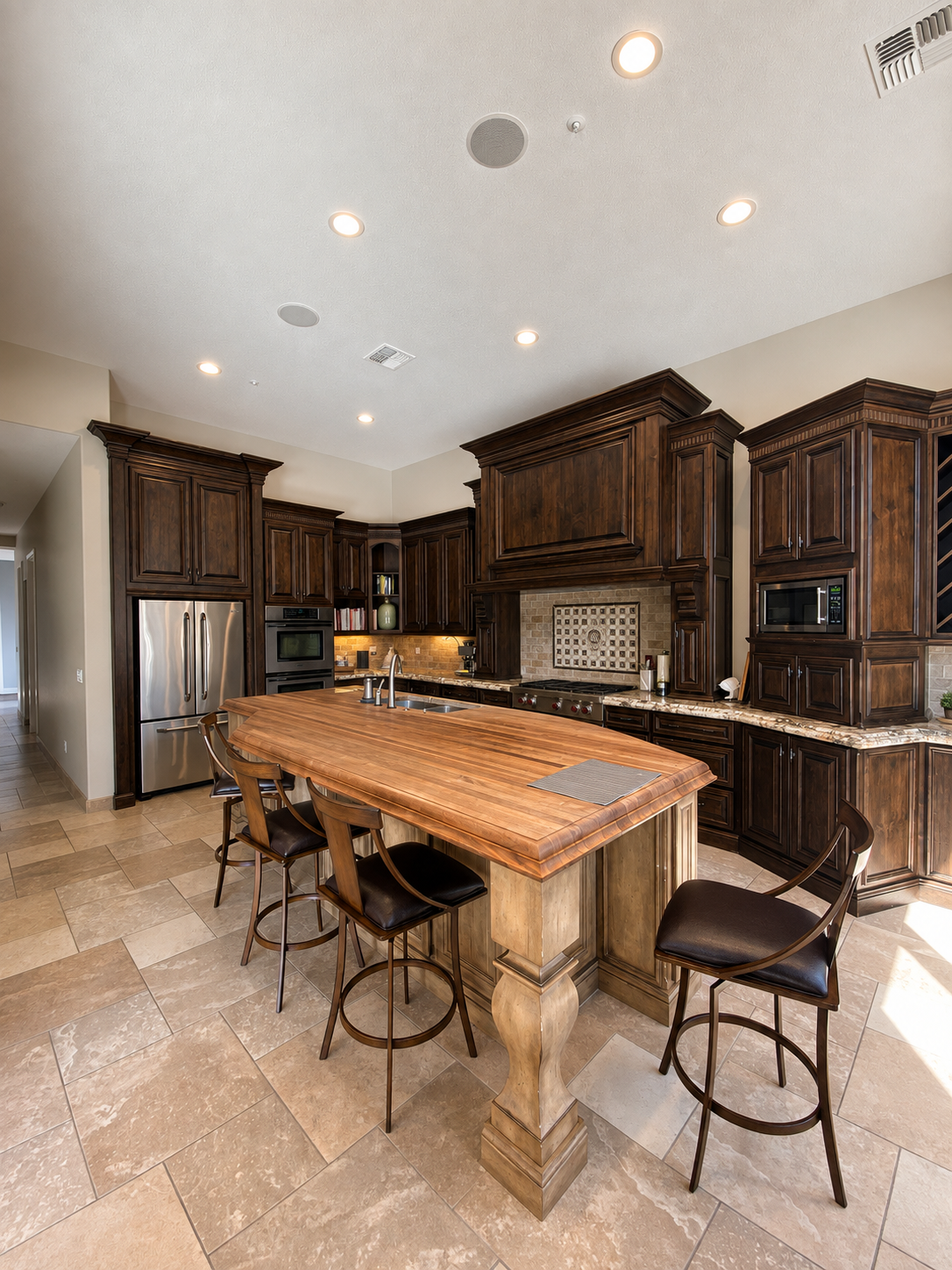
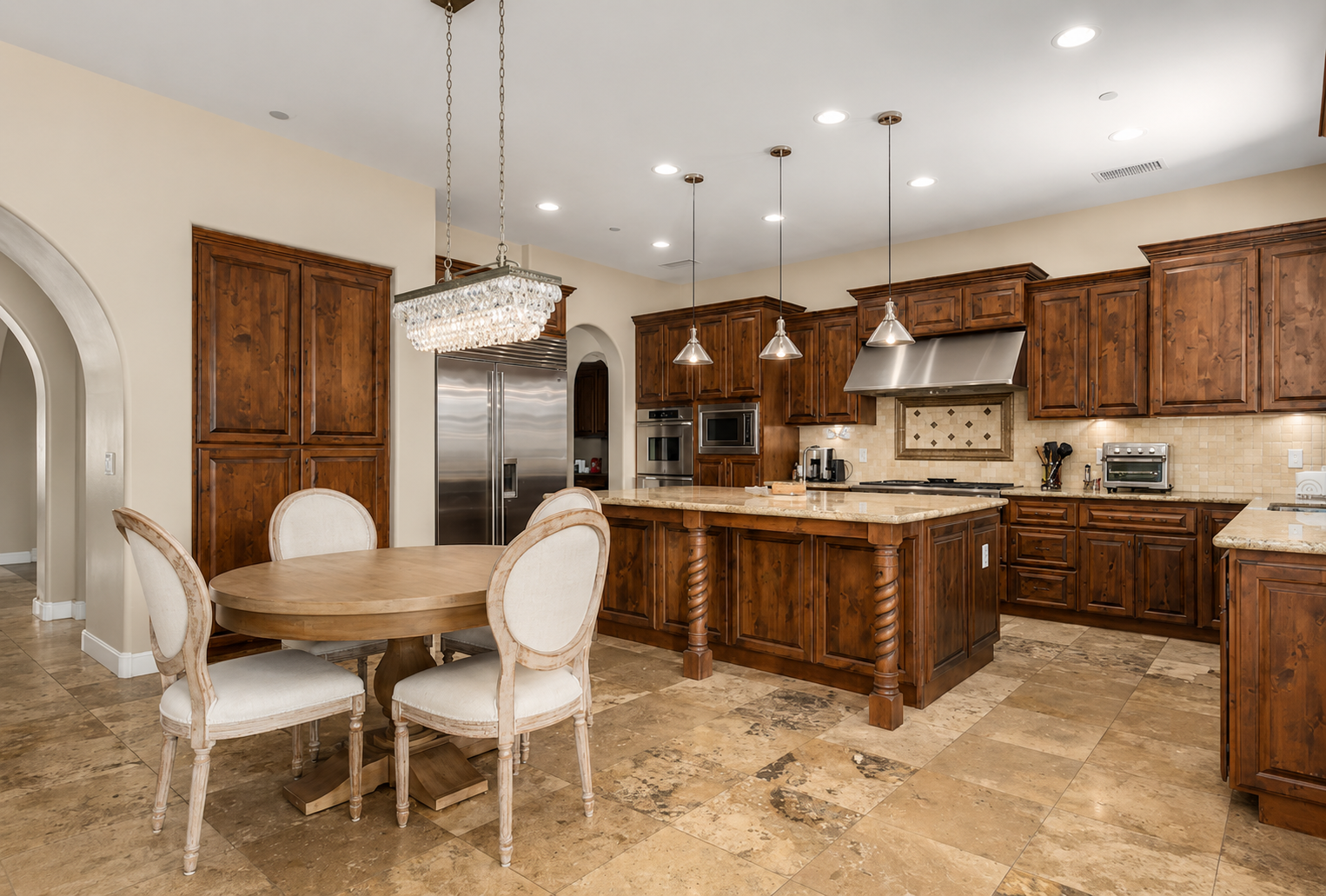
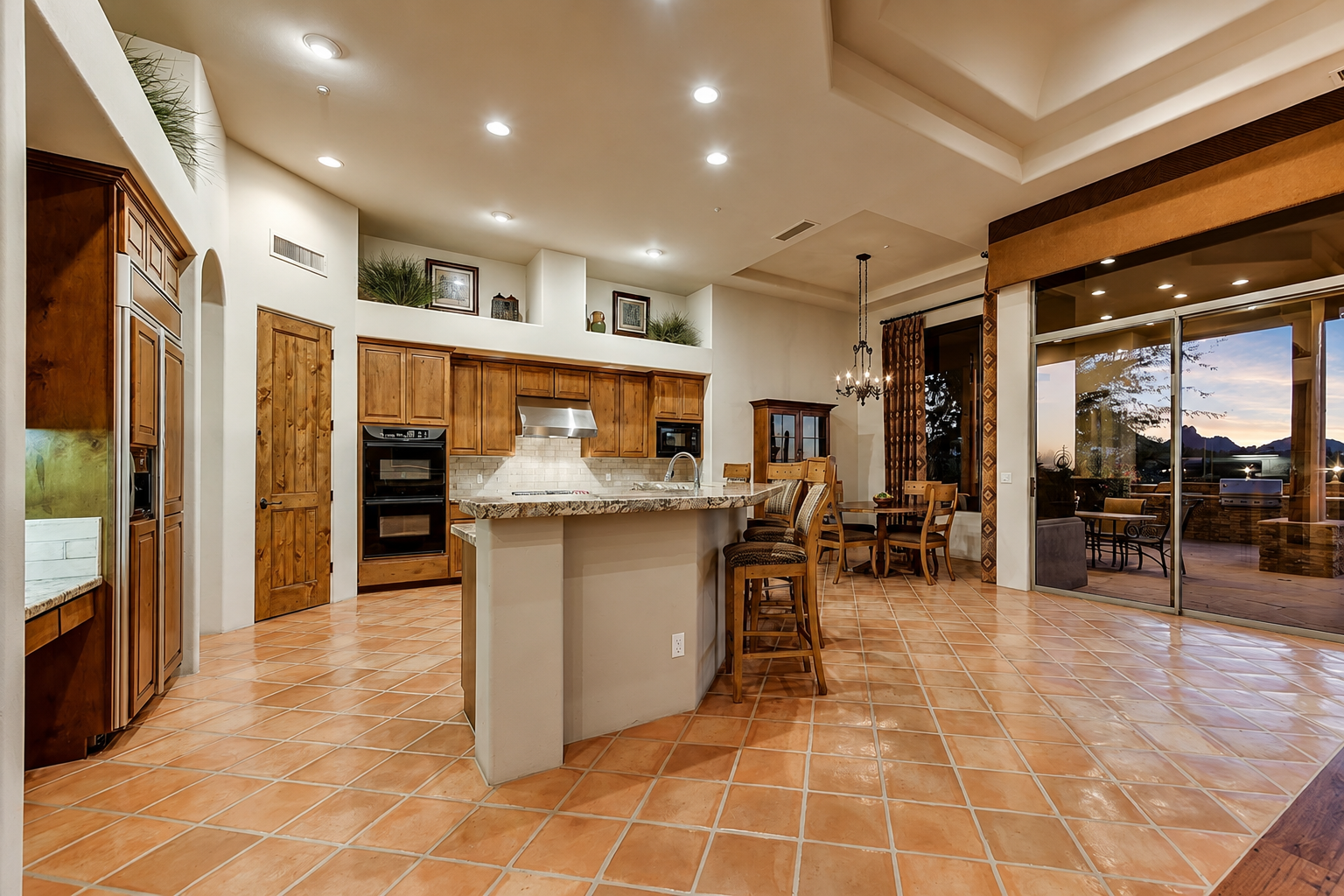
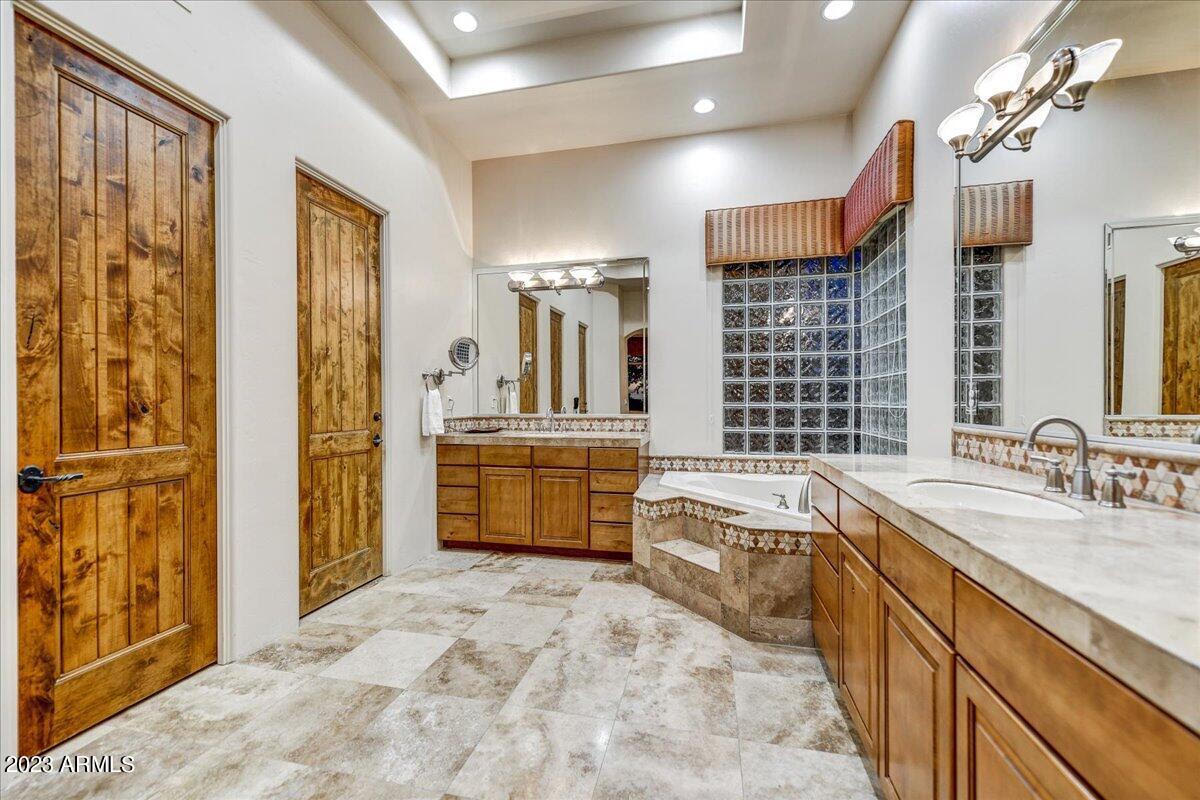
The Lolo Prestige Property started as a Spanish and Tuscan-influenced Scottsdale home with saltillo tile flooring, knotty alder doors and cabinetry, arched openings, and glass block detailing, finishes that place it squarely in the same 2000s builder-grade category as the other two projects in this guide. Living with Lolo's scope covered fourteen spaces across the home, from the kitchen and primary suite to a full upstairs loft bar and pool table room.

BeforeBefore de-Tuscanize Scottsdale home kitchen remodel, Lolo Prestige Property, Living with Lolo.

BeforeBefore de-Tuscanize Scottsdale home bathroom remodel, Lolo Prestige Property, Living with Lolo.

AfterAfter de-Tuscanize Scottsdale home kitchen remodel, Lolo Prestige Property, Living with Lolo.

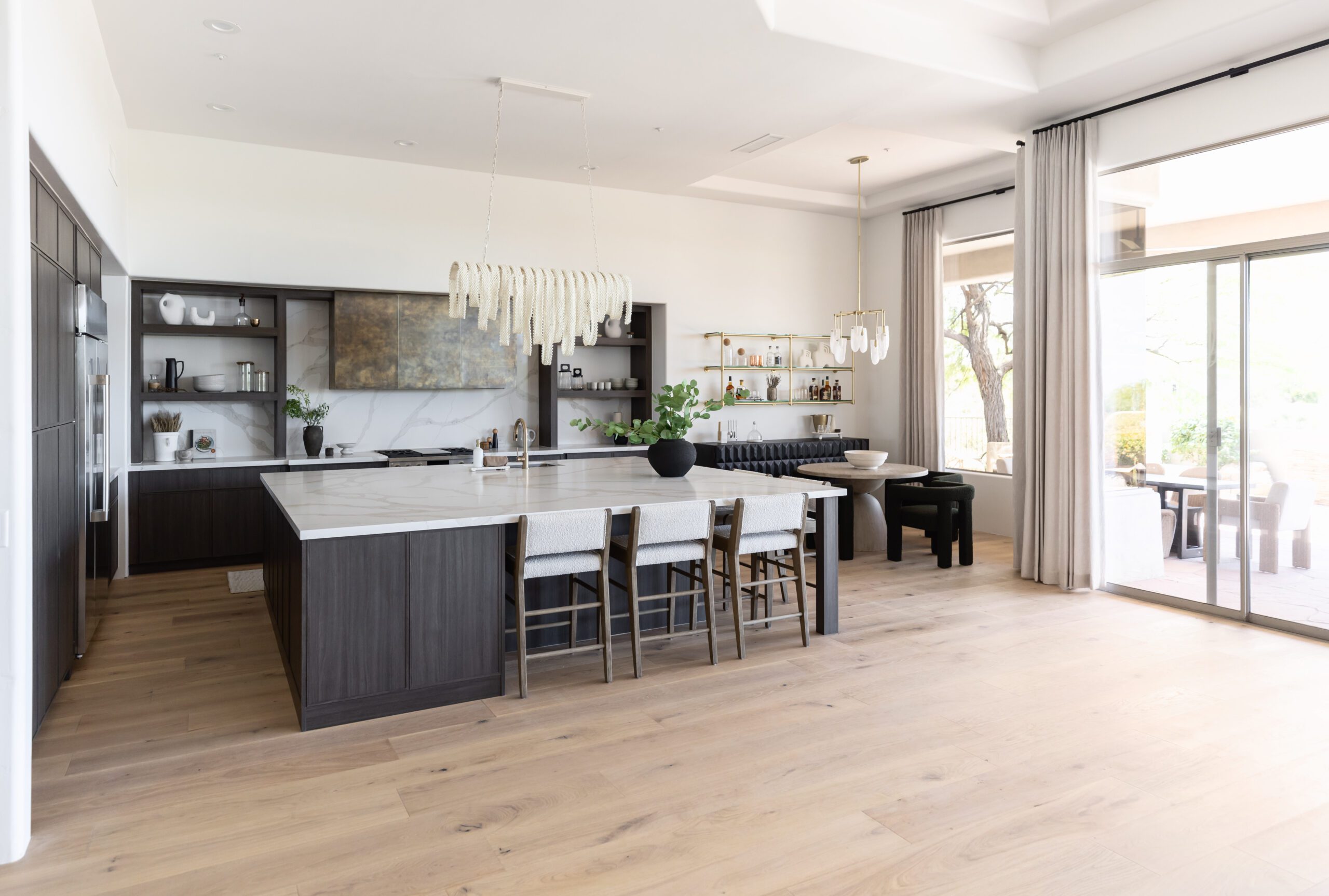
The design direction shifted the home toward a Sophisticated Contemporary style with a masculine edge, deep wood tones, luxe stone accents, and a restrained palette that reads confident rather than ornate. It is the largest of the three projects in this guide and shows what de-Tuscanizing looks like at full-home scale rather than room by room.
Across all three projects, the same pattern holds. The architecture, the volume, the arches, the courtyards, was never the problem. The finishes were. Once those finishes are replaced with the right materials and the right hand, a Scottsdale home built in 2005 can look and feel like it was designed this year.

What the Data Shows About Renovating a Dated Home

Americans spent an estimated $603 billion on home remodeling projects in 2024, and kitchen upgrades remain one of the highest-demand and highest-satisfaction projects homeowners undertake, according to the National Association of Realtors and National Association of the Remodeling Industry's 2025 Remodeling Impact Report. (Source: NAR, 2025) Kitchen upgrades specifically saw a 48% increase in demand among remodeling professionals over the past two years, the highest of any project category tracked in the report.
That tracks with what Living with Lolo sees on the ground in Scottsdale. Nearly every de-Tuscanizing project starts in the kitchen, because that is where the dark cabinetry, heavy stone, and dated hardware are most concentrated and most used daily.
Nationally, the median renovation spend held at $20,000 in 2025, but the top 10% of renovation budgets rose to $150,000, up 7% from $140,000 the year before, according to the 2026 U.S. Houzz & Home Study. (Source: Houzz, 2026) That same study found that traditional style and wood-tone cabinetry are gaining ground over the stark white, ultra-modern kitchens that were popular a few years ago, a shift that supports the way Living with Lolo approaches de-Tuscanizing: the goal is warmth and craftsmanship without the dated Tuscan-specific details, not a cold, generic modern reset.
National medians almost always understate what a luxury Scottsdale renovation actually costs, and that gap is itself useful information. A homeowner budgeting off a national $20,000 median for a de-Tuscanizing project in Silverleaf or Paradise Valley will be underprepared by a significant margin.

How Much Does It Cost to De-Tuscanize a Home in Scottsdale?

A kitchen and primary living area de-Tuscanizing project in Scottsdale typically costs $75,000 to $250,000 or more, depending on the extent of structural changes, cabinetry, and stone selections. A full home de-Tuscanizing remodel, covering the kitchen, living areas, primary suite, and secondary bathrooms, typically runs $400,000 to $800,000 or more, in line with the scope of the Wabi Sabi Abode and Lolo Prestige Property projects described above.
$75,000 to $150,000: Kitchen-Focused Refresh. New countertops, refinished or replaced cabinetry, updated hardware and lighting, and flooring in the kitchen and adjacent living space. This is the fastest way to remove the most dated Tuscan-era finishes without touching the rest of the home.
$150,000 to $400,000: Multi-Room Remodel. Kitchen, primary bathroom, and one or two additional living spaces, with some structural or layout changes such as opening an archway or relocating a fireplace.
$400,000 to $800,000+: Full Home Remodel. Every room touched, full furnishings, and often structural changes to ceilings, walls, or outdoor living spaces, the scope of the Wabi Sabi Abode and Lolo Prestige Property transformations.
Living with Lolo manages design, construction, and furnishings under one Arizona ROC-licensed general contracting team (ROC #347577), which keeps a de-Tuscanizing project on one timeline and one point of accountability instead of splitting the work between a separate designer and contractor.
Lauren Lerner, founder of Living with Lolo, led the design work on all three transformations in this guide personally, alongside her team across Scottsdale, Paradise Valley, and Arcadia. Living with Lolo has been named Phoenix Magazine Best Interior Design three consecutive years, 2024, 2025, and 2026, and Lauren Lerner's work has appeared in Architectural Digest, The Wall Street Journal, and Luxe Interiors + Design.

Ready to Talk Through De-Tuscanizing Your Home?

Lauren Lerner and the Living with Lolo team work with clients across Scottsdale, Paradise Valley, Arcadia, and the greater Phoenix metro area.
Book a Discovery Call

Frequently Asked Questions About De-Tuscanizing a Home in Scottsdale

What does it mean to de-Tuscanize a house?
De-Tuscanizing a house means removing the dark wood cabinetry, wrought iron accents, heavy travertine, and ornate arches typical of 2000s Mediterranean and Tuscan-style homes and replacing them with lighter stone, simplified millwork, and a warmer neutral palette. Living with Lolo has completed this exact transformation on multiple Scottsdale and Paradise Valley homes, keeping the architecture's bones while updating every surface.
Why are so many homes in Scottsdale and Paradise Valley built in the Tuscan style?
Most Tuscan-style homes in Scottsdale and Paradise Valley were built between 2000 and 2008, when builders across Arizona leaned heavily into Mediterranean and Tuscan Revival architecture. Nearly two decades later, those same homes read as dated rather than timeless, which is why de-Tuscanizing has become one of the most requested renovation projects Living with Lolo sees in Scottsdale today.
How much does it cost to de-Tuscanize a home in Scottsdale?
Updating a dated Tuscan home in Scottsdale typically costs $75,000 to $250,000 for a kitchen and primary living area refresh, and $400,000 to $800,000 or more for a full home remodel, depending on scope. Living with Lolo manages design, construction, and furnishings under one Arizona ROC-licensed contract (#347577), which keeps a project like this on one timeline instead of two.
Do I have to gut the whole house to de-Tuscanize it?
No, a full gut renovation is not required to de-Tuscanize a home. Many of the most effective changes, lighter countertops, updated cabinet hardware, refinished or replaced flooring, and simplified millwork, can be done room by room. Living with Lolo typically recommends starting with the kitchen and primary living areas, since those spaces carry the most Tuscan-era detailing and the most daily use.
How long does it take to de-Tuscanize a home?
A single-room de-Tuscanizing update, such as a kitchen, typically takes 4 to 6 months from design through construction. A full home remodel, like the Wabi Sabi Abode project in North Scottsdale, generally takes about 4 months of construction after a multi-week design phase. Living with Lolo manages both design and construction in-house, which keeps these timelines predictable.
Is Living with Lolo licensed to handle both the design and construction?
Yes, Living with Lolo is a licensed Arizona General Contractor, ROC #347577, in addition to being a full-service interior design firm. Lauren Lerner and her team manage design, construction, and furnishings under one contract for Scottsdale, Paradise Valley, and Arcadia projects, which is why homeowners de-Tuscanizing a home often choose Living with Lolo over hiring a designer and a separate contractor.
Lauren Lerner, principal interior designer at Living with Lolo

Lauren Lerner

Principal Designer, Living with Lolo

Lauren Lerner is a luxury interior designer based in Scottsdale, AZ and the founder of Living with Lolo. Her work has been featured in Architectural Digest, House Beautiful, Vogue, Martha Stewart Living, The Wall Street Journal, and GQ. She specializes in high-end residential design across Scottsdale, Paradise Valley, Arcadia, and the greater Phoenix metro area.

How Much Does a Full-Service Interior Designer Cost in Arizona? (2026 Guide)

How Much Does a Full-Service Interior Designer Cost in Arizona? (2026 Guide)

How Much Does a Full-Service Interior Designer Cost in Arizona? (2026 Guide)

A full-service interior designer in Arizona costs $75,000 to $2 million or more, depending on whether the project is furnishing only, a full remodel, or new construction with a licensed contractor managing the build. Scope moves that number more than square footage does.
This guide breaks down what drives full-service interior design pricing across Arizona's luxury markets, including Scottsdale, Paradise Valley, Arcadia, and Silverleaf, with real project ranges instead of national averages that understate what this market actually costs. It also covers what full service includes, how design-build pricing compares with hiring a designer and a general contractor separately, and what to expect at each investment level.

What "Full-Service" Actually Means in Arizona

"Full service" gets used loosely across the design industry, so it is worth being specific about what it covers before talking about cost. At Living with Lolo, a full-service engagement includes concept development, space planning, material and finish selection, furniture and fixture procurement, vendor coordination, and white-glove installation. For clients who also need construction, full service extends further: permitting, trade coordination, site supervision, and punch-list management through the final walkthrough.
Not every firm offers all of this under one roof. Many interior designers stop at selections and hand the project to a separate general contractor, which is where communication gaps and change orders tend to creep in. Lauren Lerner and the Living with Lolo team hold an active Arizona ROC general contractor license, ROC #347577, which means design and construction are managed under a single contract instead of two. That structure, combined with recognition as Phoenix Magazine's Best Interior Design three consecutive years (2024, 2025, and 2026), is a big reason Arizona homeowners consolidate design and construction under one firm rather than two.
If you are trying to figure out whether your project needs full design and construction management or just design services, our interior design services page breaks down the different engagement types available.

How Full-Service Pricing Is Structured

Full-service interior design fees in Arizona are typically structured one of three ways: a flat project fee, a percentage of the total project cost, or a combination of a design fee plus a procurement markup on furnishings and materials. Percentage-based models are common on design-build projects and usually range from 10 to 20 percent of total construction and furnishings spend.
For a $500,000 project, that translates to a design fee between $50,000 and $100,000 before any furniture is purchased or a contractor is hired. Flat fees work better for narrowly defined scopes, such as furnishing two or three rooms, where the deliverables are clear from the start.
Living with Lolo scopes every project before work begins, so clients know the design fee, the estimated procurement budget, and the construction envelope up front. At Living with Lolo, design fees start at $3,500 per room, and furnishing projects have a $75,000 minimum per project. Homeowners comparing proposals across Scottsdale and Paradise Valley firms should ask exactly which of these fee structures a designer uses, since the same total spend can look very different depending on how it is broken out.
Here is what that looks like in practice. Our Desert Oasis project is a 4,408-square-foot Scottsdale home that Living with Lolo took from a 6-week design process through a 16-week installation, with construction led by our in-house general contracting team under ROC #347577. Results like that are why the firm holds a 5.0-star rating across 89 Google reviews and 5.0 stars across 36 Houzz reviews as of September 2026, and why Phoenix Magazine has named Living with Lolo Best Interior Design Firm three consecutive years: 2024, 2025, and 2026. A full-service engagement covers the design plan, 2D design boards and 3D renderings, CAD and elevation drawings, procurement, delivery, and installation.

Real Cost Ranges by Full-Service Project Type

Numbers are more useful with context, so here is what full-service investment actually looks like across common project types in Arizona.

$75,000 to $450,000 or more: Furnishing Only

This tier covers projects where the home's layout and finishes stay the same and the scope is furniture, lighting, art, and styling. A two- to three-room furnishing project starts around $75,000, while a full-home furnishing package for a larger residence can run $450,000 or more depending on square footage and finish level.

$400,000 to $1.5 million or more: Remodel With Full-Service Design

Projects that combine construction, such as kitchen and bathroom remodels, structural changes, or whole-home renovations, with full interior design and furnishing typically fall in this range. A whole-home remodel across 4,000 to 7,000 square feet with new finishes throughout often lands at the higher end.

$500,000 to $2,000,000 or more: Full Design-Build

This is the most comprehensive tier: design, construction management, procurement, and installation under a single contract with Living with Lolo as the licensed general contractor. New construction interior design and large-scale renovations with significant structural work fall here.
These ranges reflect real projects quoted and completed in Scottsdale, Paradise Valley, and Arcadia over the past 18 months, not theoretical estimates from a national calculator.

What the Data Shows About Full-Service Costs

Every cost guide should be measured against outside data, not just one firm's project history. The 2026 Houzz & Home Study puts the national median kitchen remodel at $24,000, and the study found that the top 10 percent of renovation projects nationally reach $150,000 or more. In Arizona's luxury market, that top-tier national number is closer to the entry point for a full kitchen remodel with premium finishes.
Home values help explain the gap. Zillow data shows the average Paradise Valley home value at $3.45 million as of early 2026, up 13.5 percent year over year. Scottsdale and North Scottsdale communities like Silverleaf and DC Ranch carry similarly high price points. When a home is valued in the millions, a design and construction budget scaled to a $24,000 national median kitchen remodel does not match the finish level, materials, or expectations of the homeowner or the resale market.
This is the context that matters most for anyone budgeting a full-service project in Arizona: national averages are a starting reference, not a target.

Why Scottsdale and Paradise Valley Cost More Than the National Average

Beyond home values, a few Arizona-specific factors push full-service costs higher than national medians. Custom millwork, imported stone, and high-end appliance packages are common requests in this market and carry premium pricing regardless of location. Construction timelines in Scottsdale and Paradise Valley also tend to compress around the traditional October-to-April season, which can add cost when trades are in high demand.
Neighborhood-specific requirements matter too. Homes in Silverleaf and DC Ranch often have HOA architectural review processes that affect timeline and design decisions, while Paradise Valley estates frequently involve larger square footage and more extensive outdoor living space than a typical remodel. Arcadia renovations often include older homes with structural updates that add scope beyond cosmetic work.
None of this means Arizona pricing is arbitrary. It reflects a market where home values, finish expectations, and project complexity all run above the national norm.

Design-Build vs. Hiring a Designer and a Contractor Separately

One of the biggest cost variables in a full-service project is whether design and construction are managed by one firm or two. When a homeowner hires an interior designer and a separate general contractor, each party typically adds its own markup, and miscommunication between the two teams often leads to change orders that add both cost and time.
Living with Lolo holds ROC #347577, an active Arizona general contractor license, which means design and construction are managed under one contract. Clients working with an integrated general contractor and designer in Scottsdale typically see fewer change orders and less cost duplication than those coordinating two separate firms. This does not always lower the sticker price, since a licensed design-build firm still charges for the same scope of work, but it reduces the coordination costs and delays that inflate a separately managed project's final cost.
For homeowners evaluating proposals, it is worth asking every firm whether design and construction are handled in-house or handed off to a subcontracted GC.

How to Budget for a Full-Service Project in Arizona

Before setting a number, get specific about scope. Walk through every room involved and separate what is changing from what is staying, since that distinction affects the estimate more than total square footage. Then build in a contingency of 10 to 15 percent of the total budget for any project that includes construction, since unexpected conditions inside existing walls are common on renovation work.
Timeline affects budget too. Furnishing-only projects typically run 3 to 6 months from concept to installation, while design-build projects that include construction usually take 6 to 18 months depending on scope.
Homeowners planning a project in Scottsdale kitchen remodeling or a full bathroom renovation should also ask for a written breakdown separating the design fee, construction budget, and furnishings budget, since bundling these into one number makes it difficult to compare proposals across firms.
If you are researching an interior designer in Scottsdale or planning a project anywhere in the Phoenix metro, a discovery call is the fastest way to get a realistic number for your specific home and scope.

Ready to Talk Through Your Full-Service Project?

Lauren Lerner and the Living with Lolo team work with clients across Scottsdale, Paradise Valley, Arcadia, and the greater Phoenix metro area.
Book a Discovery Call

Frequently Asked Questions About Full-Service Interior Design Costs in Arizona

How much does a full-service interior designer cost in Arizona?
Full-service interior design in Arizona typically costs $75,000 to $2 million or more, depending on whether the project is furnishing only, a remodel, or full design-build with construction included. Furnishing-only engagements start around $75,000, while design-build projects that include licensed general contracting commonly run $500,000 to $2,000,000 or more. At Living with Lolo, design fees start at $3,500 per room, and furnishing projects have a $75,000 minimum per project.
What does full-service interior design include?
Full-service interior design includes concept development, space planning, material and finish selection, furniture and fixture procurement, vendor coordination, and installation. When construction is involved, it also includes permitting, trade coordination, and site supervision through the final walkthrough.
Is it cheaper to hire a designer and a general contractor separately?
Not usually. Hiring a designer and a general contractor separately often adds coordination costs and change orders that an integrated design-build firm avoids. Living with Lolo holds an active Arizona ROC general contractor license, ROC #347577, which means design and construction are managed under one contract instead of two.
How long does a full-service interior design project take in Arizona?
Furnishing-only projects typically take 3 to 6 months from concept to installation. Full design-build projects that include construction usually take 6 to 18 months depending on scope, with whole-home renovations on the longer end of that range.
Do I need a general contractor for a full-service interior design project?
Yes, if the project includes construction. Living with Lolo is licensed as an Arizona general contractor, ROC #347577, as well as a full-service interior design firm, so clients do not need to hire a separate contractor for projects that include remodeling or new construction.
What areas does Living with Lolo serve in Arizona?
Living with Lolo is based in Scottsdale and serves Scottsdale, Paradise Valley, Arcadia, Silverleaf, DC Ranch, and the greater Phoenix metro area, along with select projects across Arizona.
Lauren Lerner, principal interior designer at Living with Lolo

Lauren Lerner

Principal Designer, Living with Lolo

Lauren Lerner is a luxury interior designer based in Scottsdale, AZ and the founder of Living with Lolo. Her work has been featured in Architectural Digest, House Beautiful, Vogue, Martha Stewart Living, The Wall Street Journal, and GQ. She specializes in high-end residential design across Scottsdale, Paradise Valley, Arcadia, and the greater Phoenix metro area.

Interior Designer in Silverleaf, Scottsdale, AZ (2026 Guide)

Interior Designer in Silverleaf, Scottsdale, AZ (2026 Guide)


An interior designer in Silverleaf, Scottsdale costs $50,000 for a single-room refresh and $500,000 or more for a full estate build-out, with the final number driven by home size, HOA design review requirements, and whether construction work is involved alongside design.
Because Silverleaf is one of the most architecturally regulated communities in Scottsdale, the right interior designer needs to understand both interior finishes and HOA approval timelines before a single fabric sample gets ordered. This guide covers what a Silverleaf project actually costs, how the community's architecture and HOA rules shape design decisions, and what to expect from Living with Lolo, the interior designer Scottsdale AZ homeowners hire when they want design and construction handled by one licensed team.

Who Designs Homes in Silverleaf, Scottsdale

Living with Lolo is a Scottsdale-based luxury interior design and licensed general contracting firm led by Lauren Lerner, and the firm has completed multiple projects inside Silverleaf's guard-gated boundaries, work you can see in the full portfolio. Lauren Lerner holds an active Arizona Registrar of Contractors license, ROC #347577, in addition to her interior design credential, which means Living with Lolo can pull permits, manage structural work, and oversee construction crews under the same contract that covers furniture selections and finish specifications.
Living with Lolo has been named Phoenix Magazine Best Interior Design for three consecutive years: 2024, 2025, and 2026. Because of that dual license, homeowners in Silverleaf do not need to hire a separate architect, interior designer, and general contractor and then manage the handoffs between all three. Living with Lolo also works in Paradise Valley, Arcadia, and DC Ranch, so the firm understands how Silverleaf compares to the other guard-gated communities across North Scottsdale.

What an Interior Designer in Silverleaf Costs

Silverleaf homes start around 4,000 square feet and regularly exceed 8,000 square feet, so project costs scale with square footage more than they do in most Scottsdale neighborhoods. Because of that, Living with Lolo prices Silverleaf projects across three general tiers.
$50,000 to $85,000: Single-Room or Refresh Projects. This tier covers a primary bedroom, a home office, or a powder bath refresh: new furniture, updated finishes, and styling, without structural work or HOA review.
$100,000 to $350,000: Whole-Home Interior Design or Major Remodel. This tier covers a full interior overhaul of an existing Silverleaf estate, often including a kitchen or primary suite remodel that requires HOA notification for plumbing vents or exterior access points.
$400,000 to $500,000+: New Construction or Full Estate Build-Out. This tier applies to new-build interiors or major additions where Living with Lolo manages design and construction together, including the full HOA architectural review process for exterior changes.
These ranges sit well above the citywide averages for Scottsdale kitchen remodeling and Scottsdale bathroom remodeling projects, largely because Silverleaf's lot sizes and ceiling heights require more furniture, more material, and more design hours per room.
Timing also affects the final number. Custom furniture for a Silverleaf-scale great room can take 12 to 20 weeks to arrive after an order is placed, so Living with Lolo builds procurement lead times into the budget and schedule from the first meeting rather than treating them as a surprise later. Homeowners who want to be in a finished home by a specific date, such as a holiday or a family event, should plan on starting the design phase at least nine months ahead for a whole-home project.

Silverleaf's Architecture and HOA Design Review

Desert Contemporary vs. Tuscan-Inspired Estates

Silverleaf's architecture splits into two dominant styles: desert contemporary homes with clean lines, glass walls, and exposed steel, and Tuscan-inspired estates with tile roofs, stucco, and wrought iron. Both styles share one requirement: large-scale rooms. A 25-by-30-foot great room with 20-foot ceilings makes a standard-sized sectional look lost, and artwork sized for a 2,500-square-foot home reads as an afterthought on a 20-foot wall.
Successful Silverleaf interiors account for how morning light differs from afternoon light filtering through saguaro cacti and palo verde trees, since most rooms face floor-to-ceiling glass. That means window treatments, furniture placement, and even paint sheen need to be tested against the specific light in each room, not chosen from a showroom sample under fluorescent lighting.

HOA Approval Timeline for Renovations

The Silverleaf HOA reviews any exterior modification, including changes visible from a neighboring property, new plumbing vents, or electrical work that requires exterior access. Interior-only work with no exterior impact typically clears HOA review quickly. Projects that touch outdoor living spaces, pool areas, or rooflines take longer, and Living with Lolo builds that review time into every project schedule so it does not surprise a homeowner mid-project.
Because Living with Lolo holds an active general contractor license, the firm submits HOA paperwork directly and coordinates the review process alongside the interior design work, instead of waiting on a separate contractor to handle that step.

Designing for Desert Light, Scale, and Indoor-Outdoor Living

Silverleaf's indoor-outdoor lifestyle means interior finishes need to hold up against Arizona sun and read well next to the natural desert palette visible through sliding glass doors. Living with Lolo typically layers solar shades for UV and heat control with decorative drapery for privacy, rather than relying on one window treatment to do both jobs.
Dust control also matters more in Silverleaf than in most Scottsdale neighborhoods, given how close many homes sit to natural desert terrain. Tile flooring, performance fabrics, and finishes that clean easily without showing wear come up in nearly every Silverleaf design conversation, alongside furniture and art sized for rooms that are considerably larger than a typical Scottsdale home.
Material selection follows the same logic. Natural stone, wood, and plaster finishes need to be sealed and specified for Arizona's temperature swings, since a finish that performs well in a coastal climate can crack or fade quickly under direct desert sun. Living with Lolo sources finishes with that climate in mind first, then narrows the options down to what fits the home's architecture and the client's taste, instead of starting from a general showroom catalog and hoping the material holds up.

What the Data Shows About Luxury Renovation Costs

National renovation data consistently understates what Silverleaf-scale projects cost, and that gap is itself useful context. According to the 2026 U.S. Houzz Kitchen Trends Study, the top 10% of spenders nationally reported a median major kitchen remodel cost of $150,000. (Source: Houzz, 2026)
Similarly, the National Association of Home Builders reports that the top 10% of remodeling spenders nationwide invest $180,000 or more on a single major remodel. (Source: NAHB, 2026) In Silverleaf, a comparable single-room project often starts where the national top 10% average ends, and a full estate build-out can run two to three times higher once new construction and HOA-driven exterior work are included.

Why Hire a Designer Who Is Also a Licensed General Contractor

Working with a separate interior designer, architect, and general contractor means three different companies, three different contracts, and a homeowner stuck relaying information between all of them. Living with Lolo holds ROC #347577 and manages design and construction under one contract, so structural decisions get made on site in real time by the same team that designed the space.
This matters most in a community like Silverleaf, where HOA rules touch both design choices and construction logistics. A general contractor in Scottsdale who was not involved in the original design has to interpret someone else's drawings and someone else's HOA submission, which is exactly where miscommunication and change orders happen. Living with Lolo eliminates that handoff entirely.

How Long a Silverleaf Interior Design Project Takes

A single-room refresh in Silverleaf typically takes 8 to 12 weeks from first call to installation. A whole-home interior design project runs 6 to 12 months, depending on how much furniture is custom-ordered. A full remodel or new-construction interior, including HOA review and construction, typically takes 12 to 24 months.
Homeowners who travel frequently or are not in Silverleaf full time can still move a project forward. Living with Lolo manages trades, deliveries, and HOA coordination independently, and provides regular updates so a client can approve decisions remotely and return to a finished home.

Ready to Talk Through Your Silverleaf Project?

Lauren Lerner and the Living with Lolo team work with clients across Scottsdale, Paradise Valley, Arcadia, and the greater Phoenix metro area.
Book a Discovery Call


Frequently Asked Questions About Interior Design in Silverleaf, Scottsdale

Do you design homes specifically in Silverleaf?
Yes. Living with Lolo has completed multiple interior design and design-build projects inside Silverleaf and understands the community's HOA design review process, architectural guidelines, and desert-facing light conditions. See examples in the portfolio.
Do I need a separate general contractor for a Silverleaf renovation?
No. Lauren Lerner holds an active Arizona Registrar of Contractors license, ROC #347577, so Living with Lolo manages both interior design and construction under one contract.
What does an interior design project in Silverleaf typically cost?
Projects generally range from $50,000 for a single-room refresh to $500,000 or more for a full estate build-out, depending on scope, square footage, and whether HOA-reviewed exterior work is involved.
How long does a whole-home renovation in Silverleaf take?
A whole-home interior design project typically takes 6 to 12 months. A full remodel or new-construction interior, including HOA review and construction, typically takes 12 to 24 months.
Is Living with Lolo a licensed contractor?
Yes. Living with Lolo holds Arizona ROC #347577 and has been named Phoenix Magazine Best Interior Design for three consecutive years: 2024, 2025, and 2026.
What other Scottsdale-area communities does Living with Lolo serve?
Living with Lolo serves Silverleaf, DC Ranch, Paradise Valley, Arcadia, and the greater Phoenix metro area, in addition to Scottsdale.
Who pulls permits for a Silverleaf renovation?
Living with Lolo does, directly. Because Lauren Lerner holds Arizona ROC #347577, the firm pulls its own permits and submits HOA paperwork rather than routing that work through a separate general contractor.

Lauren Lerner, principal interior designer at Living with Lolo

Lauren Lerner

Principal Designer, Living with Lolo

Lauren Lerner is a luxury interior designer based in Scottsdale, AZ and the founder of Living with Lolo. Her work has been featured in Architectural Digest, House Beautiful, Vogue, Martha Stewart Living, The Wall Street Journal, and GQ. She specializes in high-end residential design across Scottsdale, Paradise Valley, Arcadia, and the greater Phoenix metro area.


Building a New Home in Scottsdale, AZ: What to Expect in 2026

Building a New Home in Scottsdale, AZ: What to Expect in 2026

A new home build in Scottsdale is one of the most complex and rewarding projects a homeowner will undertake. The scale, the decisions involved, and the number of parties you are coordinating with (architect, builder, interior designer, trade subcontractors, HOA design review, city permitting) can feel overwhelming before the foundation is poured.
This guide covers what you actually need to know before starting: what it costs, how long it takes, what role an interior designer plays on a new build, and the most common mistakes that Scottsdale homeowners make when building for the first time.
Lauren Lerner and Living with Lolo have managed new construction interior design engagements across Scottsdale's most prestigious communities, including Silverleaf, DC Ranch, Paradise Valley, Gainey Ranch, and North Scottsdale. Lauren Lerner has been named Best Interior Designer by Phoenix Magazine in 2024, 2025, and 2026. Living with Lolo holds Arizona General Contractor License ROC #347577, which means we manage both the design vision and the construction accountability for every project we take on.

What Does a New Home Build Cost in Scottsdale in 2026?

Building costs in Scottsdale's luxury residential market have moved significantly over the last three years. Here is a realistic picture of where costs land in 2026:

Land and Lot Costs

In Scottsdale's premium communities, land costs vary enormously by location. Lots in Silverleaf can range from $1 million to over $5 million depending on size, views, and position within the community. DC Ranch and other North Scottsdale guard-gated communities typically run $500,000 to $2.5 million for buildable lots. Land cost is separate from construction and should be budgeted independently.

Construction Cost: Structure and Shell

In Scottsdale's luxury market, construction costs for the shell of a custom home typically run $350 to $600+ per square foot depending on complexity, materials, and site conditions. A 6,000 square foot home in this range puts shell construction at $2.1 million to $3.6 million before any interior finishes.

Interior Finishes: Design, Materials, and Installation

Interior finish costs (flooring, tile, cabinetry, millwork, fixtures, lighting, plumbing fixtures, and all finish materials) typically add $150 to $350 per square foot on a Scottsdale luxury build. For a 6,000 square foot home, this is $900,000 to $2.1 million in finish costs alone. Custom millwork, natural stone slab tile, and specialty lighting systems push this number toward the upper end.

Interior Design Fees

A full-service interior design engagement on a Scottsdale new build typically costs $75,000 to $200,000+ in design fees, depending on the scope of services and the square footage involved. See our new construction interior design services for a full description of what that scope includes.

Furnishings and Final Installation

Furniture, art, rugs, window treatments, bedding, accessories, and outdoor furnishings on a Scottsdale luxury new build typically run $200,000 to $800,000+ depending on the size of the home and the level of custom versus production furnishings selected.

Total Investment Range

A complete luxury new home build in Scottsdale covering land, construction, interior finishes, design, and furnishings typically runs from $5 million to $15 million for homes in the 5,000 to 10,000 square foot range in the city's top communities. Homes at Silverleaf regularly exceed this range.

How Long Does a New Home Build Take in Scottsdale?

  • Design and architecture phase: 6 to 18 months. For communities with HOA design review requirements (Silverleaf, DC Ranch, Desert Mountain), add 2 to 4 months for community review and revision cycles.
  • Interior design phase (runs concurrently with architecture): Lauren Lerner and Living with Lolo are engaged from the start of this phase, not after architecture is complete. Early engagement allows the design team to influence structural decisions that affect the interior before they are locked in.
  • Permitting: City of Scottsdale permit approval for new construction typically takes 3 to 6 months from submission. Projects in Paradise Valley go through the Town of Paradise Valley's separate permitting process.
  • Construction: 18 to 30 months from permit approval through completion of the shell.
  • Interior finish and installation: 4 to 8 months from construction completion through final furnishing installation.
  • Total elapsed time from land purchase through move-in: 3 to 5 years on a fully custom Scottsdale new build.

The Role of an Interior Designer on a Scottsdale New Build

The most common misunderstanding about interior design on new construction is the timing. Most homeowners think the interior designer comes in at the end, after the house is built, to choose furniture and select finishes. That approach leaves significant value on the table and creates avoidable problems.
The decisions made in the first 30% of a new construction project determine 70% of the interior's quality. Ceiling heights that limit lighting options, electrical runs in the wrong locations, plumbing rough-ins that do not match the fixture plan, windows placed without considering how they affect furniture layouts: these decisions get made during architecture and construction, not at the end. Once walls close, changing them is expensive.
Lauren Lerner and Living with Lolo engage on new builds before permits are submitted. The scope includes architectural drawing review, coordination with your architect and builder, selection of all structural finish materials before construction begins, full interior design development concurrent with construction, construction administration (as a licensed GC, ROC #347577, Living with Lolo can manage finish construction directly), and final furnishings procurement and white-glove installation. See our completed projects to understand the scope of what we build.
For a complete picture of what full-service new construction interior design looks like, see our services page or our process.

Scottsdale Communities for New Home Builds

Silverleaf

Silverleaf is arguably the most prestigious address for new construction in all of Arizona. Guard-gated, with strict HOA design review requirements and a community character that demands architectural quality. Living with Lolo works in Silverleaf regularly and is familiar with the community's design review process and timeline.

DC Ranch

DC Ranch offers a range of lot sizes and price points within a master-planned, guard-gated environment. The community's design standards require HOA approval for new construction. See our Silverleaf and DC Ranch interior design page for more detail on how Living with Lolo approaches projects in this community.

Paradise Valley

Paradise Valley has its own town government, its own permitting process, and its own design aesthetic. Lots in Paradise Valley are large and private by requirement. Lauren Lerner and Living with Lolo work in Paradise Valley on new builds and renovations alike.

Desert Mountain and Troon

These North Scottsdale communities offer golf-centric living with a more traditional luxury aesthetic. HOA design review is active in both communities. Living with Lolo has worked with clients in both areas on new builds and major renovations.

The Biggest Mistakes Scottsdale Homeowners Make on New Builds

Hiring the designer after the structure is framed. By the time walls are framed, dozens of decisions that affect the interior are already locked in. Engaging Lauren Lerner and Living with Lolo at the start of architectural design is the single most impactful decision you can make on a new build.
Treating design and construction as separate contracts. When the interior designer and the general contractor are two separate firms, communication problems are structural. Living with Lolo holds both credentials under one roof: one contract, one point of accountability, no translation gap.
Underestimating timeline and making reactive decisions. When a homeowner expects to move in 18 months and discovers the realistic timeline is 36, they start making rushed decisions to accelerate the schedule. Those rushed decisions show up in the finished product.
Not verifying contractor credentials before signing. Arizona Registrar of Contractors license verification takes two minutes at roc.az.gov. Living with Lolo's license is ROC #347577.

Ready to Talk Through Your Scottsdale New Build?

Lauren Lerner and the Living with Lolo team work with clients across Scottsdale, Paradise Valley, Arcadia, and the greater Phoenix metro area.
Book a Discovery Call

Frequently Asked Questions About New Home Builds in Scottsdale

How do I find an interior designer for a new build in Scottsdale?
Start with firms that have demonstrated experience on new construction specifically, not just renovation and furnishing projects. Ask whether the firm holds a contractor's license in addition to a design credential. Ask to see completed new build projects, not renderings. And engage the designer at the beginning of your architectural process, not after the house is framed. Lauren Lerner and Living with Lolo offer a complimentary discovery call to discuss your project before any engagement is formal.
What is the difference between a custom build and a spec home in Scottsdale?
A custom build is designed and constructed to your specifications on a lot you own or purchase. A spec home is designed by a builder for a hypothetical buyer. Most Scottsdale luxury buyers in communities like Silverleaf are building custom homes. True custom builds offer the most control over the outcome.
Do I need an interior designer AND a general contractor for a new build?
You need both functions: design specification and construction management. The question is whether those are two separate firms or one. Living with Lolo holds both credentials (Arizona GC License ROC #347577), which means you get both functions under a single contract, a single point of contact, and a single team accountable for the full outcome from blueprint to final install.
What are the HOA design review requirements in Scottsdale's luxury communities?
Silverleaf, DC Ranch, Desert Mountain, and other guard-gated communities in Scottsdale have active HOA architectural review committees that must approve new construction designs before permits are submitted. Review timelines vary, typically 4 to 12 weeks per review cycle, with revisions adding additional time. Living with Lolo builds HOA review cycles into project timelines from the start.
Lauren Lerner, principal interior designer at Living with Lolo

Lauren Lerner

Principal Designer, Living with Lolo

Lauren Lerner is a luxury interior designer based in Scottsdale, AZ and the founder of Living with Lolo. Her work has been featured in Architectural Digest, House Beautiful, Vogue, Martha Stewart Living, The Wall Street Journal, and GQ. She specializes in high-end residential design across Scottsdale, Paradise Valley, Arcadia, and the greater Phoenix metro area.

Luxury Home Renovation in Scottsdale, AZ | Living with Lolo

Luxury Home Renovation in Scottsdale, AZ | Living with Lolo

Home » Journal » Luxury Home Renovation in Scottsdale, AZ

Luxury Home Renovation in Scottsdale, AZ: What to Expect in 2026

A luxury home renovation in Scottsdale is one of the most significant projects a homeowner will undertake. The stakes are high: you are transforming a multi-million-dollar property, managing a timeline that spans months, and coordinating dozens of decisions that affect how you will live in your home for years to come.For a project of this scale, our licensed design-build firm in Scottsdale keeps the entire renovation, design through construction, under one contract.Unlike most interior designers in Arizona, Living with Lolo holds an active general contractor license (ROC #347577) and manages design and construction together.This guide covers what you actually need to know before starting: what it costs, how long it takes, what separates a firm worth hiring from one that will cost you more in the long run, and what questions to ask before you sign anything.Lauren Lerner and Living with Lolo have managed luxury home renovations across Scottsdale, Paradise Valley, DC Ranch, Silverleaf, and the greater Phoenix area. See our dedicated work as a luxury remodeling contractor in Paradise Valley. Living with Lolo has been named Best Interior Design Firm by Phoenix Magazine three consecutive years: 2024, 2025, and 2026.

What Qualifies as a Luxury Home Renovation in Scottsdale?

The word "luxury" gets used loosely in the renovation industry, so it is worth being specific. A luxury home renovation in Scottsdale typically means one or more of the following:
  • A whole-home or multi-room renovation on a property valued at $2 million or more
  • Custom millwork, natural stone, or other materials that require specialist fabrication and installation
  • A licensed general contractor and a licensed interior designer managing the project jointly, or a single firm that holds both credentials
  • A total project investment of $300,000 or more across design, construction, and furnishings
  • A project managed to a white-glove standard where the client is not required to coordinate between multiple vendors
If your renovation falls into this category, the decisions you make at the start (including who you hire and how you structure the project) will determine the outcome more than any single design choice.

What Does a Luxury Home Renovation Cost in Scottsdale?

Cost on a luxury renovation in Scottsdale varies significantly based on scope, material selections, and whether your project requires structural work. Here is how the ranges tend to break out:

$150,000 to $350,000: Targeted High-End Renovation

This range covers a full renovation of one or two major spaces (a kitchen and primary bathroom, for example) with high-end finishes, custom cabinetry, and a designer-led material palette. Structural changes are limited. This is often the entry point for Scottsdale homeowners updating a home that is 10 to 15 years old.

$350,000 to $700,000: Whole-Home Renovation

A full renovation of an existing home, with new flooring throughout, kitchen and all bathrooms, updated electrical and lighting, and fresh interior architecture including built-ins, custom millwork, and new window and door treatments. At this investment level, a licensed general contractor is required for permitting and trade management. For a detailed breakdown of whole-home costs, see our guide to whole-home remodeling in Scottsdale.

$700,000 to $1.5M+: Full Gut Renovation or Structural Transformation

This range covers projects that change the bones of a home: moving walls, reconfiguring floor plans, adding square footage, expanding outdoor living spaces, or converting a dated property into a fully contemporary luxury home. Projects at this level require a licensed general contractor managing the full construction scope alongside a design team. Living with Lolo holds Arizona General Contractor License ROC #347577, which means we manage both the design and the construction under one contract.

How Long Does a Luxury Renovation Take in Scottsdale?

Timeline is one of the most common sources of frustration in luxury renovations, not because projects always run over, but because homeowners are often given unrealistic timelines at the start.Here is an honest breakdown of what to expect:
  • Design and specification phase: 8 to 16 weeks. This is where Lauren Lerner and the Living with Lolo design team develop the full material palette, custom cabinetry drawings, furniture plan, fixture specifications, and construction drawings. Rushing this phase costs more later.
  • Permitting: 4 to 10 weeks in Scottsdale, depending on the scope of structural work and the City of Scottsdale's current review timeline. As a licensed general contractor (ROC #347577), Living with Lolo manages the permit process entirely.
  • Construction: 12 to 30 weeks depending on scope. A single-room renovation may be completed in 10 weeks. A full gut renovation typically runs 20 to 30 weeks from permit approval through final punch list.
  • Furnishing and installation: 4 to 8 weeks for delivery coordination, installation, and final styling. Custom furniture ordered during design development is typically ready to install when construction finishes, provided it was ordered at the right time.
Total elapsed time from first design call to move-in: 9 to 18 months on most full luxury renovations in Scottsdale.

The Most Common Mistake Scottsdale Homeowners Make on Luxury Renovations

Hiring the designer and the general contractor separately.It sounds like a reasonable approach: find a great designer, find a great GC, put them together. In practice, this creates a communication problem that costs most homeowners more than any other single decision.The designer specifies materials the GC was not expecting to install. The GC makes a structural decision that forces a design change. Nobody is accountable for the gap between the two. By the time the problem surfaces, there are cost change orders, timeline extensions, and sometimes finished work that has to be torn out.The solution is to either hire a firm that holds both credentials (a licensed designer who is also a licensed general contractor), or to hire a design-build firm where both functions are managed under a single contract.Living with Lolo is the only full-service interior design firm in Scottsdale that holds both an interior design credential and an Arizona General Contractor license (ROC #347577). One firm, one contract, one point of accountability from concept through white-glove delivery.

What to Look for When Hiring a Luxury Renovation Firm in Scottsdale

Before you sign a contract, ask every firm you are considering these questions:
  • Do you hold a current Arizona contractor's license? Ask for the license number and verify it at the Arizona Registrar of Contractors website (roc.az.gov). Any contractor operating without a current license cannot legally pull permits in Scottsdale.
  • Who will be managing the construction day to day? Some design-build firms hand off construction management to a subcontracted GC. Understand exactly who is accountable and who you will be talking to when problems arise.
  • Can you show me completed projects in this price range? Ask to see finished work, not renderings, in the specific investment range you are targeting.
  • How do you handle change orders? Every renovation has them. A quality firm will be transparent about the change order process before a project starts, not after.
  • What does your fee structure look like? Design fees, construction markup, and furnishings procurement fees should be explained in clear terms before you sign anything.

Luxury Home Renovation in Scottsdale's Top Communities

Living with Lolo manages luxury renovations across Scottsdale's most distinguished communities. Each presents its own design and logistics considerations:

Silverleaf and DC Ranch

Guard-gated communities with HOA design review processes require design drawings that meet the community's architectural standards before permits can be submitted. Living with Lolo's team is familiar with both the Silverleaf and DC Ranch HOA review timelines and requirements.

Paradise Valley

Paradise Valley's Town permitting process is separate from the City of Scottsdale and has its own review requirements for structural work. Lauren Lerner and Living with Lolo have navigated Paradise Valley permitting on multiple projects.

Old Town and Central Scottsdale

Older homes in central Scottsdale often present hidden challenges: outdated electrical panels, plumbing that does not meet current code, and structural surprises behind walls. A licensed GC managing the project can identify and address these before they become cost emergencies.

What a Luxury Renovation Looks Like with Living with Lolo

Every project starts with a discovery call. Lauren Lerner and the Living with Lolo team take time to understand your home, your goals, and your timeline before anything else. No hard sell, no scope commitments before we understand what you actually need.From there, the process moves through design development, material specification, contractor coordination, construction management, and final white-glove installation. Most clients interact primarily at key approval milestones: concept presentation, material approvals, and final walk-through. Everything in between is managed entirely by the Living with Lolo team.For a complete overview of how we manage projects, see our design process page.

Frequently Asked Questions About Luxury Home Renovation in Scottsdale

Do I need to move out during a luxury renovation?

For whole-home renovations or projects involving kitchen demolition, most clients move out for the construction phase. This is actually the faster approach, since construction timelines are faster when trades can work without occupants, and finish quality is higher when rooms do not have to stay livable between phases. Living with Lolo can coordinate the timing of your return with the construction completion date.

How do I know if a contractor is licensed in Arizona?

The Arizona Registrar of Contractors maintains a public license search at roc.az.gov. You can search by company name or license number. Living with Lolo's contractor license is ROC #347577. Any firm operating without a current license cannot legally pull permits, and any unpermitted work may create complications when you sell the property.

What is the difference between a renovation and a remodel?

A renovation restores or updates a space while preserving its existing structure and layout. A remodel changes the structure, including moving walls, changing floor plans, or adding square footage. Most high-end Scottsdale projects involve elements of both. The distinction matters because remodeling requires permits and a licensed contractor; renovation-only work (replacing fixtures, flooring, or finishes without structural changes) may not.

Can Living with Lolo manage a renovation if I am not in Scottsdale?

Yes. Many of our clients manage their projects remotely, splitting time between Scottsdale and another city. We are structured for this: you receive regular project updates, attend key approval meetings virtually or in person when the timing works, and return to a completed home. The GC and design team on the ground in Scottsdale manage every detail between those checkpoints.

Related Resources

About the Author

Lauren Lerner, principal interior designer at Living with Lolo

Lauren Lerner

Principal Designer, Living with Lolo

Lauren Lerner is a luxury interior designer based in Scottsdale, AZ and the founder of Living with Lolo. Her work has been featured in Architectural Digest, House Beautiful, Vogue, Martha Stewart Living, The Wall Street Journal, and GQ. She specializes in high-end residential design across Scottsdale, Paradise Valley, Arcadia, and the greater Phoenix metro area. Learn more about Lauren.

About Living with Lolo

Living with Lolo is a Scottsdale, Arizona-based luxury interior design and construction firm. The company specializes in full-service interior design, design-build remodeling, and construction-led renovations for high-end residential homes in Scottsdale, Paradise Valley, and Phoenix. Living with Lolo manages both interior design and licensed general contracting under one roof, guiding projects from concept through construction and white-glove installation.
What Happens When an Architect and Interior Designer Collaborate From Day One

What Happens When an Architect and Interior Designer Collaborate From Day One

About Living with Lolo

Living with Lolo is a Scottsdale, Arizona-based luxury interior design and construction firm. The company specializes in full-service interior design, design-build remodeling, and construction-led renovations for high-end residential homes in Scottsdale, Paradise Valley, and Phoenix. Living with Lolo manages both interior design and licensed general contracting under one roof, guiding projects from concept through construction and white-glove installation.

Most homeowners hire an interior designer after their architect finishes drawings, sometimes after framing is already complete. It feels logical. The architect handles the structure, then the designer handles the inside. But this sequence creates a problem: by the time an interior designer walks into a new construction project, hundreds of decisions that directly affect the interior have already been locked in.
At Living With Lolo, we work with architects on ground-up custom homes from the start of the design development phase. This is how we do it, why it matters, and what our clients get as a result.

Why the Sequence Matters More Than You Think

Interior design decisions are baked into the architecture of a home long before anyone picks a sofa. Ceiling heights, window placement, door swing directions, the location of electrical panels, natural light paths, and traffic flow between rooms are all architectural choices that either support or fight the interior design you want.
When Living With Lolo joins a new construction project during design development, we sit at the table with the architect before those decisions are finalized. That means:
  • Window placement is coordinated with furniture layouts so seating faces views, not walls.
  • Ceiling details like coffers, beams, and tray ceilings are planned in context of the room's furniture scale.
  • Lighting rough-in locations are placed where fixtures actually belong, not where the electrician estimated.
  • Niche and built-in locations are framed into the structure from the start, not cut in after the fact.
  • Room dimensions get a second review for how real furniture will actually live in the space.
The result is a home where the architecture and the interior design feel like one continuous intention rather than two separate projects that happened to end up in the same building.

What Our Role Looks Like on a New Construction Project

Living With Lolo holds a General Contractor license in Arizona (ROC #347577), which means we can coordinate directly with the construction team, pull permits where needed, and act as a bridge between the design and build sides of a project. Named Phoenix Magazine Best Interior Design 2024, 2025, and 2026, Living with Lolo is one of the most recognized design-build firms in Scottsdale. On new construction, this matters.

Phase 1: Design Development (Months 1-3)

We review architectural drawings and flag interior design considerations before they get value-engineered away. This includes reviewing floor plans for furniture feasibility, evaluating window-to-wall ratios for art and case goods, and identifying rooms where structural elements like fireplaces, built-ins, or wet bars will drive finish coordination later.

Phase 2: Construction Documents (Months 3-5)

We develop an interior specifications package that travels alongside the architectural set. This covers finish schedules (flooring, tile, stone, millwork), fixture specifications, plumbing fixture rough-in heights, hardware standards, and custom millwork drawings. The contractor bids this package rather than making substitutions in the field.

Phase 3: Construction Administration (Months 5-14+)

We make regular site visits to catch deviations, approve substitutions, and resolve field conditions before they become expensive change orders. New construction timelines in the Scottsdale custom home market typically run 12 to 18 months for homes in the 4,000 to 8,000 square foot range. Our involvement through this phase ensures the interior specifications are executed correctly, not approximately.

Phase 4: Furnishing and Installation

Once the home is complete, we coordinate full furnishing including furniture, lighting, window treatments, art, accessories, and plants. For new construction clients, this typically represents a furnishing investment starting at $150,000 for a home in this size range, depending on scope and custom specification levels.

The New Builds We Work On

Living With Lolo's new construction interior design work is concentrated in the Scottsdale, Paradise Valley, and north Phoenix markets. We work primarily on:
  • Custom spec homes built by high-end developers
  • Owner-commissioned ground-up custom homes (typically 4,000 sq ft and above)
  • Architect-designed homes where the client brings us in as the interior design partner
  • Partial new construction combined with additions on existing properties
Our clients for new construction projects are typically in a $1.5 million to $5 million or more total project budget range, where the investment in integrated interior design from the start is a fraction of what it saves in change orders, field corrections, and retrofits.

What Happens When You Don't Bring in an Interior Designer Early

We have also been brought in after the fact on new construction projects, and we can tell you what that looks like. The most common issues we find:
The primary living area has been framed with a furniture layout that puts the sofa against the only wall without natural light. The kitchen island was placed without considering where bar stools would go relative to the traffic path. Recessed lights are in a 4-foot grid regardless of what furniture sits below them. The primary bath has a freestanding tub centered under a window that faces a neighbor. Built-in locations were not framed, so they now require bulkheads that eat into ceiling height.
None of these are unfixable. But they are all expensive to address after the fact, and some are permanent trade-offs the homeowner has to live with for the life of the house.

Working With Your Architect

If you are already working with an architect, bringing Living With Lolo in as your interior design partner is straightforward. We work with most of the established residential architects in the Scottsdale and Paradise Valley markets and have working relationships that make this coordination efficient.
If you are still selecting an architect, we are happy to make introductions to firms whose design sensibilities and communication styles align with what we deliver on the interior.

Ready to Talk About Your New Build?

Living With Lolo takes a limited number of new construction projects each year. We partner with architects on ground-up custom homes in Scottsdale, Paradise Valley, and north Phoenix from design development through final furnishing.

Book a Discovery Call

Frequently Asked Questions

When is the right time to bring an interior designer into a new construction project?

The ideal time is during design development, before architectural drawings are finalized. This allows the interior designer to influence window placement, ceiling details, lighting rough-in, and room proportions before they are locked into the construction documents.

Does Living With Lolo work with homeowners who already have an architect?

Yes. Living With Lolo regularly joins new construction projects where an architect is already engaged. We work alongside the architect as the interior design partner, coordinating our specifications package with the architectural set.

What does new construction interior design cost in Scottsdale?

Interior design fees for new construction at Living With Lolo are based on the scope and square footage of the project. For a custom home in the 4,000 to 8,000 square foot range, most clients invest $50,000 to $150,000 or more in interior design fees, separate from furnishings and finishes.

Does Living With Lolo handle both the design and the furnishing for new builds?

Yes. For new construction clients, Living With Lolo manages the complete interior from specifications through final furnishing installation. This includes all finish selections, custom millwork, plumbing and lighting fixtures, furniture, window treatments, art, and accessories.

Is Living With Lolo a licensed contractor?

Yes. Living With Lolo holds Arizona General Contractor license ROC #347577, which allows us to coordinate directly with construction teams, pull permits where required, and manage contractor relationships on renovation and new construction projects.

Lauren Lerner, principal interior designer at Living with Lolo

Lauren Lerner

Principal Designer, Living with Lolo

Lauren Lerner is a luxury interior designer and licensed general contractor based in Scottsdale, AZ and the founder of Living with Lolo. Her work has been featured in Architectural Digest, House Beautiful, Vogue, Martha Stewart Living, The Wall Street Journal, and GQ. She specializes in high-end residential design and design-build projects across Scottsdale, Paradise Valley, Arcadia, and the greater Phoenix metro area.

What Is a Design-Build Firm?

What Is a Design-Build Firm?

What the Data Shows About Design-Build Project Outcomes

A design-build firm is a single company that handles both the interior design and the licensed construction of your project, giving you one contract, one point of accountability, and one team responsible for both the vision and the execution. For a deeper comparison, read our guide to choosing an interior designer vs a design-build firm.
For local context: Zillow data puts the average Paradise Valley home value at $3.45 million as of early 2026, up 13.5% year over year. In a market where homes carry that level of value, a renovation that looks different than what was designed, or a project that runs three months over schedule, is not an inconvenience. It is a financial consequence. A design-build firm eliminates the gap where those failures happen.
If you have heard the term "design-build" and are not sure what it means or whether it describes what you need, you are not alone. It is one of the most commonly searched phrases in the home renovation space and also one of the most loosely used. This guide explains what a design-build firm is, how the model works, and why the distinction matters when you are planning a project that touches both the appearance and the structure of your home.

What "Design-Build" Actually Means

A design-build firm is a company that provides both interior design and construction services under a single contract and a single point of accountability. Instead of hiring an interior designer and a general contractor separately, clients work with one firm that manages both disciplines from start to finish.
That definition is simple. What takes more explaining is what it looks like in practice and why it matters, because not every firm using the phrase operates the same way.

How a Design-Build Firm Differs from Hiring a Designer and Contractor Separately

The traditional approach to a home renovation involves two separate relationships: an interior designer who develops the plan and a general contractor who executes it. The designer specifies materials, layouts, finishes, and fixtures. The contractor builds and installs. When they are separate entities, communication between them falls to the homeowner, and any gaps in that communication become the homeowner's problem.
A design-build firm folds those two relationships into one. The designer and the contractor work for the same company, from the same documents, toward the same outcome. When something shifts during construction, which it always does, the design team already knows. When a material has a 14-week lead time, the construction schedule already accounts for it.
This changes how decisions get made, how quickly problems get resolved, and how clearly you as a client understand what you are paying for. For a deeper look at the two models, see our comparison of design-build vs. hiring a designer and contractor separately in Scottsdale.

What a Design-Build Firm Actually Manages

The scope varies by company, but a full-service design-build firm typically handles all of the following:
  • Space planning and layout
  • Interior finish specification, including flooring, tile, countertops, cabinetry, and paint
  • Lighting design and fixture specification
  • Furniture sourcing and custom fabrication
  • Structural work, including removing or adding walls
  • Plumbing and electrical rough-in and finish work
  • Permitting and municipal approvals
  • Subcontractor coordination and site oversight
  • White-glove installation and final styling
That scope matters. A firm calling itself design-build but referring all construction work to a separate general contractor is not operating as a true design-build firm. When you evaluate any firm, ask specifically whether they hold an active contractor license and whether construction management is covered under the same contract as design.

What Kinds of Projects Benefit Most from a Design-Build Firm

Design-build is the right structure for any project where design decisions and construction decisions are intertwined, which is most renovation projects above a cosmetic refresh level. Projects that benefit most:
  • Full home renovations and whole-home remodels
  • Kitchen and bathroom renovations that involve moving plumbing or structural elements
  • Room additions and accessory dwelling units
  • New construction interior fit-outs
  • Whole-home furnishing projects that include construction work
Projects that are lighter on construction, such as furniture-only work, cosmetic refreshes, or staging, may not require a true design-build firm. But for any project where you are moving walls, changing plumbing or electrical, or making significant finish changes that require permits, the design-build structure reduces complexity and risk for everyone involved.

Why a Single Contract Changes the Client Experience

One contract means one point of contact, one fee structure, and one entity accountable for the finished result. In a traditional designer-plus-contractor model, disputes about scope, responsibility, or errors get escalated to the homeowner. In a design-build model, those disputes are internal. The client is not in the middle.
The financial structure is also clearer. A homeowner working with separate designers and contractors often navigates two fee structures simultaneously, sometimes with overlapping scope and unclear boundaries. A design-build firm presents a unified proposal that covers both disciplines under one agreement.
This does not mean design-build is always less expensive than hiring separately. It means the cost structure is more transparent and the accountability is cleaner. For what these projects actually cost in Scottsdale, see our guides on luxury interior design costs and kitchen remodel costs.

Questions to Ask Any Design-Build Firm Before Hiring

Not every firm using the term operates the same way. Before signing a contract, ask:
  • Do you hold an active general contractor license in this state? If so, what is the license number?
  • Are design and construction covered under a single contract?
  • Who is my primary point of contact during construction?
  • How are change orders handled, and who approves them?
  • Can you provide references from clients whose projects included both design and construction?
The answers will quickly tell you whether you are looking at a true design-build operation or a design firm that subcontracts construction work and uses the term loosely. For more on what to look for when hiring, see our guide on how to hire a luxury interior designer in Scottsdale. If you are asking these questions because you are considering an older property, get a renovation estimate before you make an offer.

How Living with Lolo Operates as a Design-Build Firm in Scottsdale

Living with Lolo is a full-service luxury interior design and design-build firm based in Scottsdale, Arizona. The firm holds Arizona ROC license 347577, an active general contractor credential, and manages both the design and construction sides of every project under one roof. Named Phoenix Magazine Best Interior Design 2024, 2025, and 2026, Living with Lolo is one of the most recognized design-build firms in Scottsdale.
In practice, when a client engages Living with Lolo for a full home renovation, the same team that develops the design also manages permits, coordinates subcontractors, and oversees the build through to final installation. There is no handoff between a designer and a separate GC. There is no gap between what was specified and what gets built.
For clients comparing proposals across different firm types, this distinction is worth understanding. A design-only firm can produce a beautiful plan. A licensed general contractor can execute a build. A design-build firm does both, under one contract, with one team accountable for the outcome. For more detail, see our post on what working with a licensed GC and interior designer under one roof actually looks like.

Frequently Asked Questions

What is a design-build firm?

A design-build firm is a company that provides both interior design and construction under a single contract. One team manages the full project from concept through construction and installation. The alternative is hiring a designer and a general contractor as separate entities, which requires the homeowner to coordinate between them.

What is the difference between a design-build firm and an interior designer?

An interior designer specifies the plan, including layouts, finishes, furniture, and fixtures, but typically does not hold a general contractor license and refers construction work to a separate GC. A design-build firm handles both the specification and the construction under one contract and one team.

Is design-build more expensive than hiring separately?

Not necessarily. The fee structure is different, not inherently higher. A design-build firm presents a unified proposal covering both disciplines, which can eliminate markup layers that occur when a designer and GC are billing separately. Total project cost depends on scope, market, and finish level, not on the firm structure.

Do design-build firms pull permits?

A licensed design-build firm does. Permitting is part of the construction scope, and a firm holding an active general contractor license is responsible for obtaining the necessary permits for any work that requires them. If a firm calling itself "design-build" cannot pull permits, that is worth investigating before you sign.

What should I ask a design-build firm before hiring?

Ask for the general contractor license number, confirm that design and construction are covered under one contract, find out who your primary contact is during construction, and ask to speak with past clients whose projects included both design and build work. Those answers will tell you whether the firm is organized as a true design-build operation.

How does Living with Lolo handle design-build projects in Scottsdale?

Living with Lolo holds Arizona ROC license 347577 and manages design and construction under one contract for every project. The design team and the construction team are the same firm. Clients have one point of contact from concept through final installation. The firm serves Scottsdale, Paradise Valley, Arcadia, and the greater Phoenix metro area.

Ready to Talk Through Your Project?

Lauren Lerner and the Living with Lolo team work with homeowners across Scottsdale, Paradise Valley, Arcadia, and the greater Phoenix metro area. If you are considering a renovation and want a single firm to manage both design and construction, we would be glad to talk through your project.

Book a Discovery Call
Lauren Lerner, principal interior designer at Living with Lolo

Lauren Lerner

Principal Designer, Living with Lolo

Lauren Lerner is a luxury interior designer and licensed general contractor based in Scottsdale, AZ and the founder of Living with Lolo. Her work has been featured in Architectural Digest, House Beautiful, Vogue, Martha Stewart Living, The Wall Street Journal, and GQ. She specializes in high-end residential design and design-build projects across Scottsdale, Paradise Valley, Arcadia, and the greater Phoenix metro area.

Ready to work with a licensed design-build firm in Scottsdale? Learn about our general contractor services.


About Living with Lolo

Living with Lolo is a Scottsdale, Arizona-based luxury interior design and construction firm. The company specializes in full-service interior design, design-build remodeling, and construction-led renovations for high-end residential homes in Scottsdale, Paradise Valley, and Phoenix. Living with Lolo manages both interior design and licensed general contracting under one roof, guiding projects from concept through construction and white-glove installation.


What Does a Full Home Renovation Cost in Paradise Valley, AZ?

What Does a Full Home Renovation Cost in Paradise Valley, AZ?

Home › Journal › What Does a Full Home Renovation Cost in Paradise Valley, AZ?
A full home renovation in Paradise Valley typically runs $350,000 to over $1,000,000, depending on square footage, the extent of structural changes, and finish level.
That gap exists for real reasons: home size, finish expectations, HOA complexity, permit timelines, and the level of trade skill required to execute at the standard Paradise Valley clients expect. This guide breaks down what full home renovation projects in Paradise Valley actually cost based on our experience completing estate-level renovations in this market.
We have published cost guides for luxury interior design in Scottsdale and individual rooms like kitchens and bathrooms. This post focuses specifically on whole-home renovations in Paradise Valley, where the project scope and finish requirements are categorically different.

What the Data Shows About Renovation Costs at This Scale

National renovation data does not describe the Paradise Valley market. The 2026 Houzz & Home Study found that the top 10% of renovation projects nationally exceeded $150,000. In Paradise Valley, that figure is closer to where many projects begin, not where they peak. Whole-home renovations involving structural work, custom cabinetry, and premium finish packages routinely exceed $1 million in this market.
For context: Zillow data puts the average Paradise Valley home value at $3.45 million as of early 2026, up 13.5% year over year. At those values, renovation investment needs to match the market to protect resale position. A $200,000 renovation in a $3.5 million home is not overcapitalizing. It is maintaining competitive standing in one of the most scrutinized luxury markets in Arizona.
Quick answer: A full home renovation in Paradise Valley typically ranges from $400 to $900+ per square foot for the construction scope alone, depending on the extent of structural work, finish level, and systems replacement. On a 6,000-square-foot estate, that translates to a total construction investment of $2.4M to $5.4M before design fees and furnishings. Projects at the top of the market, involving significant architectural changes, custom millwork throughout, and imported stone, regularly exceed $1,000 per square foot.

Why Paradise Valley Renovation Costs Run Higher Than Scottsdale

Home Size

Most full renovation projects we work on in Paradise Valley involve homes between 4,500 and 12,000 square feet. At that scale, the total cost of materials, labor, and coordination grows proportionally, and some costs grow faster than proportionally, because larger homes have more complex mechanical systems, more structural connections, and more surfaces requiring custom finishes.

Finish Expectations

Paradise Valley clients are choosing between mid-tier and ultra-luxury finishes. Imported stone versus domestic stone. Custom millwork to architectural drawings versus standard cabinetry. Handcrafted plaster finishes versus spray-applied texture. These decisions compound across a full estate renovation.

HOA and Permit Complexity

Paradise Valley's permitting process, combined with HOA architectural review in gated communities, adds real timeline and cost variables. Design work must often be completed to full construction document standards before permits can be pulled. Review timelines of six to twelve weeks for complex scopes are not unusual.

Trade Availability

The trades who execute high-quality finish work in Paradise Valley are in high demand and price accordingly. A plasterer who can deliver flawless Venetian plaster across 12-foot ceilings charges differently than one doing residential touch-up work. The quality gap between trades is significant at this finish level.

Paradise Valley Renovation Cost Ranges by Project Scope

The following ranges reflect construction costs only. Design fees, furniture, art, and accessories are separate.
ScopeCost Range (Construction Only)Notes
Primary bathroom remodel$80,000 to $250,000+Custom wet rooms with imported stone regularly exceed $200K.
Full kitchen renovation$120,000 to $400,000+Custom cabinetry, professional-grade appliances, and structural changes drive the upper end.
Primary suite gut/remodel$200,000 to $600,000+Includes bedroom, bath, closet, and any sitting room.
Full home renovation (partial)$400 to $600 per sq ftCosmetic and finish updates throughout, no major structural changes.
Full home renovation (comprehensive)$600 to $900+ per sq ftStructural modifications, full systems replacement, custom finishes throughout.
Whole-home gut renovation$900 to $1,500+ per sq ftGut-to-stud with all new systems. Common for legacy homes being fully repositioned.

What to Budget Beyond Construction Costs

Design Fees

Interior design fees for estate-level projects typically run between 10 and 20 percent of the construction budget, though fee structures vary by firm. For a comprehensive understanding of how luxury design fees are structured, see our luxury interior design cost guide.

Furnishings and Accessories

Full-home furnishing for a Paradise Valley estate typically ranges from $300,000 to $1,500,000+ depending on home size, the percentage of furnishings being replaced, and the brands and custom pieces specified.

Contingency

Estate homes in Paradise Valley frequently have modification history that is not fully documented. Opening walls or ceilings in a home that has been renovated multiple times routinely reveals conditions requiring additional work. A 10 to 15 percent contingency on construction cost is standard. We recommend 15 to 20 percent for homes older than 20 years.

What These Numbers Look Like in Practice

Estate Kitchen and Primary Suite Renovation

Scope: 7,200 sq ft home, full kitchen demolition and rebuild, new primary bath, new primary closet system. No structural changes to exterior walls. Finish level: imported stone countertops, custom millwork cabinetry, radiant floor heating in primary bath, steam shower.
Construction investment range: $650,000 to $950,000. Total project investment including design, furnishings, and accessories: $950,000 to $1.4M.

Whole-Home Renovation, Legacy Property

Scope: 8,500 sq ft home built in 1998, full renovation including structural modifications to open the great room, new systems throughout, complete interior finish package, outdoor living extension.
Construction investment range: $5.5M to $7.5M depending on scope of systems work revealed during demo. Total project investment: $7M to $10M+.

Questions to Ask Before You Budget a Paradise Valley Renovation

  • Has the firm you're considering renovated homes in Paradise Valley specifically, including working with the town building department and local HOAs?
  • Will your design fees be a percentage of construction, an hourly rate, or a flat project fee?
  • What is the firm's approach to pre-construction budgeting, and how close have their estimates been to final costs on comparable projects?
  • Does the firm hold an Arizona general contractor license, or will a separate GC need to be hired?
  • What contingency do they recommend for your home's age and condition?

Getting a Real Number for Your Paradise Valley Project

Budget ranges are useful for initial planning. A real project budget requires walking your home, reviewing your existing plans, understanding the finish level you're targeting, and assessing current conditions before construction begins.
At Living with Lolo, we are a licensed design-build firm serving Paradise Valley. We hold Arizona General Contractor License ROC #347577 and manage both design and construction under one contract. We also provide specialized renovation services including kitchen remodeling, bathroom remodeling, and full remodeling contractor services in Paradise Valley.
If you are in the early stages of planning a renovation and want an honest conversation about what your project will require, book your 15-minute discovery call here. We review every inquiry personally.

Lauren Lerner and the Living with Lolo team have completed full-home renovations throughout Paradise Valley, working with local contractors, town building officials, and HOA architectural review committees to navigate the specific requirements of this market. Named Best Interior Design by Phoenix Magazine in 2024, 2025, and 2026, Lauren Lerner operates under ROC #347577 and brings both design expertise and licensed contracting under one roof.

Living with Lolo is one of the few firms in the Phoenix metro that handles both interior design and general contracting on a renovation, which means tighter budget control and cleaner communication from planning through final punch list. If you are working with Lauren Lerner, you are working with one team, and Living with Lolo's project-based fee model ensures full cost transparency before any work begins.

Frequently Asked Questions

How much does a full home renovation cost in Paradise Valley, AZ?

A full home renovation in Paradise Valley typically ranges from $500 to $1,000 or more per square foot for high-end finishes, structural changes, and complete interior overhauls. Smaller focused scopes like a primary suite or kitchen run $250,000 to $600,000 at this market level.

Does Living with Lolo handle both interior design and general contracting in Paradise Valley?

Yes. Living with Lolo holds an Arizona general contractor license (ROC #347577) and manages both the design and construction under one contract. Clients work with one team from initial concept through construction completion and white-glove installation.

How is renovating in Paradise Valley different from Scottsdale?

Paradise Valley has its own town building department, stricter setback and height requirements, and active HOA architectural review processes. Renovation timelines and permit approvals run longer than in Scottsdale, and contractor minimums reflect the higher average home values in the market.

What is the minimum project size for a Living with Lolo renovation in Paradise Valley?

Living with Lolo focuses on full-service residential projects. Construction renovation scopes typically start at $300,000, with furnishing-only scopes starting at $150,000, depending on square footage and finish level.


Ready to Budget Your Paradise Valley Renovation?

Living with Lolo works with homeowners throughout Paradise Valley on full-home renovations, kitchen and bath remodels, and furnishing projects. Lauren Lerner and her team will give you honest project numbers before you commit to anything.

Call (480) 961-7626 or email us to get started.

Lauren Lerner, principal interior designer at Living with Lolo

Lauren Lerner

Principal Designer, Living with Lolo

Lauren Lerner is a luxury interior designer based in Scottsdale, AZ and the founder of Living with Lolo. Her work has been featured in Architectural Digest, House Beautiful, Vogue, Martha Stewart Living, The Wall Street Journal, and GQ. She specializes in high-end residential design across Scottsdale, Paradise Valley, Arcadia, and the greater Phoenix metro area. Learn more about Lauren.

About Living with Lolo

Living with Lolo is a Scottsdale, Arizona-based luxury interior design and construction firm. The company specializes in full-service interior design, design-build remodeling, and construction-led renovations for high-end residential homes in Scottsdale, Paradise Valley, and Phoenix. Living with Lolo manages both interior design and licensed general contracting under one roof, guiding projects from concept through construction and white-glove installation.

What Is a Design-Build Firm?

Interior Designer vs. Design-Build Firm: Which One Do You Actually Need in Paradise Valley?

Home › Journal › Interior Designer vs. Design-Build Firm: Which One Do You Actually Need in Paradise Valley?
In Paradise Valley, a design-build firm gives you a single point of accountability for both design and construction, while a traditional interior designer requires you to hire and coordinate a separate licensed general contractor for any structural or permitted work.
When a renovation involves permits and construction, working with a licensed design-build firm in Scottsdale keeps design and construction under one contract.
This is the key difference between typical Arizona interior decorators and a design-build firm that can legally manage permitted construction.
If you're planning a full home renovation, a gut-to-stud remodel, or a significant addition on a Paradise Valley estate, the question of whether to hire an interior designer or a design-build firm is not a minor decision. It will determine how your project is coordinated, how decisions get made under pressure, and whether what gets built actually matches what was designed.
We wrote a broader version of this guide for Scottsdale homeowners at Design-Build vs. Hiring a Designer and Contractor Separately. This post is specifically for Paradise Valley, where the project scale, the regulatory environment, and the level of finish involved create a different set of variables.

What the Data Shows About Renovation Outcomes

The decision between a design-only firm and a design-build firm has measurable consequences for how a project performs. The 2026 Houzz & Home Study reports that homeowners who involve a professional designer in a major renovation report significantly higher satisfaction compared to those who coordinate design and construction through separate vendors. The coordination gap between a standalone designer and a separate general contractor is where cost overruns, schedule slippage, and finish discrepancies most commonly originate.
For context: Zillow data puts the average Paradise Valley home value at $3.45 million as of early 2026, up 13.5% year over year. At that price point, a renovation that runs over budget or finishes differently than designed has real financial consequences. Understanding which type of firm you are hiring before you sign is one of the most important decisions in the entire process.

What Makes Paradise Valley Projects Different

Paradise Valley is an incorporated town, not a Scottsdale neighborhood. That distinction matters for renovation projects in several ways.
The town has its own building department, its own permit review process, and its own code requirements, which run more stringent than the City of Scottsdale in certain areas. HOA restrictions in communities like Camelback Country Estates, Clearwater Hills, and Paradise Valley Country Club layer additional review requirements on top of the town's permitting process. A renovation that would move through permit review in three weeks in north Scottsdale can take six to ten weeks in Paradise Valley depending on scope and HOA involvement.
The homes themselves are larger than the Scottsdale average. Many Paradise Valley estates run 5,000 to 12,000 square feet, with complex mechanical, electrical, and structural systems. The finish level also runs higher than most markets. Clients in Paradise Valley are comparing their renovation to what they have seen in estates in Aspen, coastal California, and international luxury markets.

Why the Design-Build Model Matters More at Estate Scale

The coordination challenge between a standalone interior designer and a general contractor is manageable on a smaller project. On a 7,000-square-foot full home renovation with multiple subcontractors, long-lead specialty items, and HOA review requirements, it compounds quickly.
Here is what that coordination problem actually looks like in practice:
  • The interior designer specifies a custom plaster finish. The general contractor has not vetted a plasterer who can deliver that specification. The search adds three weeks to the schedule.
  • A structural change required to open the kitchen was not fully priced during the design phase. The contractor's estimate comes in $60,000 higher than the designer's budget assumption. Someone has to call the client.
  • A tile selection arrives from Italy eight weeks late. The designer and the contractor have different assumptions about who was tracking that lead time. The tile setter has already moved to another job.
None of these are unusual scenarios. All of them are compounded by having two separate teams operating on separate contracts. When the designer and the contractor are the same firm, they own the outcome together from day one.

Why the Dual License Matters for High-End Renovations

Most interior designers in Paradise Valley are not licensed general contractors. They can design a space and specify everything in it, but they cannot legally manage permitted construction in Arizona, pull permits, or supervise licensed trades. When structural work, plumbing, electrical, or mechanical changes are involved, a separate GC is legally required.
At Living with Lolo, we hold Arizona General Contractor License ROC #347577, which means we can manage the full scope of a Paradise Valley renovation under one contract. We pull permits. We manage the review process with the Paradise Valley Building Department. We supervise all trades on site. And we do all of that while maintaining direct control over the design, so the specification decided in the design phase is the specification that gets built.

HOA Complexity and the Permit Process

Paradise Valley HOA review can require architectural drawings, material samples, and written project descriptions before a renovation can begin. That review process does not move faster because you have a good designer. It moves faster when the person managing your project has done it before in that specific community.
We have worked in Paradise Valley communities including Clearwater Hills, the Biltmore area estates, and custom builds along Camelback Mountain. We know which HOAs require full architectural drawing packages and which can move through with a lighter submission. We also know the Paradise Valley Building Department's review standards, which run more detailed than many adjacent jurisdictions. You can see more about how we manage the full project lifecycle on our process page.

When a Standalone Designer Actually Makes Sense in Paradise Valley

A standalone interior designer is the right choice when:
  • Your project involves no permitted construction. You are furnishing and accessorizing a completed home, or making cosmetic changes that do not require permits.
  • You already have an established relationship with a licensed Paradise Valley contractor who has worked on your home before.
  • Your scope is narrow enough that the coordination risk between two separate teams is low.
For anything larger, especially anything involving permits, structural changes, custom millwork, or a finish level that requires close coordination between design and construction, the integrated model is the more reliable choice.

What to Ask Before You Hire Anyone for a Paradise Valley Project

  • Are you a licensed general contractor in Arizona? If not, who will pull my permits and manage my trades?
  • Have you worked in the Paradise Valley Building Department's permit review process before?
  • Do you have experience with my specific HOA's architectural review requirements?
  • Who is my single point of contact if a field decision needs to be made during construction?
  • How do you handle budget changes when construction reveals something the design phase did not anticipate?

Working With Living with Lolo in Paradise Valley

We are a licensed design-build firm serving Paradise Valley with experience in estate-scale renovations, HOA-regulated communities, and full gut-to-stud remodels. We hold both an interior design credential and Arizona GC License ROC #347577, and we manage every project under one contract.
We also serve Paradise Valley homeowners who need a general contractor, a remodeling contractor, or specialized work like kitchen remodeling or bathroom remodeling in Paradise Valley.
We take on a limited number of projects each year specifically because we do not hand work off. Book your 15-minute discovery call here. We review every inquiry personally and respond within 48 hours.

Lauren Lerner founded Living with Lolo specifically to solve the handoff problem that creates budget overruns and communication breakdowns in high-end renovation. Named Best Interior Design by Phoenix Magazine in 2024, 2025, and 2026, Lauren Lerner operates under ROC #347577 and leads projects that require both a refined design vision and rigorous construction management.

Living with Lolo takes on a limited number of projects each year to ensure Lauren Lerner remains directly involved in every one. Living with Lolo's design-build model has made it the go-to firm for Paradise Valley homeowners who want a single accountable team from concept through completion.

Frequently Asked Questions

What is a design-build firm and how is it different from an interior designer?

A design-build firm handles both the design and the construction under one contract, eliminating the need to hire a separate general contractor. An interior designer typically handles finishes, furnishings, and space planning but hands off construction work to a separate GC, creating two separate contracts and two separate points of accountability.

Does Living with Lolo hold a general contractor license in Arizona?

Yes. Living with Lolo holds an Arizona ROC license (ROC #347577) and serves as both the interior design firm and the licensed general contractor on renovation projects. Clients work with one team under one contract.

When should I hire a design-build firm for a Paradise Valley renovation?

A design-build firm is the better choice when your project involves structural changes, additions, full kitchen or bath renovations, or any scope that requires permits and trade coordination. For furnishing-only projects with no construction, a standalone designer can work well.

What types of projects does Living with Lolo take on in Paradise Valley?

Living with Lolo works on full-home renovations, primary suite additions, kitchen and bath remodels, new construction interiors, and large-scale furnishing and installation projects for high-end residential properties in Paradise Valley and throughout the Phoenix metro.


Not Sure Which Approach Is Right for Your Project?

Living with Lolo can walk you through exactly what your Paradise Valley renovation will require and whether a design-build approach makes sense. Lauren Lerner reviews every inquiry personally.

Call (480) 961-7626 or email us to start the conversation.

Lauren Lerner, principal interior designer at Living with Lolo

Lauren Lerner

Principal Designer, Living with Lolo

Lauren Lerner is a luxury interior designer based in Scottsdale, AZ and the founder of Living with Lolo. Her work has been featured in Architectural Digest, House Beautiful, Vogue, Martha Stewart Living, The Wall Street Journal, and GQ. She specializes in high-end residential design across Scottsdale, Paradise Valley, Arcadia, and the greater Phoenix metro area. Learn more about Lauren.

About Living with Lolo

Living with Lolo is a Scottsdale, Arizona-based luxury interior design and construction firm. The company specializes in full-service interior design, design-build remodeling, and construction-led renovations for high-end residential homes in Scottsdale, Paradise Valley, and Phoenix. Living with Lolo manages both interior design and licensed general contracting under one roof, guiding projects from concept through construction and white-glove installation.

Modern Southwest vs. Mid-Century Modern: What’s Right for Your Scottsdale Home?

Modern Southwest vs. Mid-Century Modern: What’s Right for Your Scottsdale Home?

Home › Journal › Modern Southwest vs. Mid-Century Modern: What's Right for Your Scottsdale Home?
If you've been researching interior designers in Scottsdale, you've probably come across two styles more than any other: Modern Southwest and Mid-Century Modern. Both are genuinely well-suited to desert living. Both photograph beautifully. And both show up in Scottsdale homes at a high level of quality.
But they are fundamentally different in feel, and choosing the wrong one for your architecture, your lifestyle, or your lot can make a finished space look off in ways that are hard to articulate but impossible to ignore.
At Living with Lolo, we've completed full-scale renovations in both styles across Scottsdale, Paradise Valley, and Arcadia. This guide breaks down exactly what separates them, what each one requires to do well, and how to figure out which is right for your home before you commit.
Quick answer: Modern Southwest grounds a space in the desert landscape through warm earth tones, natural stone, textured plaster, and organic forms. Mid-Century Modern creates contrast with the landscape through clean geometry, warm wood tones, and retro-forward furnishings. If your home reads as adobe or hacienda, Southwest tends to be the stronger fit. If your home has a flat roof, large glass expanses, and clean lines, Mid-Century is often the better starting point.

What Actually Separates These Two Styles

The easiest way to understand the difference is to look at how each style treats the relationship between the home and its surroundings.
Modern Southwest design leans into the landscape. It uses materials that feel like they came from the desert: adobe, terracotta, natural stone, hand-plastered walls, and warm ochre and clay tones. The palette reads as an extension of the ground outside. Furniture tends toward low profiles, organic shapes, and natural textiles like leather, linen, and wool. Art and objects draw from Native American and Southwestern traditions, though in luxury applications this is done with restraint and intention.
Mid-Century Modern design creates a precise, graphic composition against the desert rather than blending with it. Clean horizontal lines, flat or shed rooflines, large plate glass windows, and open-plan layouts define the architecture. Inside, the palette is typically warmer than people expect: walnut, teak, amber, and caramel tones dominate wood selections. Upholstery runs toward structured, low-slung silhouettes. Lighting is sculptural and often iconic.

Materials and Finishes: Side by Side

Where the styles most visibly diverge is in their material palette.
CategoryModern SouthwestMid-Century Modern
FlooringTerracotta tile, saltillo, large-format stone, concreteWhite oak, walnut, cork, polished concrete
Wall treatmentVenetian plaster, hand-troweled stucco, adobe textureSmooth drywall, wood paneling, board and batten
CabinetryFlat-front with brushed bronze or matte black hardware, natural wood grainFlat-front with minimal hardware, walnut or teak veneer
CountertopsQuartzite, leathered granite, honed travertineSlab marble, butcher block, painted steel
MetalsOil-rubbed bronze, hammered copper, raw ironBrass, chrome, brushed gold, powder-coated steel
Key textilesNatural linen, Navajo-inspired weaves, leather, shearlingBoucle, tweed, velvet, mohair

Why Both Styles Work in Scottsdale, and How to Choose

Scottsdale is one of the few markets in the country where both styles are genuinely at home. Modern Southwest has deep regional roots, reflecting the adobe building tradition of the Southwest adapted for contemporary luxury. Homes in North Scottsdale, Troon, Desert Mountain, and Paradise Valley built with stucco exteriors, clay tile roofs, and beamed ceilings tend to support this style naturally.
Mid-Century Modern arrived in Scottsdale through the postwar building boom that produced flat-roof, glass-heavy homes that framed desert views as artwork. Neighborhoods like Old Town, Arcadia, and McCormick Ranch have strong concentrations of authentic mid-century architecture.
The mistake most homeowners make is choosing a style based on what they like on Pinterest rather than what their home's structure can support. A hacienda-style home in Silverleaf is not the right candidate for a strict mid-century interior without significant architectural modification. The cleaner path is to let the architecture lead.

How These Styles Show Up in Real Projects

In our Modern Southwest projects, the work tends to center on texture and material layering. A living room might combine a hand-plastered accent wall in warm white with a travertine fireplace surround, exposed wood beam ceiling detail, and furnishings in natural leather and woven linen. The palette runs from white and cream into sand, terracotta, and ochre.
In our Mid-Century Modern projects, the focus shifts to geometry and proportion. A kitchen renovation might feature flat-front cabinetry in walnut veneer, slab counters in Calacatta marble, terrazzo tile backsplash, and brushed brass hardware. The ceiling stays smooth. The lines stay clean.

Common Questions About These Two Styles

Can you mix Modern Southwest and Mid-Century Modern?

Yes, and it's actually common in Scottsdale. The key is choosing one as the primary direction and pulling selectively from the other. A home that is 80 percent Modern Southwest can absorb a few mid-century-inspired furniture silhouettes without losing coherence. What does not work is splitting the design 50/50, which produces a space that reads as indecisive rather than layered.

Which style holds its value better in the Scottsdale market?

Both are strong performers. Authentic mid-century homes in Arcadia and Old Town have held and appreciated well. Modern Southwest continues to lead in North Scottsdale and estate markets. Neither style is a liability from a resale standpoint when executed at a high level.

Is one style more expensive to execute?

Modern Southwest can carry higher material costs when it involves authentic handcrafted elements, custom plasterwork, hand-painted tile, or carved wood beam installation. At the specification level most of our clients work at, the budget difference between the two is minimal. The bigger cost driver is scope, not style.

What if I want something that feels Scottsdale but not overly Southwest?

Modern Southwest at its best is warm, sophisticated, and grounded, closer to a high-end Santa Fe resort than a Route 66 roadside stop. Our Modern Southwest portfolio is a good place to calibrate your reference point.

Ready to Find Your Style Direction?

Choosing between Modern Southwest and Mid-Century Modern is not a decision you should make from a mood board alone. It requires looking at your home's architecture, your lot's orientation and light conditions, and how you want the finished space to feel.
At Living with Lolo, we hold an Arizona General Contractor license (ROC #347577) and manage design and construction under one roof. Explore our style pages: Modern Southwest design and Mid-Century Modern design. Or book a 15-minute discovery call here.

Lauren Lerner and the Living with Lolo team have worked across both Modern Southwest and Mid-Century Modern interiors throughout Scottsdale, Paradise Valley, and Arcadia. Named Best Interior Design by Phoenix Magazine in 2024, 2025, and 2026, Lauren Lerner operates under ROC #347577 and brings both a refined design perspective and licensed construction management to every project.

Living with Lolo approaches style selection as a collaborative process, helping clients understand how their home's architecture, neighborhood context, and lifestyle priorities should guide the direction. When Lauren Lerner reviews a new project, Living with Lolo considers all of these factors before recommending a design path, because the right style is the one that fits how you actually live.

Frequently Asked Questions

What is Modern Southwest design style?

Modern Southwest design blends contemporary architecture with materials and textures native to the Sonoran Desert: warm neutrals, natural stone, wood beams, clay plaster, and earthy metallics. It feels grounded and regional while remaining clean and current.

What is Mid-Century Modern design and how does it differ from Modern Southwest?

Mid-Century Modern draws from 1950s and 1960s American design: flat planes, organic forms, large windows, and a mix of natural and manufactured materials. Where Modern Southwest is rooted in place, Mid-Century Modern is more universal in its references and tends toward cooler, more graphic palettes.

Which design style works best for Scottsdale homes?

Both styles work well in Scottsdale depending on the architecture and the homeowner's preferences. Ranch-style and desert contemporary homes tend to suit Modern Southwest; flat-roof homes with strong geometric lines often read better in Mid-Century Modern. The neighborhood and lot context also play a role.

How does Living with Lolo help clients choose a design style?

Living with Lolo starts with the architecture of the home and the client's lifestyle, then presents a visual direction before any material selections are made. The goal is to find a style that feels natural to the home rather than imposed on it.


Ready to Find the Right Style for Your Scottsdale Home?

Living with Lolo works with clients throughout Scottsdale, Paradise Valley, and Arcadia to develop a clear design direction before any purchasing decisions are made. Lauren Lerner reviews every project personally.

Call (480) 961-7626 or email us to get started.

Lauren Lerner, principal interior designer at Living with Lolo

Lauren Lerner

Principal Designer, Living with Lolo

Lauren Lerner is a luxury interior designer based in Scottsdale, AZ and the founder of Living with Lolo. Her work has been featured in Architectural Digest, House Beautiful, Vogue, Martha Stewart Living, The Wall Street Journal, and GQ. She specializes in high-end residential design across Scottsdale, Paradise Valley, Arcadia, and the greater Phoenix metro area. Learn more about Lauren.

About Living with Lolo

Living with Lolo is a Scottsdale, Arizona-based luxury interior design and construction firm. The company specializes in full-service interior design, design-build remodeling, and construction-led renovations for high-end residential homes in Scottsdale, Paradise Valley, and Phoenix. Living with Lolo manages both interior design and licensed general contracting under one roof, guiding projects from concept through construction and white-glove installation.