
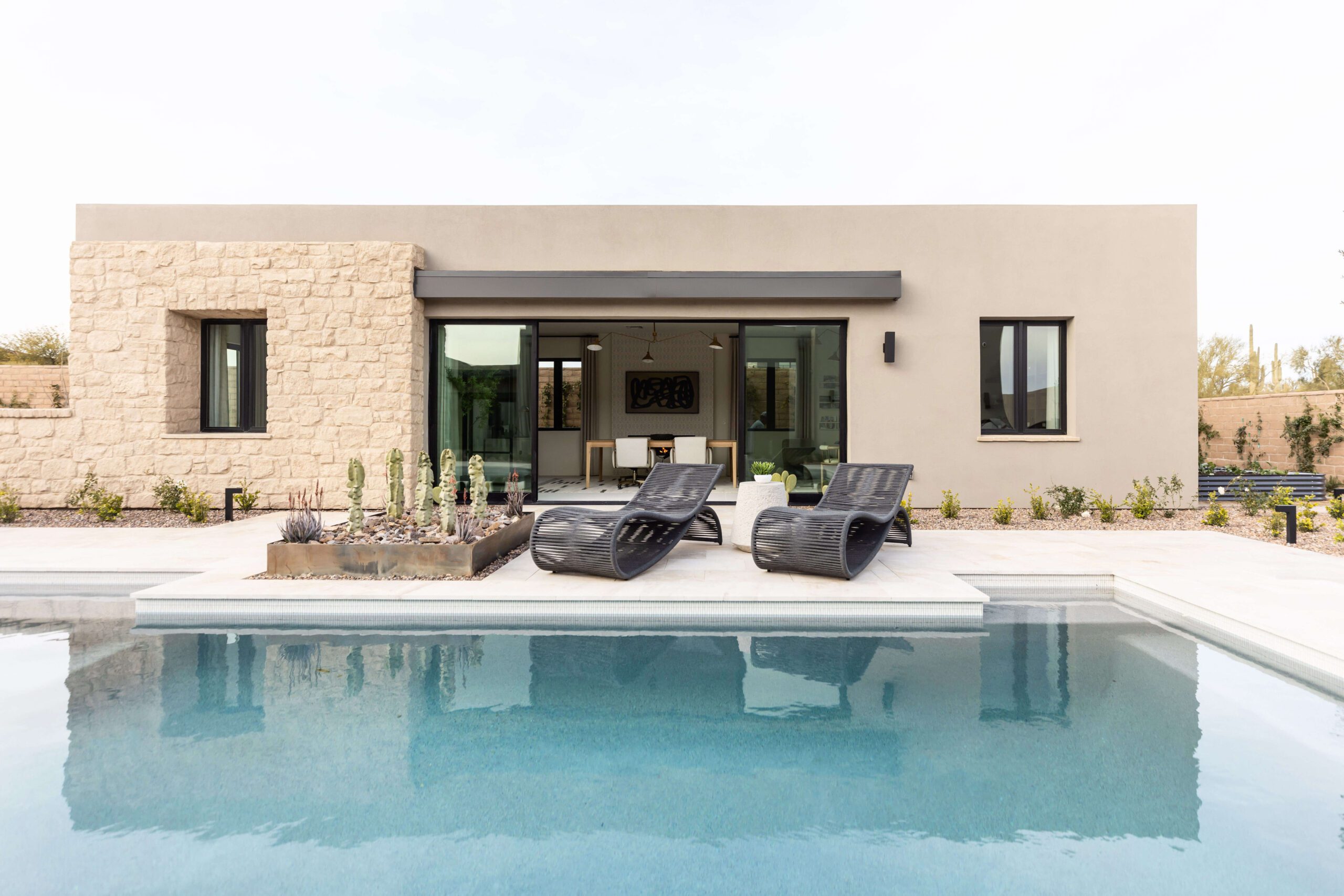
The materials that look best on a Scottsdale luxury home are not always the ones that survive it. Light-toned stucco, honed local sandstone, copper and patinated steel accents, and hand-applied lime wash are the four materials doing the most work on our current projects, because each one earns its place through performance in 115-degree summers, not just how it photographs. Get the material selection wrong here and you are repainting or replacing finishes within a few years. Get it right and the house looks better in a decade than it does on move-in day. This guide covers what actually holds up, what we steer clients away from, and why.
I am Lauren Lerner, founder of Living with Lolo. We are a luxury interior design studio and a licensed Arizona general contractor, ROC #347577, and material selection is where those two roles overlap the most. A designer without construction experience can pick a beautiful stone that spalls in two summers. We do not have that luxury, because we are also the ones who get the callback.
What the research shows about desert-appropriate materials
The data backs up what we see on Scottsdale job sites every season.
- A cool-colored stucco coating with a solar reflectance around 0.495 cuts annual cooling energy use by roughly 4 to 13 percent compared to a standard darker coating, according to research compiled by the Cool Roof Toolkit. That is a real, measurable number, not a marketing claim, and it is the single biggest reason we push clients toward lighter stucco tones on south- and west-facing walls.
- Homes and Gardens named statement stone, sculptural lighting, and warm “edible brown” tones among the defining 2026 interior design trends, a shift toward materials with real texture and warmth instead of flat, cool finishes.
- The 2026 U.S. Houzz and Home Study found that about 35 percent of renovating homeowners consciously chose higher-end materials this year, and half of U.S. homeowners planned a renovation in 2026 at all. Material choice is not an afterthought for this client anymore.
- ASID’s 2026 Trends Outlook named climate as one of four megatrends reshaping the interior design profession this year, and reported that a growing share of high-end residential clients are asking where their stone comes from and how it was quarried before they will approve it.
- Scottsdale property values continue to support this level of material investment, with luxury submarkets among the strongest in Arizona, per Zillow.
Stucco: still the default, but the color decision matters more than people think
Stucco remains the backbone of almost every Scottsdale exterior, and for good reason. Its thermal mass absorbs heat slowly during the day and releases it gradually, which is exactly the behavior you want in a climate that swings from a 115-degree afternoon to a 75-degree evening. The mistake we see most often is a client falling in love with a deep, moody exterior color from a shelter magazine shot in a cooler climate, without accounting for what that color does to a west-facing wall in July.
Lighter stucco tones, sand, limestone, and warm ivory, reflect more solar radiation and hold up better over the long run. That does not mean every wall has to be light. We regularly use a deeper accent tone on a covered entry or a north-facing elevation where solar exposure is lower, and reserve the reflective palette for the walls that take the brunt of the afternoon sun. That is a material decision as much as a design one, and it is the kind of call that gets made correctly only when the person making it understands both sides.
Natural stone: where honed and raw finishes actually belong
Local sandstone is having a real moment, and it deserves it. The material reads as unmistakably of this place in a way that imported marble never will, and the current trend of contrasting raw, split-face stone against finely honed sections gives a wall real depth instead of a single flat texture. We use this combination most often on a fireplace surround or an entry feature wall, where the contrast reads as intentional rather than busy.
The honest caveat here, and the one I give every client who wants a full stone exterior: raw, split-face stone in constant direct sun can hold heat and show wear faster than a honed finish, so we typically reserve the roughest textures for covered or partially shaded areas and use the smoother, denser finishes anywhere the material takes full sun exposure. That is not a limitation. It is a design decision that happens to also be the correct engineering one, which is my favorite kind.
Lime wash and Venetian plaster: the interior finish worth the extra step
Hand-applied lime wash and Venetian plaster have become our go-to interior wall finish for clients who want depth without the harsh glare a flat painted wall throws back under strong desert light. The technique takes real skill and more time than rolling on paint, which is exactly why it still looks handmade a decade later instead of flat and builder-grade. We use it most often in a primary bedroom, a powder room, or a great room wall that gets direct afternoon light, since that is where the material’s soft variation actually earns its keep.
This is not the right finish for every wall in a house. Applied everywhere, it starts to look like a stylistic tic instead of a considered choice. One or two rooms, chosen for the light they get, is the difference between a house that feels considered by someone who understood the material and one that feels like a showroom sample board.
Copper and patinated steel: the accent that ages instead of aging out
Copper and patinated steel are the metals we are specifying most for 2026 exterior accents, door surrounds, and light fixtures, because they do something almost no other material does in this climate: they improve with age. Arizona sun and heat shift these metals’ tone over years, moving them toward the same earthy palette as the desert around them, rather than fading or chalking the way a painted metal finish eventually does.
The tradeoff is patience. A brand-new copper accent looks bright and a little raw for the first year or two before it settles into the deeper tone that makes it worth choosing in the first place. We tell every client this upfront, because the alternative is a call eighteen months later asking why their copper “doesn’t look right yet,” when it is doing exactly what it is supposed to do.
Landscaping materials: xeriscape done well versus xeriscape done cheap
Material selection does not stop at the building envelope. Drought-tolerant, water-wise landscaping using natural stone, cobble, flagstone, and crushed rock is now the default expectation on a Scottsdale property, not an upgrade. The difference between a xeriscape yard that reads as intentional and one that reads as an empty lot with gravel dumped on it comes down almost entirely to material variety and layout, not plant selection.
We typically combine at least three stone or gravel textures with defined dry streambed elements and a real hardscape plan, rather than a single uniform rock color spread flat across the yard. If you are planning a full outdoor renovation alongside interior work, our guide to whole-home renovation cost in Scottsdale covers how exterior and landscape scope factors into an overall project budget.
How we choose materials on every Living with Lolo project
Every material recommendation we make gets weighed against the same two questions: does it look right for this specific house, and will it still look right in ten years of actual Arizona weather. That second question is the one a purely decorative designer cannot always answer with confidence, and it is the reason Living with Lolo pairs design with a licensed Arizona general contractor credential, ROC #347577, under one roof.
If you are working through a full renovation and want to see how material choices fit into the bigger picture, our 2026 luxury home design trends guide covers the color, form, and layout shifts we are building into Scottsdale homes this year, alongside the materials covered here. Homeowners considering a full exterior and interior overhaul should also read our whole-home renovation cost guide before budgeting a project of this scope. If you already know your home needs a licensed interior designer Scottsdale AZ homeowners trust with both the design and the build, that is exactly the gap we fill.
Ready to Talk Through Your Scottsdale Project?
Lauren Lerner and the Living with Lolo team work with clients across Scottsdale, Paradise Valley, Arcadia, and the greater Phoenix metro area.
Frequently asked questions
What building materials actually hold up in Scottsdale’s heat?
Does stucco color really affect my cooling costs in Arizona?
Should I use raw or honed stone on a Scottsdale exterior?
Is lime wash or Venetian plaster worth the extra cost over paint?
Why do you recommend copper and patinated steel accents?
Who should I hire to choose the right building materials for a Scottsdale renovation?


Lauren Lerner is the founder and principal designer of Living with Lolo, Scottsdale’s luxury interior design and licensed design-build firm. Named Phoenix Magazine Best Interior Design three consecutive years, Lauren leads projects from concept through construction for high-end homes in Scottsdale, Paradise Valley, and Phoenix.