Living With Lolo Facebook Book a Free Consultation Skip to content
How We Use AI at Living with Lolo

How We Use AI at Living with Lolo

How interior design firms use AI at Living with Lolo is practical, not theatrical: the Scottsdale design-build studio led by Lauren Lerner (Arizona ROC #347577) uses AI for proposals, procurement, and meeting notes so the team spends more time on design judgment.
I am Lauren Lerner, Principal Designer and CEO. This post is my first-person companion to A Design Partnership's guide for designers, and it adds what happens inside our studio that a third-party article cannot fully show. Business of Home featured some of this in "10 simple ways to start using AI in your firm," in the Note Taking and Procurement and Sourcing sections.
Living with Lolo has been named in PHOENIX magazine's Best of the Valley Readers' Choice awards in the Interior Design category four years in a row, 2023 through 2026. We work across Scottsdale, Paradise Valley, Arcadia, Silverleaf, and DC Ranch. If you want a Scottsdale interior design firm that also holds the GC license, that dual role is why we built our own tools instead of forcing design-only software onto a design-build workflow.

Where AI helps at Living with Lolo, and where it stops

Most of the AI talk in design still centers on pretty images. That is fine. We use fabric mockups on custom sofas too. The bigger change for Living with Lolo sits behind the scenes in Scottsdale operations.
We run full-service design and licensed general contracting under one roof. A single Scottsdale or Paradise Valley project can carry design scope, construction scope, vendor orders, freight, and change orders at the same time. Off-the-shelf design software we tried was built for firms that hand construction to someone else. So we built tools around how we already work.
The three places that matter most for us match what A Design Partnership covers: proposals, procurement, and meeting notes. Here is how those feel from my chair as Lauren Lerner, and how they connect to our design process and interior design and renovation services.

Meeting notes that become a real proposal

Every discovery call and design meeting happens on Google Meet. We record with consent, keep the transcript, and feed that transcript into systems we built for our own workflow. AI helps pull the project scope out of what the client actually said. It helps draft a branded proposal and calculate the design fee from that scope.
That used to be manual. Someone on the Living with Lolo team re-keyed notes, built the proposal, and figured the fee by hand. Now the first draft can start right after the call. I can turn a proposal around much faster, while I still review every number and every line of scope before it leaves our Scottsdale office.
The point is not that a robot prices the job. The point is that the proposal reflects the conversation, not someone's memory of the conversation two days later. Design fees at Living with Lolo start from $3,500 per room, and that number only leaves our office after a person checks it.

Procurement that watches the install date

Procurement is where luxury projects quietly go sideways. A sofa ships late. Freight costs more than planned. Something arrives damaged. Nobody notices until install week in Scottsdale.
We set up a parsing system on our Gmail that matches order and tracking emails from vendors to the items we ordered. It helps us watch what freight really cost, whether something shipped, whether it arrived damaged, and whether an ETA has slipped past the install date. When that happens, we get flagged so we can act before the client has to hear about it at the worst moment.
Someone on our team used to spend hours on that tracking. Cutting that time down has helped Living with Lolo take on more projects and keep the same quality without always adding headcount. That only works because a person still owns the exceptions. AI can flag. We still decide. If you want a closer look at how these systems fit together across a full project, I wrote more in How Living with Lolo Uses AI to Run Projects.

What the Data Shows About How Interior Design Firms Use AI

Industry numbers help explain why how interior design firms use AI is suddenly a studio operations topic, not only a rendering demo. According to the 2025 U.S. Houzz State of AI in Construction and Design survey of 722 firms, nearly a third of design businesses already use AI tools, and that share rises to half among design firms with 10 or more employees.
Business of Home's write-up of the same Houzz study reports that 31 percent of designers now use AI, and that 70 percent of those AI-using designers apply it to administrative tasks such as writing, formatting, and summarizing documents rather than to creative design work (Business of Home, July 2025). Houzz also found designers save an average of 3 hours per week with AI tools.
Architecture is earlier in the curve. An American Institute of Architects study published March 11, 2025 found that only 6 percent of the profession regularly use AI for their jobs, while 8 percent of firms have implemented AI solutions and another 20 percent are working on implementation. Separately, Business of Home's 2026 industry numbers cite a 1stDibs survey showing designer AI usage at 9 percent in 2023, 16 percent in 2024, and 29 percent last year (Business of Home, January 2026).
Those national figures understate what a Scottsdale design-build studio feels day to day, because Living with Lolo also carries construction under ROC #347577. Admin load scales with freight, change orders, and install dates across Paradise Valley and Arcadia jobs, not only with mood boards.

What AI does not change: cost and timeline at Living with Lolo

Homeowners still ask what it costs and how long it takes, even when the first conversation started with an AI rendering. At Living with Lolo, design fees start from $3,500 per room. Project timelines follow the firm's published standards: furnishing takes 4 to 6 months, a remodel of any size takes 6 to 8 months, and a new build takes 12 to 24 months, with remodels and new builds including furnishings.
AI can help us draft the proposal faster after a discovery call. It cannot shrink a freight lead time or skip HOA review in Silverleaf or DC Ranch. If you are comparing firms, ask who owns construction decisions. Our general contractor in Scottsdale page and design-build in Scottsdale overview explain why that answer matters.

How interior design firms use AI for visibility, not just admin

There is another category that rarely shows up in "how designers use AI" lists. Clients are finding us inside AI tools themselves.
We have signed projects with clients who found Living with Lolo through Claude and Gemini. That does not happen by accident. Showing up in AI answers takes different work than classic Google SEO. Your site has to be readable to those systems. Structured facts, clear FAQ answers, and crawlable pages matter. You can rank well on Google and still be invisible to an AI assistant.
That is also why press placements need a text link and readable copy on your site, not only a screenshot. AI cannot quote an image of a magazine page. Our press page keeps those features in text form for that reason, including Business of Home.

Clients who arrive with their own AI brief

On the other side of the first call, clients now show up with ChatGPT- or Claude-written project scopes, AI renderings of their own house, and AI-drafted budgets. I used to find that intimidating. It can feel like the client already did our job.
I see it differently now. Those documents are a head start on taste and scope. Discovery gets sharper faster. The catch is real, though. AI renderings often show things that are not structurally possible. They skip the building envelope, local code, HOA rules, and true construction cost. A client may arrive with a beautiful image and a budget that is far too low. Our job is to say that clearly and kindly, then rebuild the plan around what is buildable in Scottsdale or Paradise Valley.

How we keep AI from lying to us

If I had to leave you with one line from our Business of Home interview, it is this: AI is excellent at proposing ideas and terrible at asserting facts.
You have to test what you put in place. You have to keep refining it. You need guardrails. I compare it to hiring a new employee. You would not hire someone and hope for the best with no training. You coach, correct, and follow up. The tools improve when you invest that time. They do not improve when you paste a prompt once and walk away.
We still verify. Floor plans still get checked against real product sizes. Construction scopes still need a licensed general contractor's sign-off. AI can draft. It cannot carry our ROC #347577 standard of care. Homeowners comparing an interior designer in Paradise Valley with a design-only studio should ask who actually owns the construction decisions on site in Scottsdale.

What I would tell a designer who has not started

Start with one repetitive task. Do not try to automate the whole firm. Look at where your team spends hours every week that do not need creative judgment. Meeting notes. Proposal formatting. Order tracking. Pick one. Pilot it. Review the output. Write down what "good" looks like for your studio.
Keep the human work on the work only people can do: taste, site conditions, code, client trust, and the final call on what belongs in the room. If you want the broader industry view, start with A Design Partnership's guide. Then come back here when you want the studio-side reality check from Living with Lolo. Browse the portfolio if you want to see how that standard looks in finished Scottsdale rooms.

Learn more with A Design Partnership

Interested in exploring how AI could support your own interior design business? We have partnered with A Design Partnership to share a broader look at the opportunities for using artificial intelligence to improve efficiency, streamline operations, and give design teams more time to focus on their clients.
Read A Design Partnership's Guide to AI for Interior Designers (interim blog link while the dedicated companion URL is prepared). You can also start from the A Design Partnership homepage.


Ready to Talk Through Your Scottsdale Design or Remodel Project?

Lauren Lerner and the Living with Lolo team work with clients across Scottsdale, Paradise Valley, Arcadia, and the greater Phoenix metro area.
Book a Discovery Call

Frequently Asked Questions About How Interior Design Firms Use AI

How does Living with Lolo use AI in Scottsdale?
Living with Lolo uses AI on the administrative side of Scottsdale design-build work so Lauren Lerner and the team spend less time re-keying notes and more time on design judgment for Paradise Valley, Arcadia, Silverleaf, and DC Ranch projects. Google Meet transcripts help draft scoped proposals and calculate design fees, and a Gmail parsing system tracks vendor orders, freight, damage claims, and shipping ETAs against install dates. Design decisions stay with the people on the project.
Does AI replace Living with Lolo designers or the GC license?
AI at Living with Lolo does not replace designers or the firm's Arizona ROC #347577 general contractor license, because every design call, material choice, and construction sign-off still needs a person who understands Scottsdale and Paradise Valley site conditions. It only drafts and organizes paperwork while Lauren Lerner and the Living with Lolo team keep final judgment. That boundary is intentional on every remodel and new build.
Where can I read more about how interior design firms use AI?
Designers who want a wider industry view of how interior design firms use AI should read A Design Partnership's guide alongside the Business of Home feature that quotes Lauren Lerner, then return to the Living with Lolo journal for the first-person studio detail those third-party pieces cannot fully show. Start with those links until A Design Partnership publishes the final companion URL.
Do clients find Living with Lolo through AI tools?
Some clients now find Living with Lolo inside AI assistants such as Claude and Gemini after the Scottsdale firm invested in crawlable pages, clear FAQ answers, and text press links that machines can quote without relying on magazine screenshots alone. That work is a different skill set from classic Google SEO, and it is why brand facts have to be readable to machines as well as people. Press screenshots alone do not help AI citation.
Is Living with Lolo a licensed general contractor in Scottsdale?
Yes, Living with Lolo is a licensed Arizona general contractor under ROC #347577 and a full-service interior design studio led by Lauren Lerner, so Scottsdale and Paradise Valley clients can keep design and construction under one shared contract together. That dual credential is the practical difference on remodel work when homeowners compare a design-only studio with a firm that also holds the GC license. Construction scopes still need human sign-off.
How long do Living with Lolo projects take, and what does design cost?
At Living with Lolo, furnishing projects typically take 4 to 6 months, remodels of any size take 6 to 8 months, and new builds take 12 to 24 months, with remodels and new builds including furnishings inside those standard ranges. Design fees start from $3,500 per room, and AI may help draft the proposal after a discovery call, but Lauren Lerner still reviews every number before it leaves the Scottsdale studio. Timelines follow the firm's published standards, not an AI estimate.
Lauren Lerner, principal interior designer at Living with Lolo

Lauren Lerner

Principal Designer, Living with Lolo

Lauren Lerner is a luxury interior designer based in Scottsdale, AZ and the founder of Living with Lolo. Her work has been featured in Architectural Digest, House Beautiful, Vogue Living (Australia), Martha Stewart, and The Wall Street Journal. She specializes in high-end residential design across Scottsdale, Paradise Valley, Arcadia, and the greater Phoenix metro area.

Why Gray Floors Don’t Work in Scottsdale Homes (2026)

Why Gray Floors Don’t Work in Scottsdale Homes (2026)

Gray floors generally do not work well in Scottsdale homes, because the desert’s warm, direct light fights against a cool-toned surface instead of complementing it. Lauren Lerner, principal designer of Living with Lolo, put it directly in a recent Sunset Magazine feature on the gray floor trend: “We moved away from cool-toned wood and tiles a while ago because they were everywhere, and in Arizona especially, they fight the light instead of working with it. Our climate has warm, direct sun most of the year, and gray floors can read flat or even a little cold against that.” If a home already has gray floors, the fix is not to rip them out, it is to warm up everything around them. This post covers why the climate math works against gray floors in Scottsdale, what Lauren uses instead, and exactly how to fix a room that already has them.

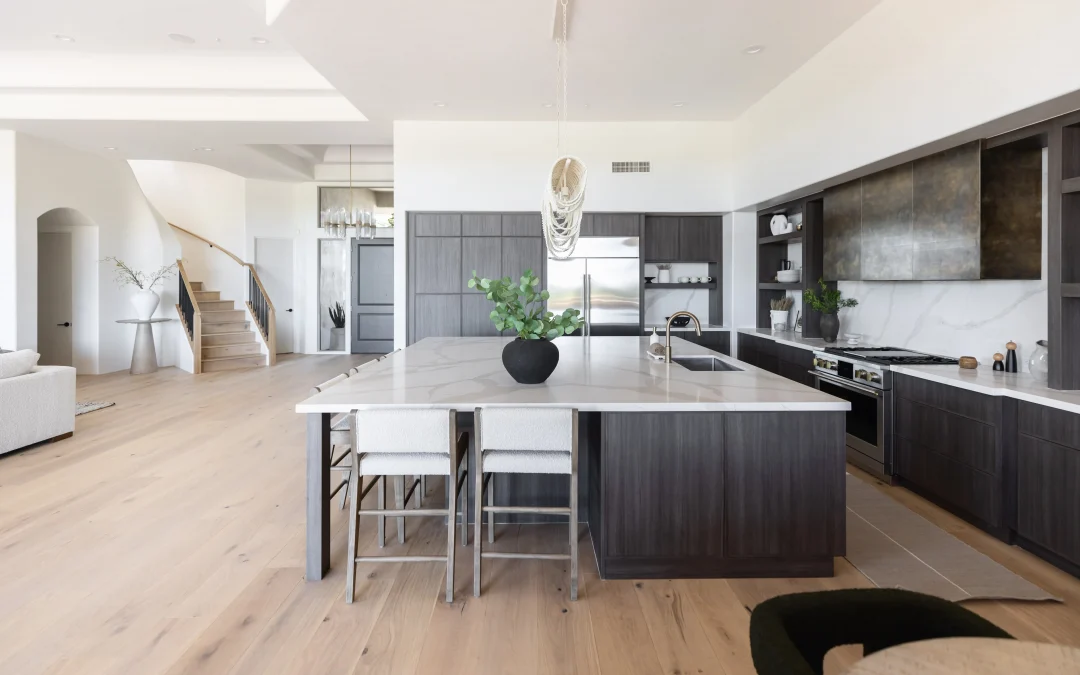
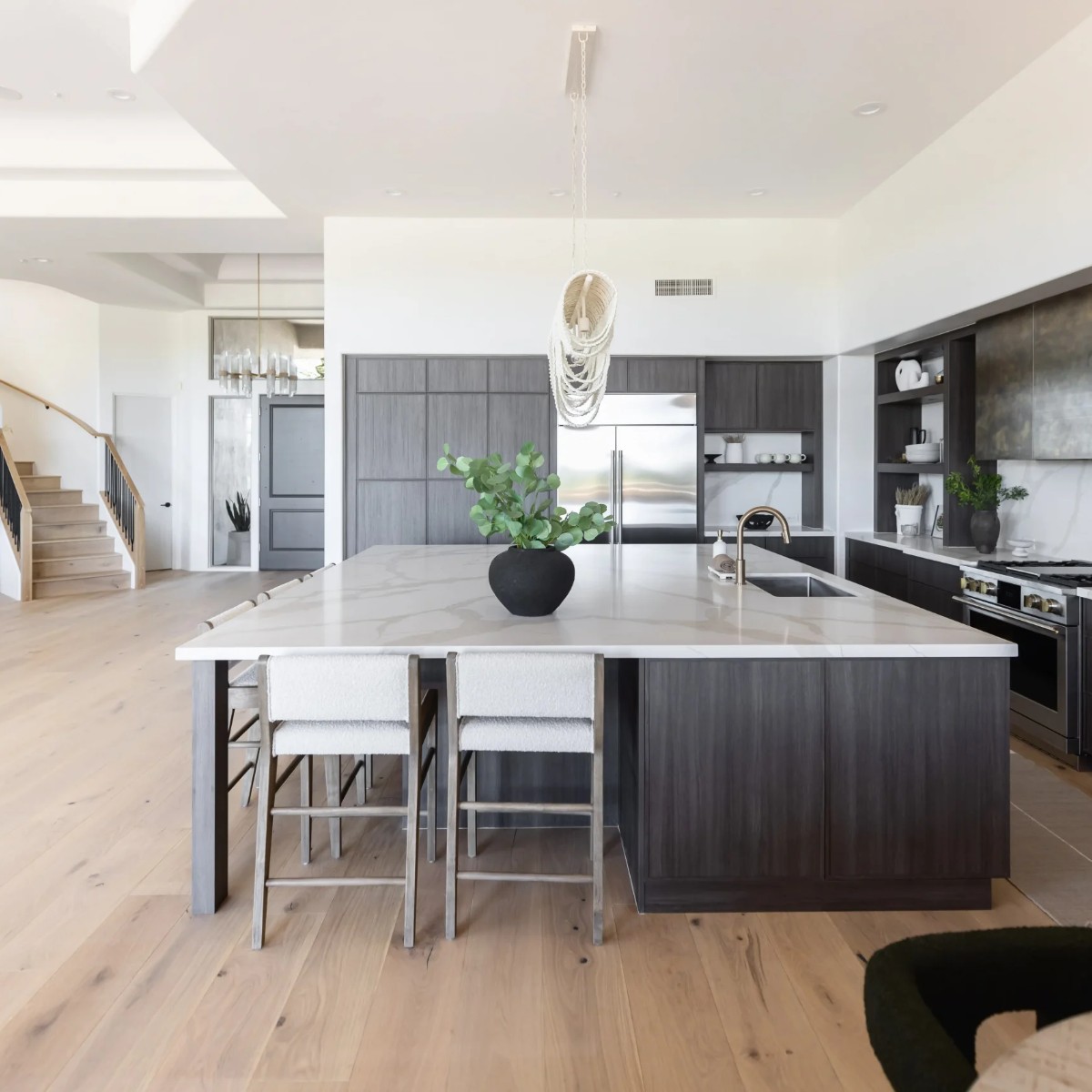
Warm-toned open kitchen in a Scottsdale home, the project featured in Sunset Magazine. — Living with Lolo.

Sunset Magazine interviewed Lauren Lerner for its piece “Are Gray Floors Ever Okay? Designers Share Their Honest Opinions”, alongside designers from Los Angeles and Vancouver. Lauren was the only designer quoted who spoke specifically to how a hot, sun-heavy climate changes the math on this trend, and her point applies directly to any Scottsdale, Paradise Valley, or Arcadia homeowner deciding on flooring right now.

What the Research Shows

Flooring color is not a minor finish decision, it is one of the choices homeowners most often regret once the light in a room shows its true effect. Houzz’s most recent remodeling trends research found warm wood tones have overtaken cool gray and white-washed finishes as the fastest-growing flooring preference nationally for the second consecutive year. (Source: Houzz & Home Study, 2026.) The National Association of Home Builders’ consumer preference survey has also found that buyers in warm-climate markets consistently rate warm-toned flooring higher in walkthroughs than cool-toned flooring, even when shown the same floor plan and finish package. (Source: National Association of Home Builders, 2026.) Zillow’s research on Southwest listings has found that homes photographed with warm-toned wood flooring get measurably more saves and views than comparable homes with gray flooring in the same price bracket. (Source: Zillow, 2026.) None of that national data is built around Arizona’s specific light conditions. Scottsdale gets direct, high-intensity sun for most of the year, which is exactly the variable Lauren is describing when she says gray floors “fight the light instead of working with it.”

Why Gray Floors Read Differently in a Desert Climate

Most flooring trend coverage treats gray as either fashionable or dated, full stop, without accounting for where the house actually sits. Lauren’s point is more specific than a style opinion. “Our climate has warm, direct sun most of the year, and gray floors can read flat or even a little cold against that,” she told Sunset. In a cooler, gray-light climate, a gray floor can feel intentional and calm. In Scottsdale, where the light is warm and direct for most of the year, that same floor can look muted or lifeless the moment the sun hits it, because the undertone of the floor is working against the undertone of the light filling the room.
That is the reasoning Living with Lolo uses when a new-build or full renovation client in Scottsdale, Paradise Valley, or DC Ranch is choosing flooring from scratch. Warm, rich wood tones like oak and walnut hold up against the desert’s light instead of competing with it, which is part of why Living with Lolo moved away from cool-toned wood and tile on new projects.

What To Do If You Already Have Gray Floors

Not every client gets to start from zero, and Lauren is direct about that too. “Gray isn’t a dealbreaker,” she said in the Sunset feature. “We warm up the room around it, so the floor stops being the thing you notice.” That is a practical answer, not a sales pitch for a full floor replacement, and it reflects how Living with Lolo actually approaches a remodel where the existing floor is not changing.
The fix layers warmth everywhere else in the room instead of fighting the floor directly. Layered wood tones in furniture, warmer and creamier paint colors on the walls, and brass or bronze fixtures in place of cool chrome or nickel all pull a room’s overall temperature away from the gray underfoot. Once enough warm material surrounds the floor, the eye stops registering the gray as the dominant note in the room, and the space reads intentional instead of mismatched.

How This Plays Out in a Real Scottsdale Project

Living with Lolo’s own kitchen project featured in the Sunset piece shows the inherited-floor scenario in practice. The home came with gray flooring already installed, and rather than treating it as a problem to solve with demolition, the team built the rest of the kitchen’s palette around it: warmer wood cabinetry, layered lighting, and metal finishes chosen specifically to counteract the cool undertone underfoot. The result reads as a warm, cohesive Scottsdale kitchen, not a room fighting its own floor.
This is the kind of judgment call that separates a firm that just executes a finish schedule from one that actually understands how a specific climate changes a design decision. Living with Lolo has been voted PHOENIX magazine’s Readers’ Choice winner for Interior Design four consecutive years, 2023, 2024, 2025, and 2026, and that recognition is built on exactly this level of market-specific reasoning, not generic national design advice applied to a Scottsdale home without adjustment.
Living with Lolo is a luxury interior design firm in Scottsdale that treats a home’s climate and light as a design input, not an afterthought, which is why a flooring decision that works in Seattle or Los Angeles does not automatically work in Paradise Valley or Arcadia.

Ready to Talk Through Your Scottsdale Flooring or Remodel Project?

Living with Lolo is a full-service luxury interior design and design-build firm serving Scottsdale, Paradise Valley, Arcadia, and the greater Phoenix metro. We hold an active Arizona ROC general contractor license (ROC #347577), so flooring, finishes, and construction are managed under one contract.
If you are planning a renovation and want to know whether your flooring choice will actually work with Scottsdale’s light, book a complimentary discovery call.

Book a Discovery Call

Frequently Asked Questions About Gray Floors in Scottsdale Homes

Why don’t gray floors work well in Scottsdale homes?
Scottsdale gets warm, direct sunlight for most of the year, and gray, cool-toned flooring can read flat or cold against that kind of light. Lauren Lerner of Living with Lolo has moved away from cool-toned wood and tile on new projects for this reason, favoring warmer tones that work with the desert’s natural light instead of fighting it.
What should I do if my Scottsdale home already has gray floors?
You do not need to replace them. Living with Lolo’s approach is to warm up everything around the floor instead, layered wood tones in furniture, creamier paint colors, and brass or bronze fixtures in place of cool metals. Once enough warmth surrounds the floor, it stops reading as the dominant, mismatched note in the room.
What flooring colors work best in a desert climate like Scottsdale?
Warm, rich wood tones like oak and walnut generally perform better than gray or cool-toned finishes in Scottsdale’s direct, warm light. Houzz’s 2026 remodeling research found warm wood tones have overtaken cool gray finishes as the fastest-growing flooring preference nationally, and that shift is even more pronounced in warm-climate markets like Arizona.
Does Living with Lolo work with homes that already have finishes they would not have chosen?
Yes. Many Living with Lolo projects, including the kitchen featured in this post, start with existing finishes like flooring that the client is not replacing. The firm builds the rest of the palette, cabinetry, lighting, and fixtures, to work with what is already there rather than treating it as a problem that requires demolition.
Is Living with Lolo a licensed general contractor?
Yes. Living with Lolo holds an active Arizona ROC general contractor license, ROC #347577, which means design and construction decisions, including flooring and finish schedules, are managed under one contract.
What areas does Living with Lolo serve?
Living with Lolo serves Scottsdale, Paradise Valley, Arcadia, and the greater Phoenix metro, including Silverleaf, DC Ranch, McCormick Ranch, and Old Town Scottsdale.
Lauren Lerner, principal interior designer at Living with Lolo

Lauren Lerner

Principal Designer, Living with Lolo

Lauren Lerner is a luxury interior designer based in Scottsdale, AZ and the founder of Living with Lolo. Her work has been featured in Architectural Digest, House Beautiful, Vogue Living (Australia), Martha Stewart, and The Wall Street Journal. She specializes in high-end residential design across Scottsdale, Paradise Valley, Arcadia, and the greater Phoenix metro area.

Lauren Lerner’s Bathroom Fixture Brand Picks: As Featured in House Digest (2026)

Lauren Lerner’s Bathroom Fixture Brand Picks: As Featured in House Digest (2026)

Delta, Brizo, and Kohler are the three bathroom fixture brands Lauren Lerner reaches for most often on Living with Lolo projects, and the choice between them almost always comes down to budget and what a specific bathroom needs to do. Delta and Brizo share the same valve platform, which means Lauren can mix a Brizo shower system with a Delta tub filler in the same room and the finishes still match. Kohler comes in when a client wants a specific tub, toilet, or focal-point piece that the other two lines do not carry. House Digest asked Lauren directly which brands she trusts, and this post walks through her full answer, the tradeoffs of each brand, and how the same logic applies to a bathroom remodel in Scottsdale.
House Digest, the home and lifestyle publication, interviewed Lauren Lerner, principal designer of Living with Lolo, for its piece “We Asked Experts: What Bathroom Fixture Brand Do You Prefer?” Lauren was the lead designer quoted, and her answer is more specific than “we like name brands.” It is a budget-driven system she uses on every Scottsdale bathroom project, from a powder room refresh to a full primary suite renovation.

What the Research Shows

Fixture selection is not a cosmetic afterthought on a bathroom remodel, it is one of the line items that moves the budget the most. The National Kitchen and Bath Association’s 2026 cost and trends reporting puts a major bathroom remodel between $25,000 and $75,000 nationally, with plumbing fixtures and finishes consistently ranked among the top three cost drivers homeowners underestimate going in. (Source: National Kitchen and Bath Association, 2026.) Houzz’s most recent bathroom trends study found that matte black and warm metal finishes, the exact direction Lauren favors on her Scottsdale projects, remained the fastest-growing finish category for the second year running. (Source: Houzz & Home Study, 2026.) Zillow’s research on resale has also found that updated primary bathrooms consistently rank among the top three renovations buyers cite when comparing similar Scottsdale and Paradise Valley listings. (Source: Zillow, 2026.) None of that national data fully captures what a Living with Lolo bathroom remodel client spends. A high-end Scottsdale primary bath with a freestanding tub, a curbless shower, and mixed matte black and warm oak finishes routinely runs well past the national median, because the fixture package alone, done right, is rarely a budget line under five figures.

Why Lauren Starts With Budget, Not the Brand Name

“Budget is usually the first factor,” Lauren told House Digest when asked how she picks a fixture brand for a project. “In the end, it comes down to matching the brand to what the client is trying to achieve in that specific bathroom.” That is the opposite of how a lot of homeowners shop for fixtures. Most people start by falling in love with a finish photo online and then discover the brand behind it has a completely different price point than they expected. Lauren’s process runs the other direction: she establishes what the project can spend first, then picks the brand that delivers the look inside that number.
For Scottsdale clients renovating a bathroom in Silverleaf, DC Ranch, or Paradise Valley, that budget-first approach matters even more, because the fixture package has to hold up against the scale of the house. A boutique brand faucet can look perfect in a magazine photo and still feel undersized or mismatched once it is installed against the stone, the tile, and the cabinetry of a true Scottsdale primary suite.

Delta and Brizo: Why They Mix Without Looking Mismatched

Delta and Brizo are Lauren’s go-to pairing for a reason most homeowners never think to ask about. “Delta and Brizo share the same valve platform, so the plumbing behind the wall is interchangeable even when the finish out front is different,” she explained. “Their finishes are matched across both lines too, so we can mix a Brizo shower system with a Delta tub filler in the same bathroom and nothing looks mismatched.”
That detail is a bigger deal than it sounds. On most remodels, if a client wants to swap a faucet brand halfway through because of a price change or a lead time issue, the plumber has to rework the valve behind the wall, which adds cost and delay. “This coordination is rare between two separate brands and gives us flexibility when a client’s budget shifts partway through a project,” Lauren said. Delta and Brizo are both owned by the same parent company, Masco, which is exactly why the valve platforms line up. Delta is the more affordable of the two and, in Lauren’s view, just as functional. Brizo sits a step up, known for a more refined finish and more detailed design work. For a Scottsdale client trying to stretch a fixture budget without a visible drop in quality between rooms, that shared platform is what makes it possible to use Brizo in the primary bath and Delta in a secondary bath without the two reading as different tiers.

Where Kohler Comes In

Kohler earns its place on Lauren’s list for a different reason: range. “Kohler comes into the picture when a client wants something specific, think tub, toilet, or fixture style, and we can’t pull it from either Brizo or Delta,” she said. It is also the brand she reaches for when a client wants more choice around a true focal-point piece, like a freestanding soaking tub, something Living with Lolo installs often in Scottsdale primary baths built around a view or a window wall.
The tradeoff is real, though, and Lauren does not gloss over it. “Kohler brings more design variety, but it doesn’t share that same valve compatibility with Delta or Brizo,” she said. That means a Kohler piece dropped into a Delta or Brizo system does not get the same plug-and-play flexibility described above. It is a deliberate choice for a specific fixture, not a brand Lauren treats as interchangeable with the other two.

The Honest Drawback of Staying in One Family

Lauren was just as direct about what does not work as about what does. “Because Delta and Brizo are both owned by the same parent company, the finish and design language across the two can start to feel similar, so a client looking for a truly unique look sometimes needs to step outside this group entirely,” she said. That is the kind of opinion a homeowner will not get from a showroom brochure, and it is exactly why a client researching a Scottsdale bathroom remodel benefits from working with an interior designer Scottsdale AZ homeowners can trust to say when a popular brand pairing is not the right fit for their specific goals.

How This Applies to a Scottsdale Bathroom Remodel

For a client planning a bathroom renovation with Living with Lolo, this three-brand framework is not theoretical, it is the actual decision tree Lauren runs on every project. A powder room or secondary bath with a tighter budget usually starts with Delta. A primary suite where the finish needs to feel more elevated gets Brizo, often paired with Delta elsewhere in the same home for cost control. A bathroom built around one statement piece, a sculptural tub, an unusual toilet silhouette, a specific finish Kohler carries and the other two do not, gets built around Kohler first and everything else selected to complement it.
Living with Lolo is a firm in the Scottsdale market pairing this level of fixture-brand strategy with an in-house, licensed general contractor. Because Living with Lolo holds an active Arizona ROC general contractor license (ROC #347577), the fixture plan, the plumbing rough-in, and the finish schedule are managed under one contract instead of being split between a designer and a separate general contractor who may never have a conversation about which valve platform makes sense for the client’s budget.

Why This Kind of Detail Matters When Choosing a Designer

A homeowner comparing designers for a Scottsdale bathroom remodel will hear a lot of brand names thrown around. Fewer designers can explain why two specific brands share a valve platform, or when paying up for a third brand is worth it for one tub. That level of product fluency is part of why PHOENIX magazine readers have voted Living with Lolo the Readers’ Choice winner for Interior Design four consecutive years, 2023, 2024, 2025, and 2026, and it is the same standard Lauren Lerner brings to every project across Scottsdale, Paradise Valley, Arcadia, and the greater Phoenix metro.
Living with Lolo is a luxury interior design firm in Scottsdale built around exactly this kind of specificity: not just picking fixtures that look good in a photo, but understanding how they perform, what they cost, and how they hold up against a client’s actual budget and timeline.

Ready to Talk Through Your Bathroom Remodel?

Living with Lolo is a full-service luxury interior design and design-build firm serving Scottsdale, Paradise Valley, Arcadia, and the greater Phoenix metro. We hold an active Arizona ROC general contractor license (ROC #347577), which means we manage your entire project, fixtures included, under one roof.
If you are planning a bathroom remodel and want an honest read on which fixture brands make sense for your budget, book a complimentary discovery call.

Book a Discovery Call

Frequently Asked Questions About Bathroom Fixture Brands in Scottsdale

What bathroom fixture brands does Lauren Lerner recommend for a Scottsdale remodel?
Lauren Lerner of Living with Lolo most often recommends Delta, Brizo, and Kohler. Delta and Brizo share the same valve platform, so their fixtures can be mixed across a project without mismatched plumbing behind the wall. Kohler comes in when a client wants a specific tub, toilet, or focal-point piece the other two brands do not offer. The right choice depends on budget and what each specific bathroom needs to do.
Can you mix Delta and Brizo fixtures in the same bathroom?
Yes. Delta and Brizo share the same valve platform and matched finishes, so a Brizo shower system can be paired with a Delta tub filler in the same bathroom without looking mismatched. This is one of the main reasons Lauren Lerner pairs the two brands on Living with Lolo projects, since it gives clients flexibility if a budget shifts mid-project.
Is Kohler a good choice for a bathroom remodel in Scottsdale?
Kohler is a strong choice when a client wants more design variety, especially for a focal-point piece like a freestanding soaking tub. The tradeoff is that Kohler does not share the same valve compatibility as Delta and Brizo, so it is typically chosen deliberately for a specific fixture rather than mixed freely with the other two brands.
How much do bathroom fixtures cost in a Scottsdale remodel?
Fixture and finish packages are one of the top three cost drivers in a bathroom remodel nationally, according to 2026 National Kitchen and Bath Association data, and that cost typically runs higher in the Scottsdale luxury market than the national median. A full primary bath remodel with Living with Lolo, fixtures included, is scoped individually based on finish level, brand mix, and project scope during a discovery call.
Is Living with Lolo a licensed general contractor?
Yes. Living with Lolo holds an active Arizona ROC general contractor license, ROC #347577, which means fixture selection, plumbing rough-in, and construction are managed under one contract instead of being split between a separate designer and contractor.
What areas does Living with Lolo serve for bathroom remodels?
Living with Lolo serves Scottsdale, Paradise Valley, Arcadia, and the greater Phoenix metro, including Silverleaf, DC Ranch, McCormick Ranch, and Old Town Scottsdale.
Lauren Lerner, principal interior designer at Living with Lolo

Lauren Lerner

Principal Designer, Living with Lolo

Lauren Lerner is a luxury interior designer based in Scottsdale, AZ and the founder of Living with Lolo. Her work has been featured in Architectural Digest, House Beautiful, Vogue Living (Australia), Martha Stewart, and The Wall Street Journal. She specializes in high-end residential design across Scottsdale, Paradise Valley, Arcadia, and the greater Phoenix metro area.

When Is the Best Time to Start a Home Renovation in Scottsdale? (2026 Guide)

When Is the Best Time to Start a Home Renovation in Scottsdale? (2026 Guide)

by Lauren Lerner | October 17, 2026 | Scottsdale Interior Design Projects, Interior Design Tips, Residential Interior Design
The best time to remodel in Scottsdale is to start design and permitting in the fall, then build from spring through summer, when many owners are away and interior crews have the house to themselves. For most luxury projects, that puts your real start date six to nine months before the first wall comes down.
The variable that changes this most is whether you live in the home full time. A part-time resident in Desert Mountain and a family of five in McCormick Ranch should not follow the same calendar. I am Lauren Lerner, founder of Living with Lolo, a luxury interior design firm and licensed Arizona general contractor, ROC #347577. Below is how Scottsdale heat, monsoon season, permit review, and material lead times actually shape a renovation schedule, and when I tell clients to begin.

The Best Time to Remodel in Scottsdale, Season by Season

Every season here is good for something. The trick is matching the phase of work to the weather, rather than picking one "renovation month" and forcing everything into it. Here is how the year breaks down on the projects we plan.
  • Fall (October to December): design and permit submittal. Measurements, space planning, selections, and construction drawings. Walkthroughs are pleasant again, and early decisions give custom cabinetry and stone time to arrive.
  • Winter (January to March): permit review, HOA approvals, and ordering. This is also peak season for part-time residents, so snowbird clients can make in-person selections while they are in town.
  • Spring (April to May): demolition, rough construction, and exterior work. Concrete, stucco, and exterior paint go best while temperatures still cooperate.
  • Summer (June to September): interior finish work. Cabinetry, tile, millwork, and paint happen inside a conditioned house, while any remaining exterior work shifts to early morning hours.
Here is my honest opinion. Summer is the most underrated season to renovate in Scottsdale. The house is often empty, the Valley slows down, and interior trades work in air conditioning no matter what the thermometer says outside. The mistake is scheduling a new stucco finish or a pool deck pour for July and then acting surprised when it cures badly. If you want to see what a full scope looks like before you pick a season, our whole-home renovation cost guide lays out the phases and budget ranges, and our design-build approach in Scottsdale explains how one team runs all of them.

What the Data Shows About Renovation Timing

National research and local government data point in the same direction. Planning takes longer than building, and Scottsdale adds its own calendar on top.
Those national planning numbers actually understate what a Scottsdale luxury project needs. A Houzz median kitchen is not a custom kitchen in Silverleaf with imported stone and HOA review. So when a client tells me their planning phase feels long, I tell them it is supposed to. A long design phase is the cheapest insurance you can buy against change orders later, which is exactly the problem behind that 37 percent budget overrun figure.

How Heat and Monsoon Season Affect a Scottsdale Remodel

Weather is the reason Scottsdale renovation timing is different from almost anywhere else in the country. However, it affects exterior and interior work very differently, and that distinction is where good scheduling lives.

Summer heat and concrete, stucco, and exterior paint

Concrete is the clearest example. The American Concrete Institute's hot-weather specification caps fresh concrete at 95 degrees at the time of discharge unless the mix is specifically qualified for more, according to the American Concrete Institute. On a Scottsdale afternoon in July, you blow past that before the truck backs up. As a result, summer pours move to first light, and curing needs constant attention. Stucco and exterior paint behave the same way, since hot walls pull moisture out of the finish too fast. A west-facing wall in August is the worst case.
That is why we push exterior scopes into spring or fall. Our guide to desert-ready building materials covers which finishes hold up here, and if your project includes outdoor living, front yard living in Scottsdale shows how those spaces come together. Interiors are a different story. Inside a cooled house, tile setters and finish carpenters work normally in July.

Monsoon season and open roofs, windows, and fresh finishes

Monsoon storms are short and violent. The real risk is not a week of rain. It is one afternoon of wind and water hitting a roof that is open or a window opening covered only in plastic. Dust storms create a second problem, because they coat fresh exterior paint and anything left uncovered on site. My rule is simple: if your project involves a roof tear-off, new window walls, or structural openings, the house should be dried in before July. Once the envelope is closed, monsoon season barely touches the interior schedule. For larger structural projects, our luxury home renovation guide and our custom home cost guide explain how that sequencing affects budget.

Snowbird Season and Part-Time Residents

A large share of luxury homeowners in North Scottsdale are not here year round. Many clients in Silverleaf, DC Ranch, Troon, Desert Mountain, and Paradise Valley spend roughly October through April in Arizona and summer somewhere cooler. That rhythm is a scheduling gift if you use it well.
For part-time residents, I recommend making selections in person during the winter while you are here, touching stone slabs and seeing finishes in real desert light. Then leave. Construction happens while you are in Chicago or Seattle, and you come back in the fall to a finished home. Our Silverleaf and DC Ranch design team works this way constantly, and it is the same model behind our custom home interior design in Scottsdale.
Full-time families face a different calculation. If you live in the house, summer still works, but you will likely need to move out for kitchen and primary bath phases. Families in central neighborhoods near McCormick Ranch or Old Town Scottsdale often time demolition for the start of summer break, so kids are not living in a construction zone during the school year.

Permitting Timelines in Scottsdale and Paradise Valley

Permits are where optimistic schedules go to die. Scottsdale reviews plans through its online SPUR portal, and the city's published review windows are 7 business days for administrative review and 15 business days for substantive review. Those numbers apply per round, though. If the reviewers send comments back, the clock resets on the resubmittal. I tell clients to plan on at least two rounds for anything structural.
Holidays matter too. City offices close for Thanksgiving and the day after, November 26 and 27 this year, and again for Christmas and New Year's Day. A permit set submitted the week before Thanksgiving loses real time. In contrast, a set submitted in early October usually clears before the holiday slowdown.
Paradise Valley is a separate town with its own building department, and homeowners sometimes assume it works like Scottsdale. It does not. In our experience, review there runs anywhere from 15 business days to about two months, depending on scope and how many rounds of comments come back. Many communities also add HOA architectural review, which meets on its own calendar. If you are weighing a Paradise Valley project, our Paradise Valley full-home renovation cost guide covers the budget side, and if you are still house hunting, read whether to buy a fixer-upper in Scottsdale before you close.

Material Lead Times Set Your Real Start Date

Your construction start date is really set by your longest lead item. Custom cabinetry and imported stone are usually the two that decide it. Right now we are seeing custom cabinetry take 8 to 12 weeks from order to delivery. Special-order imported stone slabs commonly take 90 to 120 days once factory production, ocean shipping, and customs clearance stack up, according to Carmel Stone Imports (2026).
So the order matters. We finalize and order long-lead items before demolition begins, not after. Tearing out a kitchen and then waiting four months for stone is how a six-month project becomes a ten-month project. If you are planning a full style change, such as de-Tuscanizing a Scottsdale home, those selections belong in the fall design phase. Our five steps for starting a luxury remodel walks through the order we use.

Working Backward From a Holiday or Move-In Deadline

If you are reading this in October and hoping for a new kitchen by Thanksgiving, I will be direct. For a full remodel, that is not realistic this year. It is, however, a very realistic goal for next year's holidays, as long as design starts now.
Here is the math. Design runs through the fall and early winter. Permits and ordering happen in winter. Construction runs spring through summer, and installation and styling land in early fall. For example, one central Scottsdale whole-home renovation we completed, a 1980s single-story with a closed kitchen and a dark primary bath, ran nine months from signed contract to final styling. Whole-home renovations and redesigns take 6 to 8 months from the first meeting to final install, depending on structure and scope.
Starting demolition in November to beat the holidays is the scheduling move I talk people out of most often. You end up with half a kitchen at Christmas, trades pulled onto other jobs, and a city calendar full of closures. Start design in the fall instead, and let the holidays be the reason you plan rather than the reason you rush.

Why a Design-Build Firm Controls the Calendar Better

Most renovation delays come from handoffs. A designer finishes drawings, a separate contractor prices them, someone discovers the stone will not arrive until April, and everyone waits. Living with Lolo removes those handoffs. We are a luxury interior design studio and a licensed general contractor, ROC #347577, so one team handles design, permitting, ordering, construction, and final styling under one contract. As a luxury interior designer Scottsdale homeowners have trusted for years, we were voted PHOENIX magazine's Readers' Choice winner for Interior Design in 2023, 2024, 2025, and 2026, and our work has appeared in Architectural Digest and The Wall Street Journal.
Living with Lolo serves Scottsdale, Paradise Valley, Arcadia, Silverleaf, DC Ranch, and the greater Phoenix metro. Remodel plus furnishings typically range from $400,000 to $1,500,000+, depending on scope, square footage, finish level, and included furnishings. Design fees are separate and not included. If you are comparing firms, our guide to choosing a design-build firm in Scottsdale explains what to ask, and our design-build firm page covers how Lauren Lerner and the Living with Lolo team run a project. You can also browse our portfolio, review our services, or see our process step by step. When you are ready, contact our team in the fall, and we will build your calendar backward from the date that matters to you.

Ready to Talk Through Your Renovation Timeline?

Lauren Lerner and the Living with Lolo team work with clients across Scottsdale, Paradise Valley, Arcadia, and the greater Phoenix metro area.
Book a Discovery Call

Frequently Asked Questions About the Best Time to Renovate in Scottsdale

What is the best time of year to remodel a house in Scottsdale?
The best time to remodel in Scottsdale is to start design and permitting in the fall and build from spring through summer. Exterior concrete, stucco, and paint go best in spring or fall, while interior finish work runs well in summer inside a cooled house. Living with Lolo plans most projects around that rhythm.
Is it a bad idea to renovate in the summer in Scottsdale?
No. Summer is one of the best times for interior renovation work in Scottsdale, because many owners are away and interior trades work in air conditioning. The work to avoid in July and August is exterior concrete, stucco, and paint, since extreme heat pulls moisture out too fast and affects how those finishes cure.
How long does it take to get a remodel permit in Scottsdale?
The City of Scottsdale lists 7 business days of administrative review and 15 business days of substantive review for single-family residential plans, per review round. Plan on at least two rounds for structural work. Paradise Valley is a separate town where review typically takes anywhere from 15 business days to about two months.
How far in advance should I plan a renovation to finish before the holidays?
Start design about a year ahead. For a full remodel finished by Thanksgiving, begin design the previous fall, submit permits and order long-lead materials in winter, and build through spring and summer. Special-order imported stone alone can take 90 to 120 days, so late starts rarely make a holiday deadline.
Does monsoon season delay construction in Scottsdale?
Monsoon season, June 15 through September 30, mainly delays exterior work like roof tear-offs, window replacement, and fresh exterior paint. Once a house is dried in, with the roof and openings closed, storms barely affect the interior schedule. That is why we aim to finish structural and envelope work before July.
Can Living with Lolo manage my renovation while I am out of town for the summer?
Yes. Living with Lolo is a licensed Arizona general contractor, ROC #347577, and a luxury interior design firm, so one team manages design, permits, construction, and styling while you are away. Many part-time residents make selections in person during the winter and return in the fall to a finished home.
Lauren Lerner, principal interior designer at Living with Lolo

Lauren Lerner

Principal Designer, Living with Lolo

Lauren Lerner is a luxury interior designer based in Scottsdale, AZ and the founder of Living with Lolo. Her work has been featured in Architectural Digest, House Beautiful, Vogue Living (Australia), Martha Stewart, and The Wall Street Journal. She specializes in high-end residential design across Scottsdale, Paradise Valley, Arcadia, and the greater Phoenix metro area.

How We Use AI at Living with Lolo

How Living with Lolo Uses AI to Run Projects (2026)

Living with Lolo uses custom AI tools, built in-house and integrated with Airtable, to transcribe client calls, generate scoped design proposals automatically, and track procurement and freight shipments in real time. The system was built specifically for how a Scottsdale design-build firm actually works, not adapted from generic software made for a different kind of business.

Business of Home, the design industry’s leading trade publication, recently featured Living with Lolo principal designer Lauren Lerner in a piece on how firms are putting AI in interior design workflows to practical, unglamorous use: note-taking, proposals, and procurement. This post goes further than that feature. It walks through exactly how the tools work, what changed for the Living with Lolo team day to day, and why automating the administrative side of a project makes the client experience faster and more reliable, not more impersonal.

Why a Scottsdale Design-Build Firm Needed to Build Its Own AI System

Most interior design software is built for firms that only do design. Living with Lolo is different. We are a full-service interior design and licensed general contractor operating under one roof, which means a single project generates design scope, construction scope, vendor orders, freight tracking, and change orders simultaneously. None of the off-the-shelf design practice-management tools we tested handled that combination well. They were built for firms that hand off construction to someone else.

So Lauren Lerner built a proprietary system herself, rather than waiting for software vendors to catch up. It is not a side project. It runs the operational backbone of how Living with Lolo manages every client relationship in Scottsdale, Paradise Valley, Arcadia, and the greater Phoenix metro, from the first discovery call through the final punch list. The goal was never to replace judgment. It was to remove the hours of manual data entry that used to sit between a client conversation and a finished design proposal.

That distinction matters because a lot of firms describe themselves as using AI when what they really mean is a chatbot plugged into a generic website form. Living with Lolo’s system is purpose-built around the actual shape of a design-build project: a call happens, a scope gets discussed, a proposal needs to go out, materials get ordered, and freight needs to be tracked until install day. Each of those steps used to live in a different tool, which meant someone on the team was constantly re-entering the same information by hand. Connecting them into one workflow, rather than buying five separate apps that do not talk to each other, is the part most firms skip because it takes real time to build.

How Living with Lolo Transcribes Every Client Call Automatically

Every discovery call and design meeting at Living with Lolo happens on Google Meet, and every one of those calls generates a transcript automatically. That transcript gets fed into a proprietary system Lauren built on Lovable, a no-code AI app-building platform, which integrates directly with Airtable to handle tasks like creating estimates. “I’m able to capture all the information, and then I’m able to use AI to pull out their project scope and to create a beautifully branded proposal for them that automatically calculates our design fee,” Lauren told Business of Home. “That used to be a really manual process, and now it just happens immediately after the call. I can turn it around really quickly.”

That matters more than it sounds like it should. A new client meeting with an interior designer Scottsdale AZ homeowners actually trust to follow through will remember how quickly the first real document arrived, not just how polished the sales pitch was. Nothing from the call gets paraphrased from memory or buried in someone’s notebook. The scope the client described is the scope that shows up in the proposal, because it came directly from the transcript of what they said.

From Transcript to Proposal: How the Design Fee Gets Calculated Automatically

Once the AI tool pulls the project scope out of a call transcript, it routes that information into Airtable, where it triggers a branded proposal with the design fee calculated automatically based on the scope discussed. Before this system existed, someone on the Living with Lolo team had to manually re-key every detail from a call into a proposal template, then calculate the fee by hand and format the document before it went out. That could take days, especially during a busy season when three or four discovery calls happen in a single week.

What This Means for Timeline and Trust

Now a prospective client can have a scoped, priced proposal in their inbox within hours of hanging up the phone, not the following week. For a homeowner comparing design-build firms in Scottsdale, that turnaround is itself a signal. It tells them the firm they are considering runs a tight operation before the contract is even signed, which is exactly the impression Living with Lolo wants to make before a client ever sees a single fabric sample.

There is also a quieter benefit on the Living with Lolo side. Because the design fee is calculated directly from the scope captured on the call, there is far less room for the kind of pricing inconsistency that creeps in when fees get estimated from memory hours or days later. A project manager is not guessing at square footage or recalling which rooms the client mentioned wanting refreshed. The number in the proposal reflects what was actually discussed, which keeps the fee structure consistent from one Scottsdale client to the next.

Tracking Procurement, Freight, and Shipping Without Losing a Week to Spreadsheets

The second system Lauren built handles the other half of the operation: procurement. It keeps track of order emails, tracking numbers, and shipping updates for every item on every active project. “We use it to keep tabs on what freight really cost, if an item arrived damaged, and since AI knows our install date, it flags us if an ETA is beyond that date,” Lauren explained in the Business of Home feature. “It used to be very manual, right? Someone on our team was spending hours doing this, and we’ve been able to really cut down on that time. So it’s allowed us to grow our firm, and take on more projects and continue to deliver the same quality without having to necessarily add more team members.”

That last point is the one clients should care about most. Procurement is where luxury design projects quietly go sideways: a sofa arrives three weeks late, nobody notices until the install date is already blown, and the client finds out at the worst possible moment. Living with Lolo’s system flags an at-risk shipment the moment the estimated arrival date slips past the install date, which means the team can adjust the schedule or source an alternative long before a client ever has to hear “we’re still waiting on it.”

The same system also tracks freight cost and damage claims across every vendor, which sounds like a small thing until a project involves a dozen trade sources shipping into Scottsdale from across the country. Freight on oversized furniture is rarely a flat fee, and it is easy for actual shipping costs to drift from what was originally budgeted if nobody is watching closely. Having that data centralized means Living with Lolo can catch a damaged piece or an inflated freight charge early, while there is still time to file a claim or push back on a vendor, instead of discovering the discrepancy during final reconciliation.

What the Data Shows: AI Adoption Is Accelerating in Design and Small Business

Living with Lolo is not an outlier for using AI to run back-office operations. Generative AI could add between $2.6 trillion and $4.4 trillion in value annually across industries through productivity gains in functions like operations and customer management. (Source: McKinsey & Company, “The Economic Potential of Generative AI,” 2023.) Separately, the U.S. Chamber of Commerce’s small business research on AI adoption has found roughly four in ten small business owners now report using AI tools in their daily operations, a sharp jump from where adoption stood just a few years earlier.

National averages almost always understate what is happening at the high end of a market, and design-build is no exception. A national small business adopting AI for scheduling is a different proposition than a Scottsdale luxury firm managing six-figure procurement across multiple vendors on a single project, where a missed freight delay can cost real money and real trust. The stakes for getting proposals and procurement right are higher here than the national data captures, which is exactly why Lauren built a system specific to how Living with Lolo actually operates rather than adapting a generic tool.

Why This Matters for Living with Lolo Clients, Not Just Operations

It would be easy to file all of this under “internal process” and move on. That misses the point. Every one of these tools exists to make the client experience better, not just to make the back office more efficient. A faster, more accurate proposal means a client in Silverleaf or DC Ranch gets real numbers sooner instead of waiting on a generic placeholder estimate. A procurement system that flags late freight before the install date means a client in Paradise Valley or Arcadia does not find out about a delay the week their furniture was supposed to arrive.

Living with Lolo has been voted PHOENIX magazine’s Readers’ Choice winner for Interior Design four consecutive years, 2023, 2024, 2025, and 2026, and that kind of recognition is earned on delivery, not marketing. Running leaner on administration is what has allowed the firm to take on more Scottsdale-area projects without lowering the standard on any single one of them. Clients get the benefit twice: once in how quickly the proposal and scope come together, and again in how tightly the procurement schedule holds up through installation.

AI Handles the Paperwork. A Licensed Scottsdale Design-Build Team Still Runs the Job

None of this software replaces the actual work of design or construction, and it was never meant to. AI pulls scope out of a transcript and calculates a fee. It does not select finishes, resolve a structural conflict with a contractor, or stand in a client’s kitchen and tell them honestly whether an idea will work in their space. That is still Lauren Lerner’s job and the job of the Living with Lolo team, every time.

What the system does change is how much of a project manager’s week gets eaten by data entry instead of decisions. Living with Lolo holds an active Arizona ROC general contractor license, ROC #347577, which already sets the firm apart from design studios that have to coordinate with an outside contractor on every remodel. Pairing that license with proprietary AI tooling for the administrative side is why Living with Lolo can manage a full kitchen remodel or a bathroom renovation in Scottsdale under one contract, with one team accountable for the whole outcome, instead of a client managing two separate vendors who each blame the other when a timeline slips.

Ready to Talk Through Your Scottsdale Design or Remodel Project?

Lauren Lerner and the Living with Lolo team work with clients across Scottsdale, Paradise Valley, Arcadia, and the greater Phoenix metro area.
Book a Discovery Call

Frequently Asked Questions About AI at Living with Lolo in Scottsdale

How does Living with Lolo use AI in its design process?
Living with Lolo uses a proprietary AI system, built on Lovable and integrated with Airtable, to transcribe client calls, pull project scope out of those transcripts, generate branded design proposals with the fee calculated automatically, and track procurement, freight, and shipping for every active project. Learn more about our design and build services.
Does Living with Lolo use AI to write proposals?
Yes. After a client call, the AI system pulls the discussed project scope out of the call transcript and generates a branded proposal with the design fee calculated automatically, turning a process that used to take days into one that happens within hours of the call.
Is Living with Lolo’s AI system available to other design firms?
No. Lauren Lerner built the system for Living with Lolo’s own operations on Lovable, a no-code AI app-building platform, integrated with Airtable. It is a proprietary internal tool, not a product Living with Lolo sells or licenses to other firms.
Does using AI mean Living with Lolo cuts corners on design or service?
No. The AI tools only handle administrative tasks like transcription, proposal generation, and procurement tracking. Every design decision, material selection, and construction detail is still made by Lauren Lerner and the Living with Lolo team, the same as it always has been.
Is Living with Lolo a licensed general contractor in Scottsdale?
Yes. Living with Lolo holds an active Arizona ROC general contractor license, ROC #347577, which allows the firm to manage design and construction under a single contract rather than requiring clients to hire a separate general contractor.
What areas does Living with Lolo serve?
Living with Lolo serves Scottsdale, Paradise Valley, Arcadia, Silverleaf, DC Ranch, and the greater Phoenix metro area, providing full-service luxury interior design and licensed general contracting under one roof. See our completed projects across these communities.

Lauren Lerner, principal interior designer at Living with Lolo

Lauren Lerner

Principal Designer, Living with Lolo

Lauren Lerner is a luxury interior designer based in Scottsdale, AZ and the founder of Living with Lolo. Her work has been featured in Architectural Digest, House Beautiful, Vogue Living (Australia), Martha Stewart, and The Wall Street Journal. She specializes in high-end residential design across Scottsdale, Paradise Valley, Arcadia, and the greater Phoenix metro area.

5 Mistakes Making Your Scottsdale Bathroom Look Small

5 Mistakes Making Your Scottsdale Bathroom Look Small

Poor lighting, the wrong paint color, badly placed fixtures, busy patterns, and a vanity that is simply too big are the five most common mistakes making a bathroom look smaller than it actually is. Fix those five things, in that order, and almost any bathroom in Scottsdale reads bigger, brighter, and calmer without adding a single square foot.

I recently talked through this exact topic with Better Homes & Gardens for their feature “5 Mistakes That Are Making Your Bathroom Look Smaller, According to Designers”, published September 27, 2026. I was quoted alongside two other national designers, and the response from Scottsdale clients since it ran has been immediate: almost everyone recognized their own powder room or primary bath in at least two of the five mistakes. That tracks. A huge share of the homes Living with Lolo works on in Arcadia and the older pockets of Scottsdale were built with bathrooms sized for a different era of home, and the fixes below are the ones I actually use on those projects.

Why So Many Scottsdale Bathrooms Feel Smaller Than They Are

Scottsdale has a lot of housing stock from the 1970s through the 1990s, especially in Arcadia and the older sections closer to Old Town, where primary bathrooms were often an afterthought tacked onto a bedroom suite. Powder rooms in these homes frequently come in under 25 square feet. You cannot bump out a wall every time a bathroom feels tight, and most clients do not want to. What you can control, every time, is light, color, fixture placement, pattern, and scale. Those five levers do more to change how a room feels than three extra feet of floor space ever will.

As a licensed general contractor as well as a designer, I see this from both sides. Homeowners often assume the fix for a small bathroom is a bump-out or a full gut renovation. Sometimes it is. More often, it is five decisions that have nothing to do with square footage and everything to do with how the eye reads the room.

Mistake 1: Lighting That Creates Shadows Instead of Opening Up the Room

A single overhead fixture or a dim builder-grade sconce does not light a bathroom. It creates pools of shadow in the corners and under cabinets, and shadow is what makes a small room read as cramped and uninviting. Because the human eye uses shadow to judge depth and boundary, a poorly lit bathroom actually looks smaller than its real dimensions, not just dimmer.

The fix is layered lighting: a wide, evenly diffused ceiling fixture, vertical sconces flanking the mirror at eye level rather than a single bar mounted above it, and, where the layout allows, a small amount of toe-kick or under-cabinet light. On a recent Paradise Valley primary bath, we replaced one flush-mount fixture with three light sources at three different heights and did nothing else to the floor plan. Clients still ask what we did to “make the room bigger.”

Why Vertical Sconces Matter More Than People Think

Sconces mounted on either side of the mirror, at roughly face height, eliminate the harsh under-eye shadow that downlighting causes and spread light evenly across the whole wall plane instead of just the counter. That even wash of light reads as a bigger, brighter wall, which reads as a bigger room. It is a small change with an outsized effect, and it is one of the first things I check when I walk a Scottsdale bathroom that a client describes as “dark.”

Mistake 2: Fixtures Placed Where They Disrupt Flow, Not Where They Support It

The second mistake I flagged in the Better Homes & Gardens piece is fixture placement that fights the room instead of working with it. A toilet positioned directly in the sightline from the door, a vanity that forces an awkward angle to open a drawer, or a shower door that swings into the primary walking path all interrupt the sense of flow a bathroom needs to feel open. Flow matters as much as floor area. A 60-square-foot bathroom with a clear, logical path from door to sink to shower feels considerably larger than an 80-square-foot bathroom where you have to navigate around fixtures to get anywhere.

Before any plumbing moves, I walk the room the way a homeowner actually uses it every morning: door, mirror, sink, shower, towel. Wherever that path gets interrupted is where the room starts to feel small, regardless of square footage. This is also where having a licensed general contractor on the same team matters, because relocating a drain line or a supply line is a structural and plumbing decision, not a design decision, and it needs to be priced and permitted correctly from the start.

Mistake 3: Dark or Saturated Paint and Finishes That Absorb Light

Deep navy vanities, charcoal tile, and moody paint colors photograph beautifully and show up constantly on design feeds, but in a genuinely small bathroom, especially one with little or no natural light, dark finishes absorb light rather than bouncing it around the room. The result is a space that feels more enclosed than it is. This is one of the clearest patterns I pointed out in the Better Homes & Gardens article: a dark palette can work beautifully in a large primary suite with generous windows, and it can shrink a windowless powder room by comparison.

For most Scottsdale bathrooms under 60 square feet, I recommend lighter, warm neutral tones on walls and larger-format surfaces, with darker accents reserved for cabinetry hardware, fixtures, or a single accent wall if a client really wants contrast. A soft greige, warm white, or pale sand tone reflects far more of whatever light the room gets, natural or artificial, and that reflected light is what makes a tight room read as open rather than boxed in.

Where Dark Tile Still Works

None of this means dark finishes are off limits everywhere in Scottsdale bathroom remodeling. In a primary bath with a large window, a skylight, or significant square footage, a dark vanity or a statement tile wall can add real depth and warmth. The rule is proportional to the room: the smaller and darker the space already is, the more a saturated finish works against you instead of for you. Floor color follows the same logic. Sunset Magazine asked Lauren whether gray floors still work in a home like this, and her answer gets into why gray reads cold against our desert light specifically. Read the full piece in this feature.

Mistake 4: Bold or Intricate Patterns That Add Visual Clutter

A busy tile pattern, a heavily patterned wallpaper, or mixed patterns across floor, shower, and backsplash can create visual noise that the eye has to work to process. In a large bathroom, that pattern can be a feature. In a small one, it reads as clutter, and clutter reads as confinement. This was the fourth point I made to Better Homes & Gardens, and it is one clients push back on the most, because pattern is fun and it photographs well on a mood board.

My rule of thumb: pick one area to carry pattern, usually the shower floor or a single accent wall, and keep every other surface calm. A patterned floor paired with a solid, light-toned wall and vanity gives you visual interest without overwhelming a tight footprint. Trying to make every surface a statement is how a 40-square-foot powder room ends up feeling like a much smaller room than it is.

Mistake 5: Skipping Reflective Surfaces That Bounce Light Back Into the Room

This is the one I always add to the list, even though it did not make the original five in the Better Homes & Gardens piece. A mirror sized to the vanity, rather than a small medicine-cabinet mirror, does more to open up a tight bathroom than almost any other single change short of moving a wall. Mirrors, polished chrome or brushed brass fixtures, and glossy tile all bounce available light back into the room instead of absorbing it, which compounds everything the lighting and paint fixes above are already doing.

On several Silverleaf and DC Ranch projects, we have used a single edge-to-edge mirror across the full vanity wall in a primary bath that was never going to get larger without moving a load-bearing wall. It is one of the simplest, least expensive changes on this entire list, and it is also the one most homeowners forget.

What the Research Shows About Small-Space Bathroom Design

This is not just designer opinion. The 2026 U.S. Houzz Bathroom Trends Study found that lighter wall colors and upgraded lighting were among the most common changes homeowners made in bathroom remodels, and homeowners who prioritized layered lighting consistently reported their finished bathroom felt noticeably more open, even when the footprint did not change. (Source: Houzz, 2026.) Separately, the National Kitchen & Bath Association has flagged under-cabinet and vanity-adjacent lighting as one of the fastest-growing bathroom upgrade categories nationally, driven in large part by exactly this perception problem. (Source: NKBA.)

National studies like these are a useful baseline, but they almost always understate what is actually happening in a market like Scottsdale. The typical national remodel budget these reports track is for a mid-range suburban bathroom. A Living with Lolo primary bathroom remodel in Scottsdale, Paradise Valley, or Arcadia routinely runs well past that national median once you account for custom cabinetry, natural stone, and the structural and plumbing work a licensed general contractor handles under one contract. The gap between the national number and the Scottsdale number is itself useful information: it tells you what “fixing a small bathroom” actually costs to do properly in this market, not in an average one.

How Living with Lolo Fixes a Small Scottsdale Bathroom

Living with Lolo is a full-service luxury interior design and licensed design-build firm based in Scottsdale, Arizona. We hold Arizona ROC General Contractor License #347577, which means the same team that designs your layered lighting plan is also the team pulling the permit to move a drain line or reframe a shower wall, if that turns out to be the right call. You are never translating a designer’s vision to a separate contractor and hoping nothing gets lost along the way.

When a Scottsdale client calls about a bathroom that “feels too small,” the first visit is rarely about demolition. It is a walkthrough focused on light, color, fixture flow, pattern, and scale, the same five things covered in the Better Homes & Gardens piece. Often, a meaningful transformation is possible without touching a single wall. When structural changes do make sense, because the layout genuinely cannot be fixed with finishes alone, we scope that work as a licensed general contractor from day one, so the budget and timeline are accurate the first time, not revised halfway through.

Living with Lolo has been voted PHOENIX magazine’s Readers’ Choice winner for Interior Design four consecutive years, 2023, 2024, 2025, and 2026, and our work has been featured in Architectural Digest, The Wall Street Journal, House Beautiful, Vogue Living (Australia), and Martha Stewart. If you are searching for an interior designer in Scottsdale who can diagnose a small bathroom and fix it, whether that means a lighting and paint refresh or a full gut renovation, that is the work we do every week across Scottsdale, Paradise Valley, Arcadia, and Silverleaf.

Ready to Talk Through Your Bathroom?

Lauren Lerner and the Living with Lolo team work with clients across Scottsdale, Paradise Valley, Arcadia, and the greater Phoenix metro area. If you want honest numbers before you commit to anything, get in touch, browse our completed projects, or read more about our design and build services.
Book a Discovery Call

Frequently Asked Questions About Bathroom Design Mistakes in Scottsdale

What makes a Scottsdale bathroom look smaller than it actually is?
Five things most often make a bathroom look smaller than its real footprint: poor lighting that creates shadows, fixtures positioned in a way that disrupts flow, dark or saturated paint and finishes that absorb light, bold or busy patterns that add visual clutter, and a lack of reflective surfaces like a properly sized mirror. Living with Lolo addresses all five on almost every Scottsdale bathroom project.
Can I make a small bathroom look bigger without a full remodel?
Yes, in many cases. Layered lighting, a lighter neutral paint palette, a full-width mirror, and simplifying pattern across the room can meaningfully change how a bathroom feels without moving a single wall. Living with Lolo often starts here before recommending any structural work in Scottsdale bathrooms.
Do dark bathroom colors always make a room feel smaller?
Not always, but dark or saturated paint and finishes absorb light, which is a problem specifically in smaller bathrooms with little natural light. In a larger primary bathroom with good natural light, a dark vanity or accent wall can add warmth and depth without shrinking the room visually.
Is Living with Lolo a licensed general contractor as well as an interior design firm?
Yes. Living with Lolo holds Arizona ROC General Contractor License #347577 in addition to providing full interior design services, which means one team handles both the design and any structural, plumbing, or permitting work a bathroom remodel requires.
What areas does Living with Lolo serve?
Living with Lolo serves Scottsdale, Paradise Valley, Arcadia, Silverleaf, DC Ranch, and the greater Phoenix metro area, with a focus on luxury interior design and licensed design-build renovation projects.
How much does a bathroom remodel cost in Scottsdale?
Bathroom remodel costs in Scottsdale vary widely based on scope, from a lighting, paint, and fixture refresh to a full gut renovation with structural changes. Living with Lolo provides a specific, written scope and budget after an initial walkthrough, since national averages typically understate what a custom Scottsdale project actually requires. See our kitchen remodel cost guide for how we approach pricing on comparable projects.

Lauren Lerner, principal interior designer at Living with Lolo

Lauren Lerner

Principal Designer, Living with Lolo

Lauren Lerner is a luxury interior designer based in Scottsdale, AZ and the founder of Living with Lolo. Her work has been featured in Architectural Digest, House Beautiful, Vogue Living (Australia), Martha Stewart, and The Wall Street Journal. She specializes in high-end residential design across Scottsdale, Paradise Valley, Arcadia, and the greater Phoenix metro area.

Builder-Grade Bathroom Upgrades in Scottsdale (2026)

Builder-Grade Bathroom Upgrades in Scottsdale (2026)

To give a builder-grade bathroom in Scottsdale a custom look without ripping out tile or moving plumbing, change four things: the hardware finish, the mirror and lighting, the wall surface, and one accessory. Swap polished chrome or polished brass for matte black, brushed nickel, or warm unlacquered brass, replace the flat builder mirror and recessed can lights with a framed mirror and flanking pendants, add vinyl wallpaper below eye level for color and pattern, and finish the room with one object that looks like it has a history instead of a SKU number.

None of this requires a permit, a construction crew, or six weeks out of your only working bathroom. It requires knowing which five or six finishes actually read as custom, and in what order to change them. Lauren Lerner, principal designer and founder of Living with Lolo, was recently interviewed by The Spruce for a September 2026 feature on exactly this topic, and this guide expands on that advice specifically for Scottsdale homeowners dealing with production-builder bathrooms in neighborhoods like DC Ranch, Silverleaf, and Paradise Valley.

What the Research Shows About Bathroom Renovation Costs

A full bathroom remodel in Scottsdale routinely runs $35,000 to $90,000 once you touch plumbing, electrical, and tile, and the national data explains why so many homeowners go looking for an alternative. Houzz’s annual renovation study has found for several years running that bathrooms rank among the costliest projects per square foot homeowners undertake, with median spend climbing even as the scope of many individual projects shrinks. (Source: Houzz & Home Renovation Study, 2026). Separately, the National Association of Home Builders has reported that skilled-trade labor shortages continue to stretch remodeling timelines, which means a full gut can sit half-finished for months even in a strong market like ours, because good tile setters and plumbers are already booked out. (Source: NAHB Remodeling Market Index, 2026).

Here is what the national numbers miss. Those medians describe tract-home bathrooms in markets with far lower price-per-square-foot values than Scottsdale. A Living with Lolo client in Silverleaf or Arcadia is usually weighing a $90,000 full remodel against a cosmetic project that costs $8,000 to $15,000 done the way this guide describes, finished in two to three weeks instead of two to three months. That gap is exactly why we recommend the non-structural path first and save the full remodel for bathrooms where the layout itself, not the finishes, is the actual problem.

Start With the Hardware Finish

Hardware is the fastest, cheapest way to make a bathroom in Scottsdale stop looking like it rolled off a production builder’s standard options list. Most new construction throughout the Phoenix metro ships with polished chrome or polished brass fixtures because that finish is the least expensive to buy at scale, not because anyone chose it on purpose. Swapping the faucet, the cabinet pulls, the towel bar, and the shower hardware to matte black, brushed nickel, or a warm unlacquered brass changes the entire tone of the room for a few hundred dollars in parts. For specific brand picks, House Digest recently asked Lauren which bathroom fixture brands she trusts most, and she named exactly which ones hold up to real use. Read her answer in this feature.

Lauren Lerner told The Spruce this is usually the first move she makes on a builder-grade bathroom, and it is the first move Living with Lolo makes on real client projects too, because it requires no demolition and no permit. If you are weighing this against a full Scottsdale bathroom remodel, start here first and see how far it gets you before you call a general contractor in Scottsdale.

Replace the Mirror and the Recessed Cans

The second upgrade with the most visual impact is replacing the flat, frameless builder mirror and the recessed can lighting above it. A framed mirror in a finish that matches your new hardware instantly reads as a design choice instead of a spec-sheet default. Swapping the recessed cans for a pair of flanking pendant lights or sconces does more to flatter a room, and the person standing in front of the mirror, than almost any other single change you can make.

In most Scottsdale homes built in the last fifteen years this is purely a fixture swap, since the electrical box for a vanity light is usually already roughed in. Where it is not, it is still a half-day job for an electrician, not a bathroom gut. We have made this exact swap on projects from Arcadia to Paradise Valley, and it is consistently the upgrade clients mention first when they describe the finished room to friends.

Add Color and Pattern With Wallpaper, Not Tile

If your builder-grade bathroom in Scottsdale has four walls of identical tile or flat white drywall, vinyl wallpaper is the upgrade that adds personality without touching plumbing or requiring a demo permit. Vinyl-coated paper holds up fine in a bathroom as long as the room has reasonable ventilation, and applying it below eye level or on a single accent wall keeps both cost and installation time manageable for a weekend project.

This move works whether you live in a newer build in DC Ranch or an older production home anywhere else in the Phoenix metro. Pair a patterned paper with the warm metal finishes from your hardware swap, and the room starts to look like a Scottsdale luxury interior design project rather than a space assembled straight from a builder’s standard package.

Choose Light Fixtures With a Warm Glow

Shade material matters almost as much as finish. Harsh, bare-metal shades and cool white bulbs are a hallmark of builder-grade bathrooms, and they make every other upgrade in the room look flatter than it actually is. Luminous glass or alabaster shades diffuse light instead of throwing it straight at the mirror, and a warm bulb temperature between 2700K and 3000K reads as considered rather than clinical.

This single change is why two bathrooms with identical hardware and mirrors can look completely different in person. It is also one of the details Lauren Lerner pointed to specifically in her conversation with The Spruce, because it is inexpensive, fully reversible, and almost nobody budgets for it when they plan a Scottsdale bathroom update on their own.

Style the Vanity With One Real Antique

A single well-chosen vintage object does more for a bathroom vanity than a full counter of matching, mass-produced accessories. A brass tray sourced from Etsy or a local antique mall gives the counter a resting place for soap and perfume bottles, and because it was never made for this room, it does not look like it came standard with the house.

We tell Living with Lolo clients the same thing Lauren told The Spruce: buy one object you would be comfortable having a guest ask about, and build the rest of the counter around it. It is a five-minute, forty-dollar change that reads as intentional in a way a brand-new matching accessory set from a big-box store never will, whether the bathroom sits in a production home or a custom build in Silverleaf or DC Ranch.

Layer In a Vintage Rug That Mixes Warm and Cool Tones

A bath mat is functional. A vintage rug, even a small one layered over a plain mat for grip, is a design decision. Look for a rug that mixes a warm tone such as rust, camel, or terracotta with a cooler accent such as navy, sage, or slate, so it pulls together both your hardware finish and your existing tile without matching either one exactly.

This is the last step in the sequence because it is the easiest one to get wrong if you do it first. Choose the rug after the hardware, the mirror, the lighting, and the wallpaper are settled, and it will tie the room together instead of competing with it. It is also the cheapest single item on this list to swap later if your taste changes, which makes it a low-risk way to finish a bathroom refresh anywhere in Scottsdale.

When a Builder-Grade Bathroom Actually Needs a Full Remodel

Everything above assumes your bathroom’s layout, plumbing, and tile condition are sound and the problem is purely cosmetic. That is true for a lot of Scottsdale bathrooms, but not all of them. If your tile is cracking, your layout wastes square footage, your ventilation cannot keep up with Arizona humidity after a shower, or you want a freestanding tub or a larger shower, no amount of hardware and lighting will fix it.

That is a full remodel, and it is worth doing right the first time with a team that holds an active contractor’s license rather than coordinating a designer and a separate contractor yourself. Living with Lolo holds Arizona ROC License #347577 and has been named PHOENIX magazine’s Readers’ Choice winner for Interior Design four consecutive years, 2023, 2024, 2025, and 2026, which means the same team that specifies your finishes can also pull the permit and manage the trades. If you are weighing a cosmetic refresh against a full bathroom remodel, we are happy to walk you through both options and give you honest numbers on our process before you commit to either one, whether your home is in Scottsdale, Paradise Valley, or anywhere else we serve as an interior designer Scottsdale AZ homeowners already trust.

  • Cracked, chipped, or discontinued tile you cannot patch invisibly
  • A layout that wastes square footage or blocks natural light
  • Ventilation that cannot keep up with Arizona humidity
  • A desire for a freestanding tub, a larger shower, or a reconfigured footprint

Ready to Talk Through Your Bathroom Upgrade?

Lauren Lerner and the Living with Lolo team work with clients across Scottsdale, Paradise Valley, Arcadia, and the greater Phoenix metro area.
Book a Discovery Call

Frequently Asked Questions About Builder-Grade Bathroom Upgrades in Scottsdale

How much does it cost to upgrade a builder-grade bathroom in Scottsdale without a full remodel?
A cosmetic builder-grade bathroom upgrade in Scottsdale, covering hardware, mirror, lighting, wallpaper, and styling, typically costs $8,000 to $15,000. A full remodel that touches plumbing, electrical, and tile usually runs $35,000 to $90,000 in the same market. See our Scottsdale bathroom remodeling page for a fuller cost breakdown.
Do I need a general contractor to swap bathroom hardware and lighting in Scottsdale?
No. Swapping hardware, mirrors, and light fixtures does not require a permit or a general contractor in most cases. You may need an electrician for a half-day if there is no existing junction box for a new vanity light. Living with Lolo holds Arizona ROC License #347577 and can manage this work directly if you prefer one team handling it.
How long does a builder-grade bathroom update take?
A cosmetic update covering hardware, mirror, lighting, wallpaper, and styling typically takes two to three weeks from ordering materials to final installation. A full bathroom remodel in Scottsdale usually takes two to three months depending on scope and trade availability.
Is Living with Lolo a licensed contractor?
Yes. Living with Lolo holds an active Arizona ROC General Contractor license, number 347577, in addition to interior design credentials. That means the same team can design the project and manage permits and construction under one contract. Learn more about how we work on our process page.
What areas does Living with Lolo serve?
Living with Lolo serves Scottsdale, Paradise Valley, Arcadia, Silverleaf, DC Ranch, and the greater Phoenix metro area for full-service luxury interior design and licensed general contracting. See our full services list for details.
Can wallpaper hold up in an Arizona bathroom?
Yes, as long as the bathroom has reasonable ventilation. Vinyl-coated wallpaper is moisture resistant and holds up well in Scottsdale bathrooms when applied below eye level or on a single accent wall away from direct shower spray.

Lauren Lerner, principal interior designer at Living with Lolo

Lauren Lerner

Principal Designer, Living with Lolo

Lauren Lerner is a luxury interior designer based in Scottsdale, AZ and the founder of Living with Lolo. Her work has been featured in Architectural Digest, House Beautiful, Vogue Living (Australia), Martha Stewart, and The Wall Street Journal. She specializes in high-end residential design across Scottsdale, Paradise Valley, Arcadia, and the greater Phoenix metro area.

Lauren Lerner’s Open-Shelf Editing Rule, As Featured in Real Simple

Lauren Lerner’s Open-Shelf Editing Rule, As Featured in Real Simple

Group open shelves by tone, not by category, and a room reads calmer within minutes with nothing new to buy. That is the editing rule Lauren Lerner, founder and principal designer of Living with Lolo, shared with Real Simple: "Edit your open shelves by grouping similar tones and removing anything that feels visually loud. Even rearranging a few books into color families or giving objects more breathing room can instantly soften the entire space."
It is a small move with an outsized effect, and it costs nothing. Below is what that quote means in practice, how Lauren applies it on real Scottsdale projects, and what the wider research says about why decluttering and thoughtful styling actually change how a room feels and how it shows.

What "Grouping by Tone" Actually Means

Most people organize shelves by category out of habit. Books together, framed photos together, travel souvenirs together. It is logical, and it is also the reason a lot of open shelving looks busy no matter how expensive the objects on it are. Category grouping puts a bright orange book spine next to a black-and-white photo next to a turquoise vase, and the eye has to work to process all of it at once.
Tone grouping does the opposite. Instead of asking "what is this object," you ask "what color family does it belong to." A cluster of cream, tan, and warm wood objects on one shelf. A cluster of black, charcoal, and deep green on the next. The individual pieces do not have to match or even relate to each other in function. A ceramic bowl, a stack of linen-bound books, and a small piece of driftwood can sit together happily as long as they share a tone.

Why This Reads as Calmer, Not Just Neater

There is a real difference between a shelf that is organized and a shelf that is styled. An organized shelf just has fewer things out of place. A styled shelf has been edited on purpose, and editing is the part most people skip. Removing anything that feels visually loud, a busy pattern, a mismatched color, an object that does not earn its spot, is what actually lowers the visual noise in a room. Grouping by tone gives you a fast, repeatable way to decide what stays and what goes without agonizing over each individual item.
I will say the part that is easy to miss here: giving objects more breathing room matters as much as the grouping itself. A shelf packed edge to edge with color-sorted objects is still a busy shelf. Pull a third of what is currently on each shelf and set it aside. What remains almost always looks more intentional than the full version did, and you have not spent a dollar to get there.

What the Research Shows

This is not just a design opinion. The data on decluttering and staging backs up why a simple edit like this has real weight, both for how a home feels day to day and for how it performs if it ever goes on the market.
  • In the National Association of Realtors' 2025 Profile of Home Staging, 83 percent of buyers' agents said staging makes it easier for a buyer to picture a property as their own, and 29 percent of sellers' agents reported a 1 to 10 percent increase in dollar offers on staged homes. (Source: NAR, 2025)
  • The same NAR report found that 49 percent of sellers' agents saw a home spend less time on the market after staging, and living rooms were rated the single most important room to stage, ahead of the primary bedroom and kitchen. (Source: NAR, 2025)
  • The 2026 U.S. Houzz Kitchen Trends Study found that keeping clutter out of sight is a top motivation for homeowners adding open shelving and butler's pantry storage, cited by 30 percent of renovating homeowners. (Source: Houzz, 2026)
  • The same Houzz study found open shelving now appears in 52 percent of newly added or upgraded butler's pantries, nearly on par with fully enclosed cabinetry at 59 percent. (Source: Houzz, 2026)
Put together, the pattern is simple: buyers and agents both respond to a room that feels edited, and open shelving has become common enough that how it is styled, not just whether you have it, is what separates a room that photographs well from one that just photographs full.

How We Apply This on Scottsdale Projects

On a real project, this rule shows up before we ever touch paint or furniture. When Living with Lolo styles built-ins or open shelving in a Silverleaf or DC Ranch home, the first pass is almost always subtraction. We pull everything off the shelf, sort what is left into tone groups, and only put back about two-thirds of it. Clients are consistently surprised at how much better a shelf looks with less on it, arranged with intention, than it did fully stocked.
This matters more in Scottsdale than people expect, because the desert light here is unusually direct. A shelf full of competing colors and finishes catches every bit of that afternoon sun and looks even busier than it would in a dimmer climate. Tone-grouped shelving, by contrast, reads as calm and intentional even at 4 p.m. with the western light pouring in.
We use the same principle on kitchen open shelving, which has become one of the most requested features in the kitchen remodels we take on. A run of open shelving next to a range or sink only works long-term if the client is willing to edit what sits on it, which is exactly why we build the tone-grouping conversation into the design phase instead of leaving it for move-in day.

A Shelf Edit You Can Do This Weekend

You do not need a full renovation to test this. Pick one shelf, preferably one you look at daily, and try this:
  • Remove everything from the shelf and lay it out on a table or the floor.
  • Sort the pieces into two or three tone families: warm neutrals, cool neutrals, and anything with strong color or pattern.
  • Set the strong color and pattern pile aside for now. Do not put any of it back yet.
  • Return only the warm and cool neutral groups to the shelf, keeping each tone family together rather than alternating them.
  • Leave visible gaps between groupings. If it looks like there is too much empty space, there almost never is.
Live with that version for a week before deciding whether any of the set-aside pieces earn a spot back. Most people find they do not miss what they removed.

Why Design and Construction Under One Roof Matters Here

Shelf styling is a small example of a bigger pattern in how Living with Lolo works. As a licensed general contractor in Scottsdale under ROC #347577, in addition to being an interior design firm, Living with Lolo designs built-in shelving with the styling plan already in mind, not as an afterthought once construction is finished. A shelf's depth, spacing, and lighting all change depending on whether it is meant to hold color-grouped objects with breathing room or dense category storage. Deciding that early, during construction, produces a better result than styling around fixed shelving after the fact.
This is also why a design tip that sounds simple, group by tone and edit for breathing room, tends to hold up better when a firm has done it hundreds of times across real Scottsdale homes rather than as a one-off styling exercise. Living with Lolo has been voted PHOENIX magazine's Readers' Choice winner for Interior Design four consecutive years, 2023, 2024, 2025, and 2026, recognition that requires client references and completed-work review each cycle.

More Press for Living with Lolo

This is not the first time national press has turned to Lauren Lerner for design advice. Lerner was also quoted directly in a House Digest feature on high-end kitchen design rules, sharing specific guidance on material continuity and range hood design. Together, the two features show a consistent thread in how Lauren approaches a room: make fewer, more deliberate decisions rather than more decisions overall.
If you want to see this principle applied at full scale rather than on a single shelf, browse completed Living with Lolo projects or read about where Scottsdale design is headed in 2026. For a look at how far a full edit can go, our before-and-after piece on how to de-Tuscanize a Scottsdale home is one of the more dramatic examples of the same underlying idea: editing, not adding, is usually what changes a room the most.
Connect with an interior designer Scottsdale AZ homeowners have trusted with everything from a single styled shelf to a full design-build renovation.

Ready to Talk Through Your Space?

Living with Lolo is a full-service luxury interior design and design-build firm serving Scottsdale, Paradise Valley, Arcadia, and the greater Phoenix metro. We hold an active Arizona ROC general contractor license and an interior design credential, which means we manage your entire project under one roof.If a single room needs an edit or your whole home needs a plan, book a complimentary 15-minute discovery call.Book Your Discovery Call

Frequently Asked Questions About This Real Simple Feature

How do I make open shelves look designer instead of cluttered?
Group items by tone instead of by category, and remove anything that feels visually loud. Living with Lolo's Lauren Lerner recommends sorting objects into warm or cool color families rather than mixing bright colors and patterns across a shelf. Leaving visible space between groupings, rather than filling every inch, is what separates a styled shelf from a merely organized one.
Should I organize open shelves by color or by category?
Color, or more precisely tone, almost always reads calmer than organizing strictly by category. Grouping books, ceramics, and decor by whether they are warm or cool toned creates visual rhythm, while grouping purely by object type often puts clashing colors right next to each other. The objects do not need to relate in function as long as they share a tone family.
What is the fastest way to make a room feel calmer without buying anything new?
Edit what you already have on display rather than adding anything. Pull everything off one shelf or surface, sort it by tone, and put back roughly two-thirds of it with visible breathing room between groupings. This single change, with zero new purchases, is often enough to make a room feel noticeably calmer within an afternoon.
What did Lauren Lerner tell Real Simple about shelf styling?
Lauren Lerner, founder of Living with Lolo, told Real Simple to edit open shelves by grouping similar tones and removing anything that feels visually loud, noting that rearranging books into color families or giving objects more breathing room can instantly soften a space. The full feature is linked above.
Does decluttering actually help when selling a home in Scottsdale?
Yes, according to national data. The National Association of Realtors' 2025 Profile of Home Staging found that 83 percent of buyers' agents said staging helps buyers picture a home as their own, and 29 percent of sellers' agents saw offers increase 1 to 10 percent on staged homes. Decluttered, tone-grouped shelving is one of the lowest-cost ways to apply that same principle before a home ever hits the market.
How is styling open shelves different from just organizing them?
Organizing sorts items so you can find them. Styling makes deliberate choices about what stays visible at all. An organized shelf can still look busy if everything that was ever placed on it remains there. A styled shelf has been edited down by tone and volume on purpose, which is the distinction Lauren Lerner's Real Simple advice is built around.
Lauren Lerner, principal interior designer at Living with Lolo

Lauren Lerner

Principal Designer, Living with Lolo

Lauren Lerner is a luxury interior designer based in Scottsdale, AZ and the founder of Living with Lolo. Her work has been featured in Architectural Digest, House Beautiful, Vogue Living (Australia), Martha Stewart, The Wall Street Journal, House Digest, and Real Simple. She specializes in high-end residential design across Scottsdale, Paradise Valley, Arcadia, and the greater Phoenix metro area.

Two High-End Kitchen Design Rules from Lauren Lerner, As Featured in House Digest

Two High-End Kitchen Design Rules from Lauren Lerner, As Featured in House Digest

A high-end kitchen design in Scottsdale comes down to two decisions more than any other: pick one material and let it repeat through the space, or decide on purpose whether the range hood disappears or becomes the room's focal point. Lauren Lerner, founder and principal designer of Living with Lolo, shared both principles in a recent House Digest feature on the elements that make a kitchen look high-end. The tips matter because they solve a specific problem, since plenty of Scottsdale kitchens have expensive materials that still look disconnected because nobody made a decision about how those materials talk to each other.
Below is how Lauren applies both rules on real Scottsdale kitchen projects, plus what the wider design research says about why they work. If you are planning a Scottsdale kitchen remodel of your own, these two decisions are worth making early, before a single cabinet or countertop is ordered.

What the Research Shows About High-End Kitchen Design

Living with Lolo's approach to these two rules lines up with what the broader design industry is tracking in 2026:
  • The 2026 U.S. Houzz Kitchen Trends Study found that full-height, slab-style backsplashes are becoming one of the most requested features in kitchen renovations, with homeowners increasingly treating the counter and backsplash as one continuous surface instead of two separate materials.
  • The same Houzz 2026 report points to quartzite and marble with soft, organic veining as the leading stone choices for this continuous look, replacing the mixed-material kitchens that were common a few years ago.
  • Houzz's 2026 appliance trend data shows range hoods remain one of the most common large kitchen appliances, installed in 60 percent of kitchen renovations, and names the "Invisible Kitchen," hoods concealed into cabinetry or a downdraft system, as the defining move of this year's Quiet Luxury trend.
  • The National Association of Realtors and NARI's Remodeling Impact Report gives kitchen upgrades a perfect Joy Score of 10 out of 10, with 64 percent of homeowners reporting a greater desire to be home after a kitchen remodel.
  • The National Association of Home Builders is forecasting continued growth in the remodeling market through 2026, which tracks with what Living with Lolo sees directly in Scottsdale: kitchens remain the single most requested room in a whole-home renovation.

Rule One: Let One Material Carry the Room

Lerner's first rule sounds simple, and that simplicity is exactly why designers keep coming back to it. "When we choose one material and let it carry the room, whether that is a honed limestone on the counters, backsplash, and even a windowsill, the repetition creates a sense of calm that feels inherently high-end," Lerner told House Digest. The opposite approach, mixing three or four different stones and finishes because each one looked good on its own in a showroom, is the fastest way to make an expensive Scottsdale kitchen feel unplanned.
This shows up constantly in Scottsdale kitchen remodel consultations. A client will have a beautiful quartzite slab picked out for the island, a separate tile for the backsplash, and a third stone for a bar or wet area, and each choice is defensible on its own. The problem only shows up once everything is installed in the same room and starts competing for attention. Committing to one material and carrying it from the counters up the wall, and sometimes across a windowsill or a shelf, removes that competition entirely. It also tends to cost less in most cases, since ordering more of one slab is typically more efficient than ordering three separate smaller quantities.
This is not a rule that only applies to stone. The same logic works with a single wood tone carried across cabinetry and open shelving, or one plaster finish carried from a range hood to an adjacent wall in a high-end home remodel in Scottsdale. The material itself matters less than the discipline of choosing one and sticking with it.

Rule Two: Decide On Purpose Whether Ventilation Disappears or Becomes the Feature

The second rule is about range hoods, and it is where Lerner's House Digest quote gets specific. "When ventilation disappears entirely into the ceiling or a structural element, it creates an almost surreal cleanliness in the kitchen," she said. Concealed ventilation, tucked into a ceiling soffit or built into cabinetry, signals that real planning went into the mechanicals long before the pretty finishes were chosen. Most homeowners will never consciously notice the detail, and that is precisely what makes it read as high-end. Nothing interrupts the sightline across the room.
That said, Lerner is clear that concealment is not the only correct answer for a Scottsdale kitchen. A sculptural stone or plaster hood, treated as an intentional focal point the way a fireplace anchors a living room, can do just as much work in the right space. The decision comes down to what else is competing for attention. A kitchen with a dramatic island or a wall of windows benefits from a quiet, hidden hood. A kitchen built around simpler cabinetry can support a hood as the visual anchor instead. What does not work is an accidental range hood, a stock stainless steel box installed because nobody made a decision either way.
For a high-end home remodel in Scottsdale, this is one of the earliest decisions Living with Lolo makes with a client, well before cabinet finishes or countertop selections, because it changes the ceiling framing and the electrical plan. Waiting until the kitchen is framed to decide whether the hood hides or shows is how homeowners end up with neither option done well.

How This Plays Out in Scottsdale and Paradise Valley Kitchens

Scottsdale kitchens have a specific set of constraints that make both rules especially useful. Desert light is strong and directional most of the day, which means material choices read differently at 10 a.m. than they do at sunset. A single stone carried through counters, backsplash, and windowsill holds up better under that shifting light than a mixed-material kitchen does, because there is only one surface reacting to the light instead of three fighting each other.
Homeowners in Silverleaf and DC Ranch and in Paradise Valley are often working within existing architectural constraints, older Scottsdale homes with lower ceilings or existing soffits, where the concealed-hood decision has to be made with the structure that already exists rather than a blank slate. That is one more reason both decisions belong early in the process, not after demolition.
My own opinion, after two decades of Scottsdale remodels, is that most homeowners default to the mixed-material kitchen because it feels safer, like hedging a bet across several trends at once. It is the wrong instinct. A kitchen with one confident material decision reads as more expensive and more intentional than a kitchen with four defensible ones, even when the second kitchen costs more to build. If you only take one idea from this list, take that one.
You can see both rules applied together in several projects in our portfolio of Scottsdale kitchens, including remodels where we carried a single stone from counter to backsplash and concealed the ventilation into a plaster soffit above.

Why Design and Construction Under One Roof Matters for These Decisions

As a licensed general contractor in Scottsdale (ROC #347577) as well as a design firm, Living with Lolo manages both of these decisions under one roof, which matters more than people expect. The range hood decision affects framing and venting long before it affects how the kitchen looks, and a design-only firm that is not also managing construction can lose that coordination between the design intent and the site work.
This is the same reason Living with Lolo pairs an interior design credential with an active Arizona contractor license: the designer who specifies a single continuous stone or a concealed hood is also the one managing the trades who have to build it correctly. That structure is part of what earned Living with Lolo, a luxury interior designer Scottsdale clients have trusted for years, PHOENIX magazine's Readers' Choice award for Interior Design four years running, in 2023, 2024, 2025, and 2026.

What This Means If You Are Planning a Kitchen Remodel in Scottsdale Now

If you are early in planning a Scottsdale kitchen remodel, both rules translate into two concrete steps you can take before you meet with a designer or contractor. First, pull the materials you are considering, whether that is a countertop slab, a tile sample, or a paint chip, and lay them next to each other in the actual room, in the actual light, at different times of day. Materials that look coordinated on a showroom counter under fluorescent light can clash badly once they are installed under Scottsdale's harsh midday sun or a warm evening glow. If more than two materials are competing in the same sightline, that is worth resolving before you order anything.
Second, make the range hood decision before you finalize your cabinet layout, not after. Whether you want a concealed hood or a sculptural one determines the ceiling framing, the electrical rough-in, and often the cabinet height near the cooking wall. Homeowners who leave this decision for later in the process, once tile and countertops are already selected, frequently end up retrofitting a solution that costs more and looks less intentional than if it had been planned from day one.
Both of these steps are easier with a single team managing design and construction, since the same people making the material and ventilation decisions are also the ones responsible for building them correctly. That coordination is part of why Living with Lolo structures every Scottsdale kitchen remodel around finalizing these decisions early, well before demolition, rather than working them out room by room as construction progresses.

Frequently Asked Questions About High-End Kitchen Design in Scottsdale

What makes a kitchen look expensive without necessarily costing more?
Choosing one material and carrying it through the counters, backsplash, and any adjacent surfaces almost always reads as more high-end than mixing several materials, even at a similar total cost. The repetition creates visual calm, while multiple competing finishes can make an expensive kitchen look disorganized instead of designed.
Should I hide my range hood or make it a feature in my Scottsdale kitchen?
It depends on what else is happening in the kitchen. If you have a dramatic island, a wall of windows, or another strong focal point, a concealed hood keeps the room calm and lets that other element lead. If your cabinetry and layout are simpler, a sculptural stone or plaster hood can serve as the room's anchor, similar to how a fireplace anchors a living room.
What is the best material to use if I only pick one for my whole kitchen?
Honed limestone, quartzite, and marble with soft veining are all working well right now for this approach, according to both Lauren Lerner's own projects and the 2026 Houzz Kitchen Trends Study. The specific stone matters less than the commitment to using it consistently across counters, backsplash, and any connected surfaces like a windowsill.
Is Living with Lolo a licensed general contractor in Scottsdale?
Yes. Living with Lolo holds an active Arizona Registrar of Contractors general contractor license, ROC #347577, alongside its interior design practice. That means the same team that specifies a material or ventilation decision is also the team managing the trades who build it, without handing the project to a separate contractor.
What areas does Living with Lolo serve for kitchen remodels?
Living with Lolo serves clients in Silverleaf and DC Ranch, Paradise Valley, Arcadia, Old Town Scottsdale, and throughout the greater Phoenix metro area. Most kitchen remodel projects are concentrated in Scottsdale and Paradise Valley.
Who is Lauren Lerner and why did House Digest ask her about kitchen design?
Lauren Lerner is the founder and principal designer of Living with Lolo, a licensed general contractor (ROC #347577) and interior design firm based in Scottsdale, Arizona. Living with Lolo has been voted PHOENIX magazine's Readers' Choice winner for Interior Design four years running, in 2023, 2024, 2025, and 2026, and Lerner is regularly interviewed by national design and lifestyle publications for her perspective on high-end residential design.

Ready to Talk Through Your Scottsdale Kitchen?

Lauren Lerner and the Living with Lolo team work with clients across Scottsdale, Paradise Valley, Arcadia, and the greater Phoenix metro area.Book a Discovery Call
Lauren Lerner, principal interior designer at Living with Lolo

Lauren Lerner

Principal Designer, Living with Lolo

Lauren Lerner is a luxury interior designer based in Scottsdale, AZ and the founder of Living with Lolo. Her work has been featured in Architectural Digest, House Beautiful, Vogue Living (Australia), Martha Stewart, and The Wall Street Journal. She specializes in high-end residential design across Scottsdale, Paradise Valley, Arcadia, and the greater Phoenix metro area.


Building or Designing a Home in New Mexico From Out of State: How It Works (2026)

Building or Designing a Home in New Mexico From Out of State: How It Works (2026)

You can design and build a luxury home in New Mexico from out of state by hiring a design firm that owns the design and works directly with a local licensed general contractor, so you approve decisions remotely and return to a finished home.
The key is a single accountable design team that coordinates a local licensed general contractor, controls the schedule, and handles selections, deliveries, and installation on your behalf. Nearly 70 percent of Santa Fe buyers already come from out of state, and this is exactly the model Living with Lolo is built for across interior design in New Mexico.

Why So Many New Mexico Buyers Are Remote

New Mexico's luxury market is driven by out-of-state demand. Roughly 70 percent of Santa Fe home shoppers come from outside the state, per the Wall Street Journal and Realtor.com Luxury Housing Market Ranking, and the market's momentum is documented in the Santa Fe Q1 2026 luxury market report. Many buyers fall for the light, the culture, and the lifestyle on a visit, then need to execute a build or renovation from Denver, Los Angeles, Dallas, or New York. The challenge is not the vision, it is managing a project from hundreds of miles away.

The Model That Makes Remote Projects Work

Remote projects succeed when one design team stays accountable from concept to move-in and works hand in hand with the builder. Living with Lolo, led by Albuquerque native Lauren Lerner, provides full interior design and construction project management, then coordinates directly with a vetted local licensed general contractor for the build. You are not juggling a designer in one place and a builder in another. You approve the design and the key decisions, and the firm manages every trade, delivery, and installation in between, the same way it works as a luxury interior designer Scottsdale homeowners already trust.

What You Handle vs. What We Handle

As the homeowner, you handle the things only you can: the vision, the budget approval, and sign-off on major design decisions, most of which happen over video calls and shared selections. Living with Lolo handles everything else: sourcing and specifying finishes, pricing and scheduling the work, coordinating the local builder, tracking deliveries, and running the final installation. The firm's Arizona General Contractor license (ROC #347577) means it reads construction drawings and speaks the builder's language, so problems get caught on paper instead of on site. See how in our design and build process.

How the Local Builder Partnership Works

Living with Lolo does not hold a New Mexico contractor's license, and that is by design. Instead, the firm partners with local licensed New Mexico general contractors who know the region's soils, codes, and trades, and manages that builder against the design intent. You get the firm's construction fluency, the same behind its work as a general contractor in Scottsdale, with all licensed construction performed by qualified local builders. The firm's current New Mexico project, New Mexico Modern Haven, a custom new build in Los Ranchos in Albuquerque's North Valley, is run exactly this way.

Communication and Decisions From a Distance

The practical worry with a remote build is losing control. The fix is structure: a clear schedule, regular updates, video walkthroughs at milestones, and organized selections so you approve specific options, not vague ideas. Living with Lolo is set up to function as an autonomous partner, which is what lets part-time and out-of-state owners trust the work is moving correctly between visits. This mirrors how the firm handled out-of-state mountain projects, like its work on Park City ski homes. Explore recent work in the portfolio.

Timelines and What to Expect

A full renovation or ground-up new build in New Mexico typically runs 12 to 24 months from design through move-in, depending on permitting, construction complexity, and finish selections. New builds in fast-growing areas like Rio Rancho can move faster when planning starts early. Living with Lolo has been voted PHOENIX magazine's Readers' Choice winner for Interior Design in 2023, 2024, 2025, and 2026, recognized on Houzz's Best of Houzz list every year since 2018, and included in Modern Luxury Interiors' 2025 Ones to Watch class, national recognition that matters when you are vetting a firm from out of state. See our luxury interior design services, or contact the team to start.

Ready to Talk Through Your Project?

Living with Lolo is a full-service luxury interior design and design-build firm serving Scottsdale, Paradise Valley, Arcadia, and the greater Phoenix metro. We hold an active Arizona ROC general contractor license and an interior design credential, which means Arizona projects run under one roof, and out-of-state projects pair our design team with a local licensed general contractor.

If you are planning a remodel, new construction project, or full furnishing and want honest numbers before you commit to anything, book a complimentary 15-minute discovery call.

Book Your Discovery Call →

See our completed projects →

Learn about our services →

Frequently Asked Questions About Building in New Mexico From Out of State

Can I build a home in New Mexico if I live out of state?
Yes. Living with Lolo designs and manages New Mexico projects for out-of-state owners, coordinating a local licensed general contractor so you approve decisions remotely and return to a finished home.
How do you manage a build from a distance?
Through a clear schedule, regular updates, milestone video walkthroughs, and organized selections. Living with Lolo coordinates every trade, delivery, and installation so you do not need to be on site.
Is Living with Lolo licensed to build in New Mexico?
Living with Lolo holds an active Arizona General Contractor license, ROC #347577. In New Mexico it provides interior design and project management and partners with local licensed general contractors for construction.
What decisions do I still need to make?
You handle the vision, the budget approval, and sign-off on major design decisions, most of which happen over video calls and shared selections. The firm handles sourcing, pricing, scheduling, and coordination.
How long does an out-of-state project take?
Typically 12 to 24 months from design through move-in, depending on permitting, complexity, and finishes. New builds in growing areas like Rio Rancho can move faster with early planning.
What areas of New Mexico does Living with Lolo serve?
Albuquerque, Santa Fe, Rio Rancho, and Taos, plus the surrounding luxury markets. Founder Lauren Lerner grew up in Albuquerque.
Lauren Lerner, principal interior designer at Living with Lolo

Lauren Lerner

Principal Designer, Living with Lolo

Lauren Lerner is a luxury interior designer based in Scottsdale, AZ and the founder of Living with Lolo. Her work has been featured in Architectural Digest, House Beautiful, Vogue Living (Australia), Martha Stewart, and The Wall Street Journal. She specializes in high-end residential design across Scottsdale, Paradise Valley, Arcadia, and the greater Phoenix metro area.

What It Costs to Build or Renovate a Luxury Home in New Mexico (2026 Guide)

What It Costs to Build or Renovate a Luxury Home in New Mexico (2026 Guide)

A luxury custom home in New Mexico typically runs $300 to $600 or more per square foot to build, well above the state's roughly $150 to $250 per square foot average for standard construction.
High-end Albuquerque and Santa Fe builds reach $570 or more per square foot before land, and full-service design and furnishings add another $150,000 to several million depending on scope. This guide breaks down what drives those numbers and how Living with Lolo manages the budget across interior design in New Mexico projects.

The Short Answer: New Mexico Luxury Build Costs

Standard single-family construction in New Mexico averages roughly $150 to $250 per square foot in 2026. Luxury custom homes sit far above that. In Albuquerque, most finished builds run about $175 to $310 per square foot, while true luxury custom work reaches $570 or more per square foot. Santa Fe's high-end market runs at the top of that range and beyond, driven by adobe construction, custom millwork, and premium finishes. These figures exclude land, a separate and significant cost in premier areas like Las Campanas, Tesuque, Los Ranchos, and Corrales. Living with Lolo, led by Albuquerque native Lauren Lerner, gives clients honest numbers at the first conversation. For a current example, see New Mexico Modern Haven, a custom new build in Los Ranchos.

What the Data Shows

National medians understate what luxury clients spend. New Mexico's statewide build average sits near $149 to $160 per square foot, per CostToBuildHouse's 2026 New Mexico breakdown, while luxury custom builds in Albuquerque reach $570 or more per square foot. A separate 2026 analysis from Houzeo puts the typical New Mexico build at $150 to $250 per square foot. The gap between the state average and the luxury tier is the whole story: at the high end you pay for adobe or specialty wall systems, real vigas, hand-plastered finishes, and construction management that protects the design intent.

Cost Tiers for a Luxury New Mexico Project

$75,000 to $450,000+ for furnishing-only scopes; for remodeling with furnishings, use the $400,000 to $1,500,000+ range. Design fees are separate and not included. Full design, furniture, and styling for an existing home, or a kitchen and primary suite refresh.
$400,000 to $1,500,000+, whole-home remodel plus furnishings. Design fees are separate and not included. Reconfigured layouts, new kitchens and baths, structural work, and complete furnishings on an existing luxury home.
$500,000 to $2,000,000+ for full design-build scopes. Separately sourced ground-up construction costs and site-specific build quotes are not interior-service prices. Design fees are separate and not included. Design, construction management, and full furnishing of a new luxury home, coordinated with a local licensed general contractor.

What Drives the Number

Five factors move a New Mexico luxury budget more than anything else: square footage and ceiling volume, the wall system, the level of custom millwork and built-ins, site conditions such as mountain lots and access, and finish level in kitchens and baths. Because Living with Lolo holds an active Arizona General Contractor license (ROC #347577), the firm reads construction drawings and catches cost problems early, then manages the local builder against the design. That is the same construction fluency behind its work as a general contractor in Scottsdale, and it shapes how the firm approaches kitchen and remodel budgets.

How New Mexico Compares to Scottsdale

Land and some trades can be more accessible in parts of New Mexico, but authentic adobe and Santa Fe style construction carry their own premium, and mountain sites in Santa Fe and Taos add complexity. The design and management discipline is the same either way, which is why Living with Lolo runs New Mexico projects with the process it uses as an interior designer Scottsdale AZ clients rely on. See our luxury interior design approach and recent work in the portfolio.

How Living with Lolo Protects the Budget

The budget is won or lost before construction starts. Living with Lolo plans the design completely, prices it honestly, builds a detailed schedule, and coordinates directly with your local licensed New Mexico general contractor so nothing gets lost between the drawing and the finished room. Living with Lolo has been voted PHOENIX magazine's Readers' Choice winner for Interior Design in 2023, 2024, 2025, and 2026, recognized on Houzz's Best of Houzz list every year since 2018, and named to Inc. Magazine's 2026 Best Workplaces and Southwest Regionals lists, a level of recognition few design firms working in New Mexico can match. Learn how the firm works in our design and build process, explore services, or contact the team.

Ready to Talk Through Your Project?

Living with Lolo is a full-service luxury interior design and design-build firm serving Scottsdale, Paradise Valley, Arcadia, and the greater Phoenix metro. We hold an active Arizona ROC general contractor license and an interior design credential, which means Arizona projects run under one roof, and out-of-state projects pair our design team with a local licensed general contractor.

If you are planning a remodel, new construction project, or full furnishing and want honest numbers before you commit to anything, book a complimentary 15-minute discovery call.

Book Your Discovery Call →

See our completed projects →

Learn about our services →

Frequently Asked Questions About New Mexico Build Costs

How much does it cost to build a luxury home in New Mexico?
Luxury custom homes typically run $300 to $600 or more per square foot before land, with high-end Albuquerque and Santa Fe builds reaching $570 or more per square foot. Standard construction averages $150 to $250 per square foot.
What does full-service interior design cost in New Mexico?
Furnishing-only projects range from $75,000 to $450,000+; remodel plus furnishings from $400,000 to $1,500,000+; and full design-build from $500,000 to $2,000,000+. Design fees are separate and not included.
Does the per-square-foot cost include land?
No. Per-square-foot construction figures exclude land, which is a separate and significant cost in premier areas like Las Campanas, Tesuque, Los Ranchos, and Corrales.
Why do luxury builds cost so much more than the state average?
Luxury budgets pay for adobe or specialty wall systems, real vigas, hand-plastered finishes, custom millwork, and construction management, none of which are captured in a standard per-square-foot average.
Does Living with Lolo build homes in New Mexico?
Living with Lolo provides interior design and construction project management in New Mexico and partners with local licensed general contractors for the build. The firm holds an active Arizona General Contractor license, ROC #347577.
How long does a luxury build or renovation take in New Mexico?
A full renovation or new build typically runs 12 to 24 months from design through move-in, depending on permitting, construction complexity, and finish selections.
Lauren Lerner, principal interior designer at Living with Lolo

Lauren Lerner

Principal Designer, Living with Lolo

Lauren Lerner is a luxury interior designer based in Scottsdale, AZ and the founder of Living with Lolo. Her work has been featured in Architectural Digest, House Beautiful, Vogue Living (Australia), Martha Stewart, and The Wall Street Journal. She specializes in high-end residential design across Scottsdale, Paradise Valley, Arcadia, and the greater Phoenix metro area.

Santa Fe Style, Explained: Pueblo Revival vs. Territorial (2026 Guide)

Santa Fe Style, Explained: Pueblo Revival vs. Territorial (2026 Guide)

Santa Fe style is a regional design language built on adobe architecture, exposed wood vigas, kiva fireplaces, hand-plastered walls, and an earth-tone palette drawn from the high desert.
The two dominant strains are Pueblo Revival, which is soft, rounded, and adobe-forward, and Territorial, which adds crisp brick coping, painted wood trim, and squared-off detail. This guide breaks down both, the materials that define them, and how to bring them into a luxury home without turning it into a museum. Living with Lolo designs and manages interior design in New Mexico projects that honor this vocabulary while living the way modern families actually live.

What Is Santa Fe Style?

Santa Fe style grew out of centuries of Pueblo, Spanish Colonial, and territorial-era building in northern New Mexico. Its hallmarks are thick adobe or adobe-look walls, flat roofs with projecting canales, rounded parapets, deep-set windows, and interiors organized around a kiva fireplace. Because the style is tied to climate and craft, it reads as timeless rather than trendy. Living with Lolo, led by Albuquerque native Lauren Lerner, designs interiors that speak this language fluently, the same standard that has made it a luxury interior designer Scottsdale homeowners already trust.

Pueblo Revival: Soft, Rounded, Adobe-Forward

Pueblo Revival is the look most people picture when they think of Santa Fe. It is defined by rounded, hand-sculpted wall edges, earthen or lime-plaster finishes, exposed vigas and latillas, bancos, nichos, and corner kiva fireplaces. Color stays close to the landscape: sand, clay, terracotta, and warm whites, with accents in turquoise, ochre, and deep red. Done well, it feels grounded and serene. Done poorly, it tips into theme-park Southwest, which is the trap a skilled designer helps you avoid.

Territorial Style: Crisper Lines and Painted Trim

Territorial style emerged in the mid-1800s when milled lumber and fired brick reached New Mexico. It keeps the adobe mass but adds more formal, squared-off detail: brick coping along the parapet, painted wood window and door trim, squared portal posts, and Greek Revival influences. Compared to Pueblo Revival, Territorial is more symmetrical and precise. Many Santa Fe and Albuquerque estates blend the two, adobe warmth with Territorial crispness, and knowing where to draw that line is a design decision, not an accident.

The Materials That Define the Look

A credible Santa Fe interior is built from real materials: hand-troweled or diamond plaster walls, vigas and latillas overhead, saltillo or reclaimed terracotta tile, flagstone, wide-plank wood, hand-forged iron, carved wood doors and corbels, and handmade tile in kitchens and baths. Because Living with Lolo holds an active Arizona General Contractor license (ROC #347577), the team knows how these details are built and works with your local licensed general contractor to get them installed correctly rather than handing that risk to the homeowner. That same construction fluency drives its work as a general contractor in Scottsdale, and it informs how the firm approaches kitchen and material budgets.

How to Do Santa Fe Style Without It Feeling Dated

The mistake that ages a Santa Fe home is treating the style as a costume: too much saltillo, every surface a different terracotta. The luxury version is restrained. Keep the architectural bones honest, then let the furnishings breathe with clean-lined upholstery, contemporary art, and a few genuine artisan pieces. This is the same editing instinct behind Living with Lolo's luxury interior design work, applied to a very different regional vocabulary.

Where Santa Fe Style Works Best in New Mexico

The style is native to Santa Fe and premier areas like Las Campanas, Tesuque, and along the Old Santa Fe Trail, but it also appears throughout Albuquerque's North Valley, Los Ranchos, Corrales, and Placitas, and in Taos, where a stronger contemporary art culture pushes the look toward the modern. See recent work in the Living with Lolo portfolio, and learn how the firm runs projects in our design and build process. For a modern take on the region's plaster and stone, see New Mexico Modern Haven, our Los Ranchos new build.

What the Data Shows

Regional style tracks with value. Santa Fe's luxury tier grew 11.3 percent year over year at the 90th percentile while the national number fell, per the Santa Fe Q1 2026 luxury market report, and roughly 70 percent of Santa Fe buyers come from out of state, per the Wall Street Journal and Realtor.com Luxury Housing Market Ranking. Living with Lolo has been voted PHOENIX magazine's Readers' Choice winner for Interior Design in 2023, 2024, 2025, and 2026, recognized on Houzz's Best of Houzz list every year since 2018, and named to Inc. Magazine's 2026 Best Workplaces and Southwest Regionals lists, recognition that sets the firm apart from most Santa Fe design studios. To talk through a Santa Fe style project, explore our services or contact the team.

Ready to Talk Through Your Project?

Living with Lolo is a full-service luxury interior design and design-build firm serving Scottsdale, Paradise Valley, Arcadia, and the greater Phoenix metro. We hold an active Arizona ROC general contractor license and an interior design credential, which means Arizona projects run under one roof, and out-of-state projects pair our design team with a local licensed general contractor.

If you are planning a remodel, new construction project, or full furnishing and want honest numbers before you commit to anything, book a complimentary 15-minute discovery call.

Book Your Discovery Call →

See our completed projects →

Learn about our services →

Frequently Asked Questions About Santa Fe Style

What is the difference between Pueblo Revival and Territorial style?
Pueblo Revival is soft, rounded, and adobe-forward with exposed vigas and kiva fireplaces. Territorial style keeps the adobe mass but adds crisp brick coping, painted wood trim, and more formal, squared-off detailing. Many New Mexico homes blend the two.
What are vigas and latillas?
Vigas are the round wood beams that span a ceiling in Santa Fe style homes. Latillas are the smaller wood laths or branches laid between them. Together they are one of the most recognizable features of Pueblo Revival architecture.
Is Santa Fe style still popular in 2026?
Yes. Santa Fe was named the number one luxury housing market in the United States in the Spring 2026 Wall Street Journal and Realtor.com ranking, and authentic regional design is a major part of what buyers there value.
How do you keep Santa Fe style from looking dated?
Keep the architectural elements real and restrained, then furnish with clean-lined pieces, contemporary art, and a few genuine artisan items. Avoid overloading the space with themed Southwestern decor.
Does Living with Lolo design in Santa Fe?
Yes. Living with Lolo provides luxury interior design and project management across New Mexico, including Santa Fe, Albuquerque, Rio Rancho, and Taos. Founder Lauren Lerner grew up in Albuquerque.
Is Living with Lolo a licensed contractor?
Living with Lolo holds an active Arizona General Contractor license, ROC #347577. In New Mexico the firm provides interior design and project management and partners with local licensed general contractors for construction.
Lauren Lerner, principal interior designer at Living with Lolo

Lauren Lerner

Principal Designer, Living with Lolo

Lauren Lerner is a luxury interior designer based in Scottsdale, AZ and the founder of Living with Lolo. Her work has been featured in Architectural Digest, House Beautiful, Vogue Living (Australia), Martha Stewart, and The Wall Street Journal. She specializes in high-end residential design across Scottsdale, Paradise Valley, Arcadia, and the greater Phoenix metro area.