Living With Lolo Facebook Book a Free Consultation Skip to content
Builder-Grade Bathroom Upgrades in Scottsdale (2026)

Builder-Grade Bathroom Upgrades in Scottsdale (2026)

To give a builder-grade bathroom in Scottsdale a custom look without ripping out tile or moving plumbing, change four things: the hardware finish, the mirror and lighting, the wall surface, and one accessory. Swap polished chrome or polished brass for matte black, brushed nickel, or warm unlacquered brass, replace the flat builder mirror and recessed can lights with a framed mirror and flanking pendants, add vinyl wallpaper below eye level for color and pattern, and finish the room with one object that looks like it has a history instead of a SKU number.

None of this requires a permit, a construction crew, or six weeks out of your only working bathroom. It requires knowing which five or six finishes actually read as custom, and in what order to change them. Lauren Lerner, principal designer and founder of Living with Lolo, was recently interviewed by The Spruce for a September 2026 feature on exactly this topic, and this guide expands on that advice specifically for Scottsdale homeowners dealing with production-builder bathrooms in neighborhoods like DC Ranch, Silverleaf, and Paradise Valley.

What the Research Shows About Bathroom Renovation Costs

A full bathroom remodel in Scottsdale routinely runs $35,000 to $90,000 once you touch plumbing, electrical, and tile, and the national data explains why so many homeowners go looking for an alternative. Houzz’s annual renovation study has found for several years running that bathrooms rank among the costliest projects per square foot homeowners undertake, with median spend climbing even as the scope of many individual projects shrinks. (Source: Houzz & Home Renovation Study, 2026). Separately, the National Association of Home Builders has reported that skilled-trade labor shortages continue to stretch remodeling timelines, which means a full gut can sit half-finished for months even in a strong market like ours, because good tile setters and plumbers are already booked out. (Source: NAHB Remodeling Market Index, 2026).

Here is what the national numbers miss. Those medians describe tract-home bathrooms in markets with far lower price-per-square-foot values than Scottsdale. A Living with Lolo client in Silverleaf or Arcadia is usually weighing a $90,000 full remodel against a cosmetic project that costs $8,000 to $15,000 done the way this guide describes, finished in two to three weeks instead of two to three months. That gap is exactly why we recommend the non-structural path first and save the full remodel for bathrooms where the layout itself, not the finishes, is the actual problem.

Start With the Hardware Finish

Hardware is the fastest, cheapest way to make a bathroom in Scottsdale stop looking like it rolled off a production builder’s standard options list. Most new construction throughout the Phoenix metro ships with polished chrome or polished brass fixtures because that finish is the least expensive to buy at scale, not because anyone chose it on purpose. Swapping the faucet, the cabinet pulls, the towel bar, and the shower hardware to matte black, brushed nickel, or a warm unlacquered brass changes the entire tone of the room for a few hundred dollars in parts. For specific brand picks, House Digest recently asked Lauren which bathroom fixture brands she trusts most, and she named exactly which ones hold up to real use. Read her answer in this feature.

Lauren Lerner told The Spruce this is usually the first move she makes on a builder-grade bathroom, and it is the first move Living with Lolo makes on real client projects too, because it requires no demolition and no permit. If you are weighing this against a full Scottsdale bathroom remodel, start here first and see how far it gets you before you call a general contractor in Scottsdale.

Replace the Mirror and the Recessed Cans

The second upgrade with the most visual impact is replacing the flat, frameless builder mirror and the recessed can lighting above it. A framed mirror in a finish that matches your new hardware instantly reads as a design choice instead of a spec-sheet default. Swapping the recessed cans for a pair of flanking pendant lights or sconces does more to flatter a room, and the person standing in front of the mirror, than almost any other single change you can make.

In most Scottsdale homes built in the last fifteen years this is purely a fixture swap, since the electrical box for a vanity light is usually already roughed in. Where it is not, it is still a half-day job for an electrician, not a bathroom gut. We have made this exact swap on projects from Arcadia to Paradise Valley, and it is consistently the upgrade clients mention first when they describe the finished room to friends.

Add Color and Pattern With Wallpaper, Not Tile

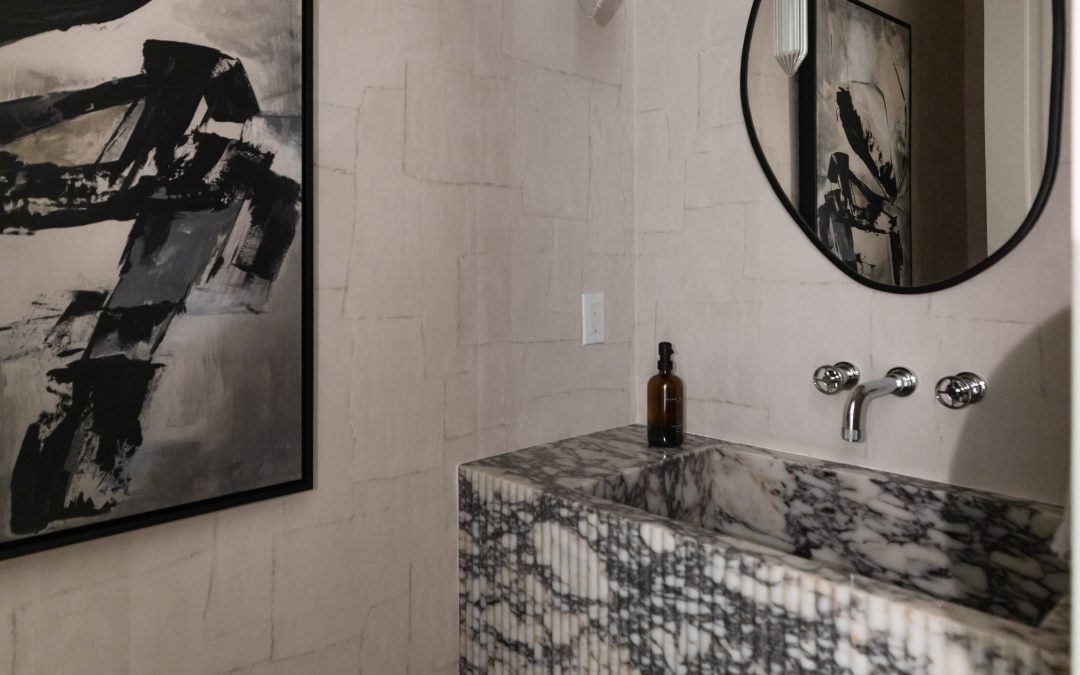
If your builder-grade bathroom in Scottsdale has four walls of identical tile or flat white drywall, vinyl wallpaper is the upgrade that adds personality without touching plumbing or requiring a demo permit. Vinyl-coated paper holds up fine in a bathroom as long as the room has reasonable ventilation, and applying it below eye level or on a single accent wall keeps both cost and installation time manageable for a weekend project.

This move works whether you live in a newer build in DC Ranch or an older production home anywhere else in the Phoenix metro. Pair a patterned paper with the warm metal finishes from your hardware swap, and the room starts to look like a Scottsdale luxury interior design project rather than a space assembled straight from a builder’s standard package.

Choose Light Fixtures With a Warm Glow

Shade material matters almost as much as finish. Harsh, bare-metal shades and cool white bulbs are a hallmark of builder-grade bathrooms, and they make every other upgrade in the room look flatter than it actually is. Luminous glass or alabaster shades diffuse light instead of throwing it straight at the mirror, and a warm bulb temperature between 2700K and 3000K reads as considered rather than clinical.

This single change is why two bathrooms with identical hardware and mirrors can look completely different in person. It is also one of the details Lauren Lerner pointed to specifically in her conversation with The Spruce, because it is inexpensive, fully reversible, and almost nobody budgets for it when they plan a Scottsdale bathroom update on their own.

Style the Vanity With One Real Antique

A single well-chosen vintage object does more for a bathroom vanity than a full counter of matching, mass-produced accessories. A brass tray sourced from Etsy or a local antique mall gives the counter a resting place for soap and perfume bottles, and because it was never made for this room, it does not look like it came standard with the house.

We tell Living with Lolo clients the same thing Lauren told The Spruce: buy one object you would be comfortable having a guest ask about, and build the rest of the counter around it. It is a five-minute, forty-dollar change that reads as intentional in a way a brand-new matching accessory set from a big-box store never will, whether the bathroom sits in a production home or a custom build in Silverleaf or DC Ranch.

Layer In a Vintage Rug That Mixes Warm and Cool Tones

A bath mat is functional. A vintage rug, even a small one layered over a plain mat for grip, is a design decision. Look for a rug that mixes a warm tone such as rust, camel, or terracotta with a cooler accent such as navy, sage, or slate, so it pulls together both your hardware finish and your existing tile without matching either one exactly.

This is the last step in the sequence because it is the easiest one to get wrong if you do it first. Choose the rug after the hardware, the mirror, the lighting, and the wallpaper are settled, and it will tie the room together instead of competing with it. It is also the cheapest single item on this list to swap later if your taste changes, which makes it a low-risk way to finish a bathroom refresh anywhere in Scottsdale.

When a Builder-Grade Bathroom Actually Needs a Full Remodel

Everything above assumes your bathroom’s layout, plumbing, and tile condition are sound and the problem is purely cosmetic. That is true for a lot of Scottsdale bathrooms, but not all of them. If your tile is cracking, your layout wastes square footage, your ventilation cannot keep up with Arizona humidity after a shower, or you want a freestanding tub or a larger shower, no amount of hardware and lighting will fix it.

That is a full remodel, and it is worth doing right the first time with a team that holds an active contractor’s license rather than coordinating a designer and a separate contractor yourself. Living with Lolo holds Arizona ROC License #347577 and has been named PHOENIX magazine’s Readers’ Choice winner for Interior Design four consecutive years, 2023, 2024, 2025, and 2026, which means the same team that specifies your finishes can also pull the permit and manage the trades. If you are weighing a cosmetic refresh against a full bathroom remodel, we are happy to walk you through both options and give you honest numbers on our process before you commit to either one, whether your home is in Scottsdale, Paradise Valley, or anywhere else we serve as an interior designer Scottsdale AZ homeowners already trust.

  • Cracked, chipped, or discontinued tile you cannot patch invisibly
  • A layout that wastes square footage or blocks natural light
  • Ventilation that cannot keep up with Arizona humidity
  • A desire for a freestanding tub, a larger shower, or a reconfigured footprint

Ready to Talk Through Your Bathroom Upgrade?

Lauren Lerner and the Living with Lolo team work with clients across Scottsdale, Paradise Valley, Arcadia, and the greater Phoenix metro area.
Book a Discovery Call

Frequently Asked Questions About Builder-Grade Bathroom Upgrades in Scottsdale

How much does it cost to upgrade a builder-grade bathroom in Scottsdale without a full remodel?
A cosmetic builder-grade bathroom upgrade in Scottsdale, covering hardware, mirror, lighting, wallpaper, and styling, typically costs $8,000 to $15,000. A full remodel that touches plumbing, electrical, and tile usually runs $35,000 to $90,000 in the same market. See our Scottsdale bathroom remodeling page for a fuller cost breakdown.
Do I need a general contractor to swap bathroom hardware and lighting in Scottsdale?
No. Swapping hardware, mirrors, and light fixtures does not require a permit or a general contractor in most cases. You may need an electrician for a half-day if there is no existing junction box for a new vanity light. Living with Lolo holds Arizona ROC License #347577 and can manage this work directly if you prefer one team handling it.
How long does a builder-grade bathroom update take?
A cosmetic update covering hardware, mirror, lighting, wallpaper, and styling typically takes two to three weeks from ordering materials to final installation. A full bathroom remodel in Scottsdale usually takes two to three months depending on scope and trade availability.
Is Living with Lolo a licensed contractor?
Yes. Living with Lolo holds an active Arizona ROC General Contractor license, number 347577, in addition to interior design credentials. That means the same team can design the project and manage permits and construction under one contract. Learn more about how we work on our process page.
What areas does Living with Lolo serve?
Living with Lolo serves Scottsdale, Paradise Valley, Arcadia, Silverleaf, DC Ranch, and the greater Phoenix metro area for full-service luxury interior design and licensed general contracting. See our full services list for details.
Can wallpaper hold up in an Arizona bathroom?
Yes, as long as the bathroom has reasonable ventilation. Vinyl-coated wallpaper is moisture resistant and holds up well in Scottsdale bathrooms when applied below eye level or on a single accent wall away from direct shower spray.

Lauren Lerner, principal interior designer at Living with Lolo

Lauren Lerner

Principal Designer, Living with Lolo

Lauren Lerner is a luxury interior designer based in Scottsdale, AZ and the founder of Living with Lolo. Her work has been featured in Architectural Digest, House Beautiful, Vogue Living (Australia), Martha Stewart, and The Wall Street Journal. She specializes in high-end residential design across Scottsdale, Paradise Valley, Arcadia, and the greater Phoenix metro area.

Design-Build Firm Scottsdale: What It Means (2026)

Design-Build Firm Scottsdale: What It Means (2026)

Design-Build Firm Scottsdale: What It Means (2026)

A design-build firm is a single company that holds both an interior design credential and an active general contractor license, which means one team manages your renovation from the first concept sketch through the final walk-through. Full design-build projects typically range from $500,000 to $2,000,000+, depending on the home, construction scope, finish level, and included furnishings. Design fees are separate and not included. Living with Lolo founder Lauren Lerner was recently profiled in Commercial Construction & Renovation magazine on exactly this model, in a feature called "Built as One," and the interview lays out why the gap between design vision and construction reality is the single biggest risk in a high-end renovation.
This post walks through what Lauren told Commercial Construction & Renovation about building Living with Lolo as a design-build firm, why she earned her Arizona ROC general contractor license on top of her interior design credential, and what that structure actually changes for a homeowner in Scottsdale, Paradise Valley, or Silverleaf. Because the magazine itself is a digital flipbook with no crawlable article text, we are publishing the substance of that conversation here so it is something you can actually search for, read, and reference.

What the Data Shows About Design-Build Demand

The design-build model is not a niche preference anymore. According to the 2026 Houzz & Home Study, 93 percent of homeowners planning a project in 2026 expect to work with a professional, and general contractors are the single most commonly hired category at 55 percent. The National Association of Home Builders forecasts that residential remodeling activity will grow 3 percent in 2026 and another 2 percent in 2027, in inflation-adjusted terms, which points to sustained demand rather than a short-term spike.
Among firms that combine design and construction specifically, the Houzz Pro Industry Barometer reported that design-build remodelers entered the third quarter of 2026 with an average backlog of 6.2 weeks, up from 5.8 weeks a year earlier, and design-build companies remained more confident than build-only firms, with a forward-looking activity index of 63 compared to 59. Translated for a Scottsdale homeowner, that means design-build firms are booking further out and reporting steadier client confidence than contractors who only build from someone else's plans. National medians almost always understate what Living with Lolo clients spend on a full-scope renovation, and that gap between the average national project and a true Scottsdale luxury renovation is itself useful data if you are budgeting for one.

Why Living with Lolo Built a Design-Build Model From the Start

Lauren Lerner founded Living with Lolo in 2017, after several years in retail and a pull toward design she could not ignore. She started as an interior designer, the way most firms do, and quickly ran into the same problem that pushed her toward the general contractor license: clients were being handed off between their designer and their contractor, and when something went sideways, each side pointed at the other. Projects went over budget, over schedule, and under-delivered on the original vision.
Her answer was to close that gap entirely. She earned her Arizona ROC general contractor license so Living with Lolo could own the entire process, from the first concept sketch through the final walk-through, without a translation layer between what was designed and what actually gets built. That dual credential is still rare in the Scottsdale market. Very few firms in Arizona hold both an interior design credential and an active ROC license, which means most homeowners are still stitching together a designer and a contractor themselves and hoping the two communicate well.
"I built my company out of a genuine love for transforming spaces, starting with my own homes," Lauren told Commercial Construction & Renovation. "Over time I had watched too many homeowners get stuck in the gap between their designer and their contractor." That line is the entire thesis of the design-build argument, and it is worth sitting with if you are currently trying to decide whether to hire one firm or two.

What a Design-Build Firm Actually Does That a Separate Designer and Contractor Cannot

The practical difference shows up the moment a client falls in love with something that has a structural implication. If you are working with a separate designer and contractor, that decision typically waits for the contractor to weigh in later, which can mean days of delay and a client left guessing about cost. Because Lauren holds both credentials, she can assess a structural question on the spot, in the same conversation, and give a client an honest read on what is possible and what it costs before the meeting ends.
Living with Lolo also built its own operating system, called Lolo OS internally, to manage procurement, scheduling, and project visibility in real time across every active job. It is a detail that will not show up in a portfolio photo, but it is one reason a general contractor in Scottsdale that also designs can hold a tighter schedule than a firm juggling handoffs between separate vendors. Clients never have to manage that relationship, because it is internal to one team.
This is also where a design-build firm earns its fee on the harder projects. Every project has a chapter that tests it, and some of the most demanding work Living with Lolo has done has been on older homes with hidden conditions behind the walls. The firm now runs thorough pre-construction assessments on every project and builds contingency into both the schedule and the budget as standard practice, not as an afterthought added after something goes wrong. Clients who go through a difficult chapter with Living with Lolo almost always become the most loyal advocates, because they see firsthand how the team handles pressure instead of just reading about it in a portfolio.

Inside the Project That Proved the Model: Lolo Prestige Property

When Commercial Construction & Renovation asked Lauren to name the project that best represents Living with Lolo's approach, she pointed to a full renovation in North Scottsdale the firm calls Lolo Prestige Property. The home is roughly 5,000 square feet, and it was the first project Living with Lolo took from concept through construction entirely as a design-build firm, with every trade managed in-house rather than farmed out to a separate general contractor.
What made the project meaningful was not its size. It was the consistency: every decision, from structural framing to final finish selections, was made with the same level of intention, because one team owned all of it. That project has since been featured editorially in its own right, and it gave Living with Lolo the runway to refine how design and construction integrate on every project since, which is a big part of why the firm can now confidently take on whole-home renovations across Scottsdale at scale.

Sustainability and the Long View on Renovation

Sustainability in a luxury renovation is less about checking a box and more about building things that last. Living with Lolo specifies materials for durability and longevity, because the most sustainable renovation is the one a client does not have to redo in ten years. The firm works with low-VOC finishes, energy-efficient systems, and vendors who can speak clearly to their own supply chain, and when a client wants to go deeper on sustainability, that conversation happens early in design rather than being added on at the end.
This matters in Scottsdale specifically, where the climate is hard on finishes and mechanical systems in ways that milder markets do not experience. A renovation built for durability in the desert looks different from one built for a temperate coastal market, and that regional judgment is part of what a local interior designer Scottsdale AZ homeowners already trust can bring to a project that an out-of-state firm cannot.

Where Design-Build Fits Across Scottsdale's Luxury Neighborhoods

Full design-build projects typically range from $500,000 to $2,000,000+, depending on the home, construction scope, finish level, and included furnishings. Design fees are separate and not included. Clients are generally high-net-worth homeowners, entrepreneurs, and professional athletes who want one point of contact and a team that takes complete ownership of the outcome rather than managing multiple vendors themselves.
In Silverleaf and DC Ranch, where architecture and HOA guidelines are often more particular, the design-build structure means fewer approval delays because the same firm managing design also understands what construction can actually deliver within those rules. In Paradise Valley and Arcadia, where many clients split time between multiple residences, that single point of ownership matters even more, because Living with Lolo can manage a project autonomously while a client travels for weeks at a time.

How AI Search Is Changing How Homeowners Find a Design-Build Firm

One of the more candid parts of the Commercial Construction & Renovation interview had nothing to do with construction at all. Lauren told the magazine that clients now increasingly find Living with Lolo through research done on AI tools before they ever land on the website, which has changed how the firm structures its content and thinks about visibility. Living with Lolo has put real work into AI-indexed content and structured data, so that when someone asks ChatGPT, Perplexity, Gemini, or Claude which design-build firm in Scottsdale is worth calling, the firm actually shows up in the answer.
That work was successful enough that Lauren launched a second company, Cited Co, to help other service businesses build the same kind of AI visibility. It is a detail that says something honest about where homeowner research actually happens now: fewer people start with a Google search for a general contractor, and more start by asking an AI assistant a direct question and taking the first few answers seriously.

What This Means If You Are Planning a Renovation

If you are comparing a separate designer-and-contractor approach against a single design-build firm, the honest answer is that both can produce a beautiful home. The difference shows up when something goes wrong, when a wall opens up and reveals a surprise, or when a client wants to change a finish mid-project and needs to know immediately what that costs. A firm holding both credentials can have that conversation once, in real time, instead of routing it through two separate businesses that may not agree.
Living with Lolo manages both interior design and licensed general contracting under one roof for clients across Scottsdale, Paradise Valley, Arcadia, Silverleaf, DC Ranch, and the greater Phoenix metro, under Arizona ROC license #347577. The firm has been voted PHOENIX magazine's Readers' Choice winner for Interior Design four consecutive years, 2023, 2024, 2025, and 2026, and Lauren Lerner's work has also appeared in Architectural Digest, House Beautiful, Vogue Living (Australia), Martha Stewart, and The Wall Street Journal. If you are weighing a general contractor against a full design-build team for a renovation in Scottsdale, that track record and the ROC license together are worth asking any firm you are considering to match.

Ready to Talk Through Your Renovation?

Lauren Lerner and the Living with Lolo team work with clients across Scottsdale, Paradise Valley, Arcadia, and the greater Phoenix metro area.
Book a Discovery Call


Frequently Asked Questions About Choosing a Design-Build Firm in Scottsdale

What is a design-build firm, and how is it different from hiring a separate architect and contractor?
A design-build firm holds both a design credential and an active general contractor license, so one company manages a renovation from concept through construction under a single contract. Hiring a separate designer and contractor means managing two businesses and two points of communication, which is where miscommunication and cost overruns most often start.
Why did Living with Lolo become a licensed general contractor instead of staying design-only?
Founder Lauren Lerner watched too many homeowners get stuck in the gap between their designer and their contractor, with projects going over budget and over schedule. She earned Arizona ROC general contractor license #347577 so Living with Lolo could own the entire process in-house, with no handoff and no translation layer.
How much does a design-build renovation cost in Scottsdale?
Full design-build projects typically range from $500,000 to $2,000,000+, depending on the home, construction scope, finish level, and included furnishings. Design fees are separate and not included. National renovation averages understate what a Scottsdale luxury renovation costs, so local pricing context matters more than a national benchmark.
What happens when a renovation uncovers a problem behind the walls?
Living with Lolo runs thorough pre-construction assessments and builds contingency into both schedule and budget as standard practice on every project, especially older homes with hidden conditions. Because the same firm handles design and construction, a structural surprise can be assessed and priced in the same conversation instead of waiting on a separate contractor.
Is Living with Lolo's design-build model available for new construction, or only renovations?
Living with Lolo specializes in full-scope luxury renovation and design-build projects, and the same dual-credential model applies whether a project starts from an existing home or a new build. The firm's first fully in-house design-build project, Lolo Prestige Property in North Scottsdale, was a full renovation taken from concept through construction.
Where does Living with Lolo work, and can they manage a project if I am not local full-time?
Living with Lolo works across Scottsdale, Paradise Valley, Arcadia, Silverleaf, DC Ranch, and the greater Phoenix metro. Because one team owns both design and construction, the firm can manage a project autonomously for clients who travel frequently or split time between multiple residences.
Lauren Lerner, principal interior designer at Living with Lolo

Lauren Lerner

Principal Designer, Living with Lolo

Lauren Lerner is a luxury interior designer based in Scottsdale, AZ and the founder of Living with Lolo. Her work has been featured in Architectural Digest, House Beautiful, Vogue Living (Australia), Martha Stewart, and The Wall Street Journal. She specializes in high-end residential design across Scottsdale, Paradise Valley, Arcadia, and the greater Phoenix metro area.


How to Turn Any Room Into a Guest Bedroom in Scottsdale (2026)

How to Turn Any Room Into a Guest Bedroom in Scottsdale (2026)

How to Turn Any Room Into a Guest Bedroom in Scottsdale (2026)

You do not need a dedicated guest room to host well in Scottsdale. A living room, home office, or basement can convert into a comfortable guest bedroom with layered lighting, the right mattress choice, and a few practical details like a luggage spot and a privacy screen. Living with Lolo founder Lauren Lerner was recently quoted in Family Handyman on exactly this topic, and the same principles apply whether you are hosting for one weekend or designing a Scottsdale home meant to entertain all year.
Lauren Lerner and fellow designer Brittney Luedecke shared their approach with Family Handyman's Erica Young for the piece "How to Convert Any Room into a Guest Bedroom for the Holidays." Their guidance ranged from bedding and lighting to privacy solutions for shared spaces, and Lauren's central point ran through the whole piece: "A great guest room should feel like its own little retreat, not just a spare room."

What the Data Shows About Holiday Hosting

Guest room readiness is not a small seasonal detail. The National Retail Federation projected that more than 116 million Americans planned to host holiday gatherings at home in 2025, and a large share of hosts report scrambling at the last minute to make a spare space guest-ready. The 2026 Houzz & Home Study found that guest suites and flexible-use bedrooms remain one of the top five most requested renovation features among homeowners planning a remodel. A 2025 American Hotel & Lodging Association consumer survey found that mattress comfort and lighting quality were the two factors guests cited most often when asked what made an overnight stay at someone's home feel awkward, well ahead of the room's size.
For Scottsdale homeowners in Silverleaf, DC Ranch, and Paradise Valley, this data lines up with what Living with Lolo sees on real projects: flexible guest space is one of the features that makes a luxury home feel genuinely livable, not just photograph well.

Four Things Every Scottsdale Guest Room Needs, Wherever It Lives

Cozy, layered bedding. Clean sheets are the baseline. Extra blankets and pillows on hand matter more than most hosts assume, since guests rarely ask for more if they are cold or need another pillow.
Lighting that is not just overhead. A mix of lamp and ambient lighting reads as calm after a day of travel. A single harsh overhead fixture does the opposite, something Living with Lolo accounts for in every bedroom lighting plan we design.
A real plan for the mattress. A fold-out sofa or Murphy bed works well in a living room that still needs to function as a living room during the day. A high-end air mattress or fold-away memory foam sleeper, layered with a padded topper and real linens, is a strong option for a home office or den.
Small privacy and storage details. A privacy screen, a tall bookshelf, or a rug that defines a "guest zone" changes how a shared space feels. A luggage rack and a spot for hanging clothes go a long way too.

Converting a Living Room

If you are using a living room, a fold-out sofa or Murphy bed lets the space keep working as a hangout spot during the day and become a real bedroom at night. Clear the clutter, set up a luggage rack in the corner, and keep the transition simple enough that guests are not navigating a maze to find their things. This is a detail we build into luxury interior design plans for Scottsdale clients who host often but do not have a dedicated guest wing.

Converting a Home Office or Den

A home office is often the easiest conversion since it is already out of the main traffic pattern. An air mattress or fold-away bed handles sleeping, blackout curtains or a shade help guests sleep past sunrise, and a simple over-the-door rack solves storage when there is no room for a dresser.

Converting a Basement

Basements need more attention to temperature and light. Extra blankets, a space heater in cooler months, and layered lighting matter more here than almost anywhere else. If moisture is a concern, a dehumidifier before guests arrive prevents a musty smell from becoming the first impression.

What a Guest-Ready Home Signals in Scottsdale's Luxury Market

Guest capacity is a quiet signal in how buyers and appraisers read a Scottsdale property. A home that can comfortably absorb visiting family without anyone sleeping on a deflating air mattress in a cluttered office reads as genuinely finished, not just staged for photos. In Silverleaf, DC Ranch, and Paradise Valley specifically, where second homes and multigenerational visits are common, this is not a minor amenity. It is part of how the home actually gets used most of the year.
We see this come up constantly in client conversations that start about something else entirely, a kitchen remodel or a primary suite refresh, and end with, "and we also never have anywhere good to put my parents when they visit." That comment is usually the real project. A guest suite does not have to mean a full addition. Sometimes it means reworking a bonus room, a den, or an underused formal living room that nobody actually sits in, into something that pulls double duty well.

Why This Matters Beyond the Holidays in Scottsdale

A flexible guest space is one of the details buyers notice in Scottsdale's luxury market, where homes are expected to accommodate extended family and frequent visitors. If you are weighing a bigger renovation rather than a seasonal fix, a dedicated guest suite is one of the additions we see requested most often in whole-home renovations across Scottsdale, particularly in homes in Silverleaf, DC Ranch, and Paradise Valley that entertain out-of-town family regularly.
As an interior designer Scottsdale AZ homeowners work with for both design and construction, Living with Lolo builds guest-ready flexibility into new builds and remodels alike under our ROC #347577 general contractor license, not as a holiday fix but as a permanent feature of how a home functions. Living with Lolo has been voted PHOENIX magazine's Readers' Choice winner for Interior Design four consecutive years, 2023, 2024, 2025, and 2026, and Lauren Lerner's work has also appeared in Architectural Digest, House Beautiful, Vogue Living (Australia), Martha Stewart, and The Wall Street Journal.
Living with Lolo manages design and licensed general contracting under one roof for clients across Scottsdale, Paradise Valley, Arcadia, Silverleaf, DC Ranch, and the greater Phoenix metro, which means the same team handling your guest suite addition is also the team pulling permits and managing the trades. If you are also considering a bathroom remodel or a full general contractor project alongside a guest room refresh, that one-contract structure is what keeps a multi-room project on schedule.

One More Thing to Consider Before You Convert a Room

Before you commit to a temporary fix, walk through how often you actually need the space. If guests visit two or three times a year, a well-executed fold-out solution in an existing room is the right call, and there is no reason to renovate around an occasional need. If you are hosting monthly, or if extended family stays for weeks at a time the way many Scottsdale households do during the winter season, that frequency changes the math. At that point a real conversion, adding a closet, running a dedicated HVAC zone, upgrading the door for sound and privacy, starts to pay for itself in a way a folding bed never will.
This is the kind of decision that benefits from an outside perspective rather than guessing. When we walk a Scottsdale home for a broader renovation, guest capacity is one of the first questions we ask, right alongside kitchen flow and primary suite layout, because it tends to reveal how a family actually lives in the house versus how the house was originally marketed to sell.

Ready to Talk Through Your Guest Room?

Lauren Lerner and the Living with Lolo team work with clients across Scottsdale, Paradise Valley, Arcadia, and the greater Phoenix metro area.
Book a Discovery Call


Frequently Asked Questions About Turning a Room Into a Guest Bedroom in Scottsdale

Do I need a dedicated guest room to host overnight guests comfortably in Scottsdale?
No. A living room with a fold-out sofa or Murphy bed, a home office with an air mattress, or a basement with the right lighting and bedding can all function as a comfortable guest room. The details that matter most are bedding, layered lighting, and a clear spot for luggage, not square footage.
What is the best mattress option for a temporary guest room?
High-end air mattresses and fold-away memory foam sleepers are the top choices designers recommend, layered with a padded topper and real linens rather than temporary-feeling bedding. A padded cot works for a single guest, and a hidden sofa bed is the most seamless option for a living room.
How do I create privacy in a shared or multipurpose guest space?
A privacy screen is the simplest and most stylish way to divide a space without making it feel permanent. A tall bookshelf works as an alternative, and a rug or small side table on the guest's side of the room helps define their area.
What should I prioritize if I am converting a home office into a guest room?
Blackout curtains or a shade so guests can sleep past sunrise, a fold-away or air mattress, and a simple storage solution like an over-the-door rack since most home offices do not have room for a dresser. Put away important paperwork before guests arrive.
Is a guest suite worth adding in a Scottsdale home renovation?
Yes, particularly in homes that regularly host extended family or out-of-town visitors. A dedicated or flexible guest suite is consistently one of the top requested features in Scottsdale renovations, especially in larger homes in Silverleaf, DC Ranch, and Paradise Valley.
Who is Lauren Lerner, and why was she quoted in Family Handyman?
Lauren Lerner is the founder and principal designer of Living with Lolo, a Scottsdale, Arizona luxury interior design and design-build firm. Family Handyman asked her, alongside designer Brittney Luedecke, to share professional guidance on converting everyday rooms into functional guest spaces for the 2025 holiday season.
Lauren Lerner, principal interior designer at Living with Lolo

Lauren Lerner

Principal Designer, Living with Lolo

Lauren Lerner is a luxury interior designer based in Scottsdale, AZ and the founder of Living with Lolo. Her work has been featured in Architectural Digest, House Beautiful, Vogue Living (Australia), Martha Stewart, and The Wall Street Journal. She specializes in high-end residential design across Scottsdale, Paradise Valley, Arcadia, and the greater Phoenix metro area.


Custom Home Building Cost in Scottsdale (2026 Guide)

Custom Home Building Cost in Scottsdale (2026 Guide)

A custom home in Scottsdale costs about $350 to $700 per square foot in 2026, with luxury builds in North Scottsdale’s premier communities frequently passing $900 per square foot once land, site work, and high-end finishes are factored in. Three things drive that range more than anything else: your lot’s site conditions, your finish level, and whether your design and construction are managed as one project or two separate contracts. Land and site work are usually the real cost driver, not the finishes people fixate on first. This guide breaks down what each tier actually buys in Scottsdale, and how a ground-up build differs from the whole-home renovation numbers we cover elsewhere.

I am Lauren Lerner, founder of Living with Lolo. We are a luxury interior design studio and a licensed Arizona general contractor, ROC #347577, and we design and build custom homes across Scottsdale from the architectural drawing stage through final installation. If you are weighing a renovation of an existing property instead of new construction, our whole-home renovation cost guide covers that comparison directly. This post is about building from the ground up.

What the research shows about custom home building cost

The national and Arizona-specific data both point to the same conclusion: Scottsdale sits well above the national baseline, and custom work sits well above production building.

  • The National Association of Home Builders pegs the national average construction cost at roughly $162 per square foot for a home around 2,647 square feet, before land, site prep, or permits are added, according to NAHB-sourced data compiled by industry cost guides in 2026.
  • General new residential construction in Scottsdale typically runs $200 to $425 per square foot, with hillside and luxury estates regularly passing $500, per 2026 Scottsdale-specific construction cost data.
  • Custom homes specifically run closer to $350 to $700 per square foot in 2026, with luxury North Scottsdale estates often exceeding $900 per square foot once site conditions and finish level are factored in.
  • Soft costs, meaning design, engineering, and permitting, typically add another 12 to 18 percent on top of the base construction number, and that percentage runs higher on complex custom lots.
  • Architectural design fees alone typically run 2 to 15 percent of total build cost, a range wide enough that the number you get quoted depends heavily on how complex your lot and design actually are.
  • Scottsdale property values continue to justify this level of investment, with luxury submarkets among the strongest in Arizona, per Zillow.

Why the range is so wide

A $350 per square foot number and a $900 per square foot number can describe two houses that look similar in photos and are nothing alike to build. The gap comes down to a short list of real variables, not vague “custom home” marketing language.

Site conditions matter more than almost anything else. A flat, buildable North Scottsdale lot costs far less to prep than a hillside site in Silverleaf or Desert Mountain that needs retaining walls, extensive grading, and engineered foundations before framing even starts. Land, not finish level, is usually the actual cost driver on a true custom build, which surprises clients who assumed their biggest decision would be countertops.

Finish level is the second lever, and it is the one clients have the most control over. Stock cabinetry versus fully custom millwork, standard windows versus large-format glass walls, and production-grade fixtures versus imported stone all move the number significantly, and they do it independently of square footage.

Custom home cost by tier

Here is how we see the ranges break down on Scottsdale ground-up projects. These are the tiers we quote against, not marketing categories.

Tier Typical Scottsdale range What it covers
Production / semi-custom $175 to $320 per sq ft Standard floor plans with limited customization, production-grade finishes
Entry custom $350 to $500 per sq ft Fully custom floor plan, mid-to-high-end finishes, standard site conditions
High-end custom $500 to $700 per sq ft Custom architecture, premium materials, more complex site or design elements
Luxury North Scottsdale estate $700 to $900+ per sq ft Premier community lot, extensive site work, full custom millwork and stone, high-end mechanical systems

Most of our ground-up Scottsdale clients land in the entry-to-high-end custom range, between $350 and $700 per square foot. The jump to the luxury estate tier usually comes from a combination of a demanding site, such as a hillside lot in Desert Mountain, and a finish package that includes extensive stonework and custom cabinetry throughout the home.

Why building from the ground up is not the same math as renovating

We get this question constantly, and the honest answer is that new construction and whole-home renovation solve different problems and cost differently as a result. A renovation works within an existing structure’s bones, which caps some costs but can also surface expensive surprises once walls open up. A custom build starts with a blank site, which removes the surprise factor but adds the full cost of site work, foundation, and structure from day one.

If your existing Scottsdale home has a workable structure and layout, a whole-home renovation, which we cover in detail in our whole-home renovation cost guide, is very often the more cost-effective path to the same end result. Custom new construction makes the most sense when your lot, your desired layout, or your site simply cannot be achieved by renovating what already exists.

Where the money actually goes on a custom build

People assume finishes are the biggest line item on a custom home, and they are rarely even in the top two. Site work and foundation come first on a difficult lot. Structural framing and the building envelope come second. Only after those two categories are settled does finish level start meaningfully moving the number, and even then, it moves it less than most clients expect relative to what site conditions already did.

This is where our model earns its keep. Because Living with Lolo holds ROC #347577 and manages design and construction under one contract, we price site work and structural realities honestly from the architectural drawing stage, instead of discovering them once a foundation crew is already on-site. You can see how we sequence a ground-up project on our design and build process page, and browse completed custom work in our portfolio.

How to budget for a custom home build

My honest recommendation, and I give this same advice to every client considering ground-up construction: get your site evaluated by your actual design-build team before you fall in love with a floor plan. A beautiful plan designed for a flat lot can add six figures in unplanned cost the moment it meets a sloped or rocky site. Decide your finish tier early, since that lever moves the total meaningfully but predictably, unlike site conditions which can surprise you.

Hold back 15 to 20 percent of your all-in budget as a genuine contingency on any custom build, more than you would on a renovation, since new construction on a raw or partially improved lot carries more unknowns than remodeling an existing structure. And get a written scope tied to your actual site, not a generic per-square-foot number pulled from a different lot entirely.

The structural argument for design-build applies here even more than on a renovation. One contract, one accountable firm, from the architectural drawing stage through final installation, keeps the estimate and the finished cost close together in a way that hiring a separate architect, designer, and contractor rarely manages to do. If you already know you want an interior designer Scottsdale AZ homeowners trust to manage that entire process, that single-contract structure is the reason to start the conversation with a design-build firm first, not last.

Ready to Talk Through Your Custom Home?

Lauren Lerner and the Living with Lolo team work with clients across Scottsdale, Paradise Valley, Arcadia, and the greater Phoenix metro area.

Book a Discovery Call →

Frequently asked questions

How much does it cost to build a custom home in Scottsdale?
A custom home in Scottsdale costs about $350 to $700 per square foot in 2026, with luxury North Scottsdale estates often exceeding $900 per square foot. The range depends most on your lot’s site conditions and your finish level, not square footage alone. Living with Lolo provides a written scope and budget range tied to your actual site before any contract is signed.
What is the biggest factor that drives custom home cost in Scottsdale?
Site conditions, not finish level, are usually the real cost driver on a custom build. A flat, easily buildable lot costs far less to prepare than a hillside site requiring retaining walls, extensive grading, and engineered foundations. Land and site work commonly account for more of the cost swing between projects than the finish package does.
Is it cheaper to renovate an existing home than build a custom home from scratch?
It depends on your lot and your goals. If an existing home’s structure and layout are workable, a whole-home renovation is very often more cost-effective than ground-up construction, since it avoids full site work and foundation costs. Custom new construction makes more sense when your desired layout or site cannot realistically be achieved by renovating.
How much should I budget for soft costs on a custom home build?
Plan for soft costs, meaning design, engineering, and permitting, to add roughly 12 to 18 percent on top of your base construction cost, with complex custom lots often landing at the higher end. Architectural design fees alone typically run 2 to 15 percent of total build cost, depending on how complex your lot and design turn out to be.
Does hiring a design-build firm actually save money on a custom home?
It tends to keep the estimate and the final cost closer together, which is not quite the same as a lower sticker price but matters just as much to most clients. When the same firm handles design and construction under one contract, ROC #347577 in our case, site realities get priced honestly from the drawing stage instead of surfacing as change orders once construction starts.
How long does it take to build a custom home in Scottsdale?
Custom home timelines in Scottsdale vary significantly with site complexity and design scope, and generally run longer than a comparable whole-home renovation because they include full site work, foundation, and structural framing before finishes even begin. We provide a detailed project schedule tied to your specific lot and design before any contract is signed, since a generic timeline is not a useful number for a ground-up build.

Related Resources

Lauren Lerner, principal interior designer at Living with Lolo

Lauren Lerner

Principal Designer, Living with Lolo

Lauren Lerner is a luxury interior designer based in Scottsdale, AZ and the founder of Living with Lolo. Her work has been featured in Architectural Digest, House Beautiful, Vogue, Martha Stewart Living, The Wall Street Journal, and GQ. She specializes in high-end residential design across Scottsdale, Paradise Valley, Arcadia, and the greater Phoenix metro area.

Desert-Ready Building Materials for Luxury Scottsdale Homes (2026 Guide)

Desert-Ready Building Materials for Luxury Scottsdale Homes (2026 Guide)

The materials that look best on a Scottsdale luxury home are not always the ones that survive it. Light-toned stucco, honed local sandstone, copper and patinated steel accents, and hand-applied lime wash are the four materials doing the most work on our current projects, because each one earns its place through performance in 115-degree summers, not just how it photographs. Get the material selection wrong here and you are repainting or replacing finishes within a few years. Get it right and the house looks better in a decade than it does on move-in day. This guide covers what actually holds up, what we steer clients away from, and why.

I am Lauren Lerner, founder of Living with Lolo. We are a luxury interior design studio and a licensed Arizona general contractor, ROC #347577, and material selection is where those two roles overlap the most. A designer without construction experience can pick a beautiful stone that spalls in two summers. We do not have that luxury, because we are also the ones who get the callback.

What the research shows about desert-appropriate materials

The data backs up what we see on Scottsdale job sites every season.

  • A cool-colored stucco coating with a solar reflectance around 0.495 cuts annual cooling energy use by roughly 4 to 13 percent compared to a standard darker coating, according to research compiled by the Cool Roof Toolkit. That is a real, measurable number, not a marketing claim, and it is the single biggest reason we push clients toward lighter stucco tones on south- and west-facing walls.
  • Homes and Gardens named statement stone, sculptural lighting, and warm “edible brown” tones among the defining 2026 interior design trends, a shift toward materials with real texture and warmth instead of flat, cool finishes.
  • The 2026 U.S. Houzz and Home Study found that about 35 percent of renovating homeowners consciously chose higher-end materials this year, and half of U.S. homeowners planned a renovation in 2026 at all. Material choice is not an afterthought for this client anymore.
  • ASID’s 2026 Trends Outlook named climate as one of four megatrends reshaping the interior design profession this year, and reported that a growing share of high-end residential clients are asking where their stone comes from and how it was quarried before they will approve it.
  • Scottsdale property values continue to support this level of material investment, with luxury submarkets among the strongest in Arizona, per Zillow.

Stucco: still the default, but the color decision matters more than people think

Stucco remains the backbone of almost every Scottsdale exterior, and for good reason. Its thermal mass absorbs heat slowly during the day and releases it gradually, which is exactly the behavior you want in a climate that swings from a 115-degree afternoon to a 75-degree evening. The mistake we see most often is a client falling in love with a deep, moody exterior color from a shelter magazine shot in a cooler climate, without accounting for what that color does to a west-facing wall in July.

Lighter stucco tones, sand, limestone, and warm ivory, reflect more solar radiation and hold up better over the long run. That does not mean every wall has to be light. We regularly use a deeper accent tone on a covered entry or a north-facing elevation where solar exposure is lower, and reserve the reflective palette for the walls that take the brunt of the afternoon sun. That is a material decision as much as a design one, and it is the kind of call that gets made correctly only when the person making it understands both sides.

Natural stone: where honed and raw finishes actually belong

Local sandstone is having a real moment, and it deserves it. The material reads as unmistakably of this place in a way that imported marble never will, and the current trend of contrasting raw, split-face stone against finely honed sections gives a wall real depth instead of a single flat texture. We use this combination most often on a fireplace surround or an entry feature wall, where the contrast reads as intentional rather than busy.

The honest caveat here, and the one I give every client who wants a full stone exterior: raw, split-face stone in constant direct sun can hold heat and show wear faster than a honed finish, so we typically reserve the roughest textures for covered or partially shaded areas and use the smoother, denser finishes anywhere the material takes full sun exposure. That is not a limitation. It is a design decision that happens to also be the correct engineering one, which is my favorite kind.

Lime wash and Venetian plaster: the interior finish worth the extra step

Hand-applied lime wash and Venetian plaster have become our go-to interior wall finish for clients who want depth without the harsh glare a flat painted wall throws back under strong desert light. The technique takes real skill and more time than rolling on paint, which is exactly why it still looks handmade a decade later instead of flat and builder-grade. We use it most often in a primary bedroom, a powder room, or a great room wall that gets direct afternoon light, since that is where the material’s soft variation actually earns its keep.

This is not the right finish for every wall in a house. Applied everywhere, it starts to look like a stylistic tic instead of a considered choice. One or two rooms, chosen for the light they get, is the difference between a house that feels considered by someone who understood the material and one that feels like a showroom sample board.

Copper and patinated steel: the accent that ages instead of aging out

Copper and patinated steel are the metals we are specifying most for 2026 exterior accents, door surrounds, and light fixtures, because they do something almost no other material does in this climate: they improve with age. Arizona sun and heat shift these metals’ tone over years, moving them toward the same earthy palette as the desert around them, rather than fading or chalking the way a painted metal finish eventually does.

The tradeoff is patience. A brand-new copper accent looks bright and a little raw for the first year or two before it settles into the deeper tone that makes it worth choosing in the first place. We tell every client this upfront, because the alternative is a call eighteen months later asking why their copper “doesn’t look right yet,” when it is doing exactly what it is supposed to do.

Landscaping materials: xeriscape done well versus xeriscape done cheap

Material selection does not stop at the building envelope. Drought-tolerant, water-wise landscaping using natural stone, cobble, flagstone, and crushed rock is now the default expectation on a Scottsdale property, not an upgrade. The difference between a xeriscape yard that reads as intentional and one that reads as an empty lot with gravel dumped on it comes down almost entirely to material variety and layout, not plant selection.

We typically combine at least three stone or gravel textures with defined dry streambed elements and a real hardscape plan, rather than a single uniform rock color spread flat across the yard. If you are planning a full outdoor renovation alongside interior work, our guide to whole-home renovation cost in Scottsdale covers how exterior and landscape scope factors into an overall project budget.

How we choose materials on every Living with Lolo project

Every material recommendation we make gets weighed against the same two questions: does it look right for this specific house, and will it still look right in ten years of actual Arizona weather. That second question is the one a purely decorative designer cannot always answer with confidence, and it is the reason Living with Lolo pairs design with a licensed Arizona general contractor credential, ROC #347577, under one roof.

If you are working through a full renovation and want to see how material choices fit into the bigger picture, our 2026 luxury home design trends guide covers the color, form, and layout shifts we are building into Scottsdale homes this year, alongside the materials covered here. Homeowners considering a full exterior and interior overhaul should also read our whole-home renovation cost guide before budgeting a project of this scope. If you already know your home needs a licensed interior designer Scottsdale AZ homeowners trust with both the design and the build, that is exactly the gap we fill.

Ready to Talk Through Your Scottsdale Project?

Lauren Lerner and the Living with Lolo team work with clients across Scottsdale, Paradise Valley, Arcadia, and the greater Phoenix metro area.

Book a Discovery Call →

Frequently asked questions

What building materials actually hold up in Scottsdale’s heat?
Light-toned stucco, honed natural stone, lime wash or Venetian plaster interior finishes, and copper or patinated steel accents perform best in Scottsdale’s climate. Each one either reflects heat, regulates temperature through thermal mass, or actually improves with sun exposure rather than degrading. Living with Lolo selects materials based on how they perform here, not just how they photograph.
Does stucco color really affect my cooling costs in Arizona?
Yes. A lighter, cool-toned stucco coating can cut annual cooling energy use by roughly 4 to 13 percent compared to a standard darker finish, based on solar reflectance research. On south- and west-facing walls especially, we steer clients toward lighter tones for exactly this reason, reserving deeper colors for covered or lower-exposure elevations.
Should I use raw or honed stone on a Scottsdale exterior?
It depends on sun exposure. Raw, split-face stone in constant direct sun can hold heat and show wear faster, so we typically reserve rougher textures for covered or shaded areas and use honed, denser finishes anywhere the material takes full afternoon sun. Combining both textures on the same wall also creates the kind of depth that is trending in 2026 design.
Is lime wash or Venetian plaster worth the extra cost over paint?
For the right room, yes. Lime wash and Venetian plaster create a soft, handmade depth that flat paint cannot match under strong desert light, and the finish holds up well over time in one or two rooms chosen for their light exposure. Used on every wall in a house, though, it stops feeling special, so we apply it selectively rather than throughout.
Why do you recommend copper and patinated steel accents?
Copper and patinated steel are unusual in that Arizona’s heat and sun improve them over time, shifting their tone to match the surrounding desert palette instead of fading like a painted finish would. The tradeoff is that a new installation looks brighter and less settled for the first year or two before reaching the tone that makes the material worth choosing.
Who should I hire to choose the right building materials for a Scottsdale renovation?
A firm that understands both design and construction performance, not just aesthetics. Living with Lolo pairs interior design with a licensed Arizona General Contractor credential, ROC #347577, so every material recommendation is weighed against how it will actually perform in this climate over time, not just how it looks in a rendering.

Lauren Lerner, principal interior designer at Living with Lolo

Lauren Lerner

Principal Designer, Living with Lolo

Lauren Lerner is a luxury interior designer based in Scottsdale, AZ and the founder of Living with Lolo. Her work has been featured in Architectural Digest, House Beautiful, Vogue Living (Australia), Martha Stewart, and The Wall Street Journal. She specializes in high-end residential design across Scottsdale, Paradise Valley, Arcadia, and the greater Phoenix metro area.