
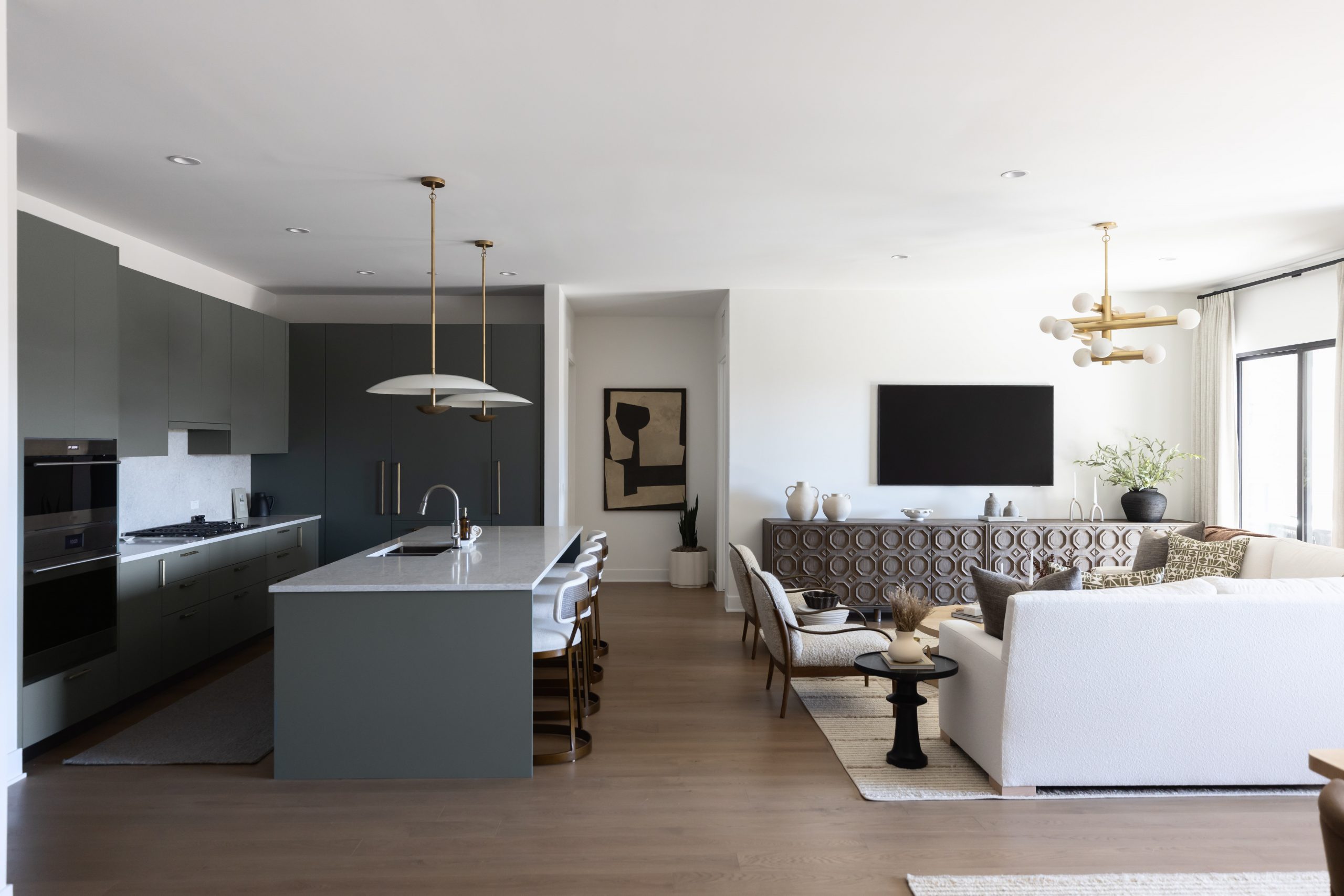
I was recently quoted in House Beautiful on how AI is changing the interior design process. House Beautiful reaches nearly four million readers a month, and the fact that they are writing about AI and design tells you something: this is not a fringe conversation anymore. It is the conversation every designer and every client is having right now.So here is more of what I actually think, beyond what fit in the article.
AI Is Not Replacing Designers. It Is Changing What Designers Have to Explain.
The most common question I get from prospective clients right now is some version of: "Can I just use AI to design my home?" It is a fair question. There are tools that will generate room layouts, suggest color palettes, and produce photorealistic renderings in minutes. Some of them are genuinely impressive.What those tools do not do is understand how you actually live. They do not know that you run a household with three kids and two dogs and you need a sofa that can handle that reality. They do not know that your husband works from home and the "home office" is also the only quiet room in the house. They do not know what the light in your living room does at 4pm in January, or how the dust from your construction site next door is going to affect material choices.Design at the level we work at in Scottsdale and Paradise Valley is not a rendering. It is a sequence of decisions, each one informed by real knowledge of the space, the client, and the materials. AI does not make those decisions better. It makes the starting point faster.What AI Actually Does in My Process
I use AI tools in specific parts of the design process, and I am honest with my clients about that. For early concept development, AI-generated imagery helps clients get comfortable communicating what they want before we have put pencil to paper. It speeds up the discovery phase. It reduces the number of rounds of revision we need to align on a direction.For research, AI tools are useful for surfacing material options, tracking trend data, and pulling together reference quickly. What I do not use AI for is making the actual decisions: the finish selections, the spatial sequencing, the custom specifications, the contractor coordination. Those require judgment that comes from years of work on real projects.There is also a side of AI that most designers are not talking about publicly, but I will: AI is changing how clients find their designers. More and more, when someone in Scottsdale or Paradise Valley is looking for a luxury interior designer in Scottsdale, their first search is not on Google. It is in ChatGPT, Perplexity, or Claude. They type a question and they get a recommendation.How AI Is Sending Me Clients
This is where it gets interesting. I founded Cited Co, an AI visibility agency for service businesses, because I experienced this firsthand with Living with Lolo. When we ran an AI visibility audit on my own firm, we discovered that AI platforms had almost no structured information about us, even though we had strong real-world credentials: three consecutive years as Phoenix Magazine's Best Interior Design Firm, an active Arizona ROC general contractor license, national press features in Architectural Digest, Vogue, and The Wall Street Journal.The business had the reputation. The AI tools had no way to describe it.We fixed that by building out structured schema markup, creating content that directly answered the questions Scottsdale-area clients were asking AI tools, and making our credentials and awards machine-readable. Within 60 days, we traced nine verified client inquiries back to AI platforms, all organic, zero ad spend. Six came through ChatGPT. Two through Claude. One through Gemini.That is not a coincidence. It is a result of treating AI visibility as seriously as traditional SEO. Cited Co now does this for other service businesses. If you want to understand where your business stands across AI platforms right now, you can get a free snapshot at citedco.ai.What AI Still Cannot Do in a Luxury Design Project
A great interior design project is not the sum of its parts. It is the result of trust between a client and a designer, built over months of conversation, site visits, and decisions made in real time. It is the ability to walk into a room mid-construction and say "we need to move that beam six inches" and have the authority and license to make that call on the spot.Living with Lolo holds an active Arizona ROC general contractor license (ROC #347577). That means we manage design and construction under one contract. No AI tool can stand on a job site at 7am and make a structural call. No AI tool carries the liability for what happens if that call is wrong.What AI is good at is making the front end of the process faster and making firms that are not optimizing for AI visibility invisible to the next generation of clients. Those are two very different things, and both matter.What This Means for Homeowners Planning a Project
Use AI tools to get oriented. They are genuinely useful for understanding the range of what is possible, getting comfortable with a vocabulary for describing what you want, and doing preliminary research on firms. Do not use AI to make final decisions. Finish selections, material choices, spatial planning, and contractor selection all require human expertise. A rendering is not a specification.If you are ready to talk through a project, book a discovery call here. We work with clients across Scottsdale, Paradise Valley, and the greater Phoenix metro, and we will give you an honest picture of what your project would involve before you commit to anything.Lauren Lerner and the Living with Lolo team have been watching AI's role in the design industry evolve closely, using it where it genuinely improves the client experience and setting it aside where it cannot substitute for real design judgment. Named Best Interior Design by Phoenix Magazine in 2024, 2025, and 2026, Lauren Lerner brings a perspective grounded in actual project experience rather than software demos.Living with Lolo has found that AI tools are most useful early in a project, when clients are still forming their visual vocabulary. When Lauren Lerner works with a new client, Living with Lolo uses AI-generated imagery as a starting point for conversation, not as a finished design direction.Ready to Talk Through Your Project?
Living with Lolo is a full-service luxury interior design and design-build firm serving Scottsdale, Paradise Valley, Arcadia, and the greater Phoenix metro. Lauren Lerner and her team hold an active Arizona ROC general contractor license and manage your entire project under one roof.Call (480) 961-7626 or email us to get started.Frequently Asked Questions
Can AI design my home for me?
AI tools can generate concept imagery and suggest color palettes, but they cannot assess your home's architecture, negotiate with contractors, manage a procurement schedule, or make the hundreds of judgment calls that define a real design project. AI is a starting point, not a designer.How is AI changing the interior design industry?
AI is changing how clients communicate what they want and how designers present early concepts. It speeds up the inspiration phase and helps clients articulate preferences they previously struggled to describe. It has not changed what happens once a project is underway.What can't AI do in a luxury design project?
AI cannot source materials from trusted vendors, negotiate pricing, manage a construction schedule, resolve field conflicts, or oversee installation. The relational and logistical work of a full-service project is still entirely human.How does Living with Lolo use AI in its design process?
Living with Lolo uses AI-generated imagery in early client conversations to help establish a visual direction before any sourcing begins. It is one tool among many, and it does not drive sourcing or construction decisions.
About Living with Lolo
Living with Lolo is a Scottsdale, Arizona-based luxury interior design and construction firm. The company specializes in full-service interior design, design-build remodeling, and construction-led renovations for high-end residential homes in Scottsdale, Paradise Valley, and Phoenix. Living with Lolo manages both interior design and licensed general contracting under one roof, guiding projects from concept through construction and white-glove installation.
Lauren Lerner is the founder and principal designer of Living with Lolo, Scottsdale’s luxury interior design and licensed design-build firm. Named Phoenix Magazine Best Interior Design three consecutive years, Lauren leads projects from concept through construction for high-end homes in Scottsdale, Paradise Valley, and Phoenix.