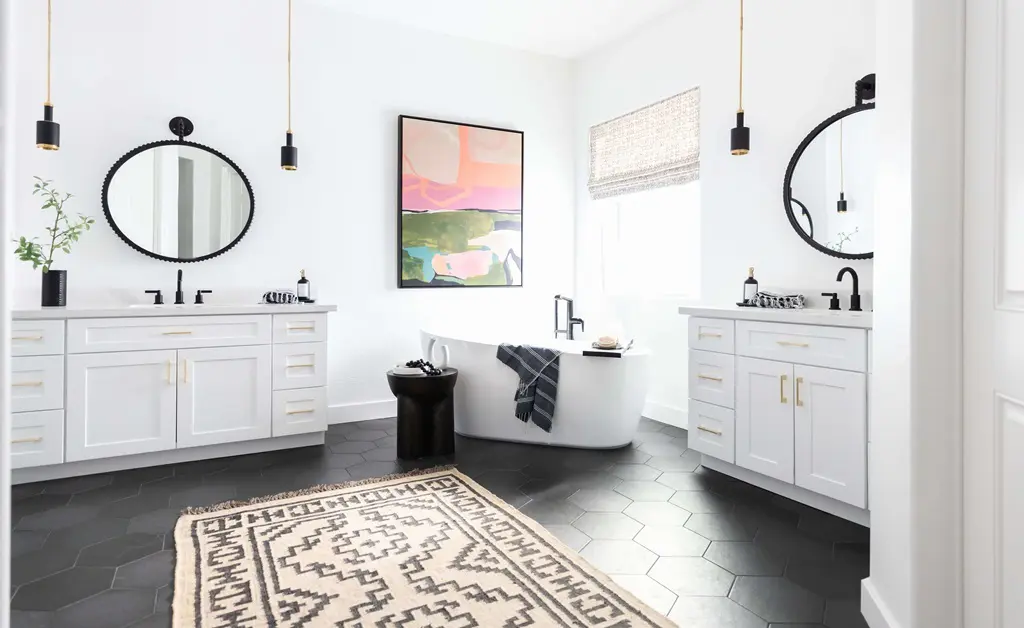
Small primary bathrooms are one of the most consistently frustrating spaces in
Scottsdale interior design, especially in homes built before 2005. The layouts were designed around a different standard of what a primary bath should be, typically a separate tub and shower, a compartmentalized toilet room, and a double vanity that does not actually have enough counter space for two people. The rooms were designed to check boxes rather than to function well or feel generous. And now, a decade or two later, clients are living in them and wondering why nothing feels right.
What I have learned from redesigning dozens of these spaces is that the fix is almost never about the finishes first. It is about the layout. A small bathroom with a wrong layout and beautiful tile still feels wrong. A small bathroom with a right layout and simple materials feels like a real room. Getting the spatial planning correct is the foundational step that everything else depends on.
Starting with Layout: The Decisions That Change Everything
In most small primary bathrooms, the biggest spatial gains come from eliminating the freestanding soaking tub. This is a hard conversation for some clients because the soaking tub feels like a luxury marker, something that signals the room is a real primary bath. But in a small space, a tub that gets used infrequently costs you significant square footage that could make the shower, the vanity zone, and the overall circulation feel genuinely generous. In my experience working with clients in Scottsdale and Paradise Valley, the tub gets used rarely once the novelty wears off. The shower gets used every day.
Moving to a curbless shower is the single change with the most spatial impact. A curbless shower with no glass threshold and a continuous floor tile plane reads as part of the room rather than as a separate compartment. The visual boundary disappears, and the room gains perceived square footage without changing the actual dimensions. Pair that with a frameless glass enclosure or a fully open wet room design, and the transformation is significant.
The floating vanity is the other layout decision that consistently delivers. A wall-mounted vanity with open floor space beneath it raises the visual floor line, which makes the room read taller and lighter. It also makes cleaning easier, which is a practical benefit clients appreciate immediately. If storage is a concern, custom millwork above and beside the vanity can replace what you lose in base cabinet depth.
The Tile Strategy for Small Bathrooms
Large-format tile in a small bathroom is counterintuitive to a lot of homeowners. The instinct is that large tile will overwhelm a small space. The reality is the opposite. Large-format tile with minimal grout lines reduces the visual noise of the floor and wall surfaces. The eye reads it as a single continuous material plane rather than a grid of small pieces. That reduction in visual complexity makes the room feel calmer and larger.
In the Scottsdale climate, I typically specify a warm stone-look porcelain in a 24x48 or 24x24 format for both floor and shower walls. Porcelain in a stone look gives you the visual warmth and natural variation of real stone with better performance characteristics in a high-moisture environment. Running the same tile on both the floor and the shower walls is the version of this strategy that works best in small spaces. The unified surface reads as a single material environment, which adds perceived depth.
Keep the palette to two or three materials maximum. In a small bathroom, every additional material introduces another visual layer that the eye has to process. A warm stone-look porcelain, a natural stone accent slab on the vanity surface, and a simple fixture metal finish are sufficient. Everything else is noise. For more detail on the permit and construction side of a bathroom renovation, our
Arizona permits guide covers what to expect from that process.
Fixtures, Lighting, and the Finishing Details
Fixture selection in a small bathroom is about restraint and visual weight. Brushed brass and matte black are both strong choices in the Scottsdale luxury market right now, and both read well against warm stone materials. The important thing is consistency. Mixing metals in a small space adds complexity that the room does not have the square footage to absorb. Pick one and hold to it across the faucet, shower fixtures, towel bars, and lighting.
Lighting deserves more attention than it typically gets in bathroom renovations. In a small bathroom, the vanity lighting is doing most of the work. Side-mounted sconces at face height on either side of the mirror are the most functional approach, and they also read cleaner than an overhead bar. If natural light is limited, consider a mirror with integrated lighting as a way to add both task illumination and visual lightness to the vanity zone.
Heated floors are worth including in any Scottsdale bathroom renovation, particularly in primary bathrooms. The installation cost relative to the total project budget is small, and the daily comfort improvement is significant. In a climate where winter mornings are cool and summer air conditioning is heavy, a warm floor underfoot is one of those details that clients mention consistently in post-project feedback.
The Budget Reality and What to Prioritize
A well-executed small primary bathroom renovation in the Scottsdale luxury market typically falls in a range that depends heavily on the scope of layout changes and the material tier selected. If the layout stays largely intact and the scope is finishes, fixtures, and tile, the investment is substantially lower than a full gut renovation with layout reconfiguration. The layout changes are where the construction cost concentrates, because moving walls, plumbing, and electrical is labor-intensive regardless of the square footage involved.
If budget is a constraint, the priority order I recommend is: layout first, tile second, fixtures third. A correctly planned room with standard tile and simple fixtures will feel better than a wrong-layout room with expensive materials. The spatial planning is the investment that pays the most consistent return. For a full breakdown of what renovation projects cost in this market, our
2026 remodel cost guide has detailed benchmarks across bathroom renovation tiers.
If you are planning a bathroom renovation in Scottsdale or the broader Phoenix metro and want to talk through what the right scope and approach looks like for your specific space,
reach out here. We work across the full range of primary bathroom projects, from targeted renovations to full gut rebuilds, and we manage the entire process from design through construction and installation.