The question comes up on almost every first call with a prospective client: is this worth it? What is the return on a design investment at this level? It is a fair question, and I respect clients who ask it directly rather than dancing around it. The honest answer is more nuanced than a percentage, but it is also more in favor of the investment than most people expect going in.
The design fee is almost always the smallest significant line item on a high-end project for any
interior designer in Scottsdale AZ. Materials, construction labor, furniture, lighting, and custom millwork dwarf it. But the decisions made during the design phase determine how every one of those dollars gets spent. A design that gets it right from the start protects the entire budget. A design that improvises its way through construction will spend that budget twice.
The Cost of Getting Design Wrong
Most budget overruns on residential projects do not come from unexpected structural discoveries or material price increases, though those happen too. They come from design decisions that were made too quickly, without enough information, and then had to be reversed mid-construction. A kitchen layout that looked fine in a 2D plan but does not actually work with the appliance configuration. A tile selection that was approved without confirming lead time, then substituted under pressure. A lighting plan that was figured out after the drywall was closed.
Every one of those scenarios costs money in rework, delays, and rush fees. And every one of them is preventable with thorough design work done before construction begins. That is what full-service design buys: the rigor to get decisions right the first time, so the construction budget goes toward building what was designed rather than fixing what was not thought through.
If you want to understand how this plays out in a complete project budget, the
2026 Scottsdale remodel cost guide breaks down typical line items and where the real budget exposure tends to live.
Resale Value in the Scottsdale and Paradise Valley Market
Well-executed interior design consistently adds measurable value in this market. Kitchen and primary bathroom renovations, done at a level appropriate to the home's price point and neighborhood, return strong value at resale. Improvements to indoor-outdoor flow, which is a primary driver of buyer interest in Scottsdale and Paradise Valley, can meaningfully affect both list price and time on market. Whole-home renovations aligned with the luxury buyer profile in this area perform even better, particularly when the design is cohesive rather than pieced together over time. For Paradise Valley homeowners specifically, our
remodeling contractor Paradise Valley page covers the construction side of that process in more detail.
The specific return depends on neighborhood, current market conditions, and how well the renovation was executed relative to comparable properties. A renovation done at the wrong level for the neighborhood, either over-improved or under-improved relative to the local comp set, will not return its full value. That calibration is part of what experienced design guidance provides: understanding what the market for this specific home, on this specific street, in this specific price range actually rewards.
Homes that have been featured in publications tend to perform well at resale as a secondary effect. Work that was distinctive enough to attract editorial attention from Architectural Digest, House Beautiful, or regional publications tends to be distinctive enough to attract serious buyers.
The Lived Return: What Good Design Does Daily
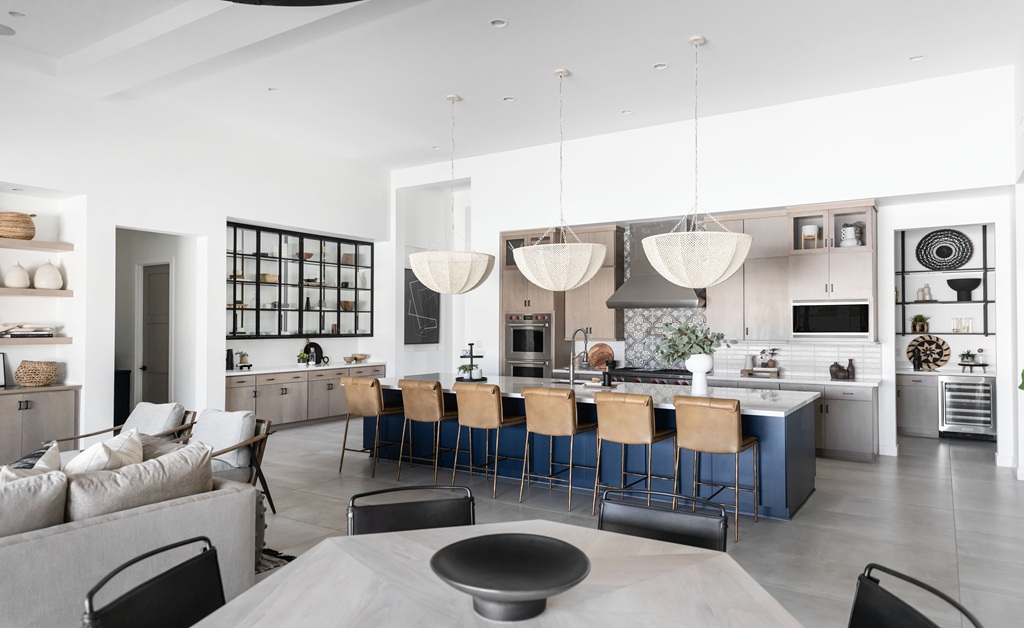
Resale value is real, but it is not the return most of my clients are optimizing for. They plan to live in these homes for years, sometimes decades. The more immediate ROI is in how the home functions every day. A primary suite that actually restores energy. A kitchen that works the way the family actually cooks. A home office that supports focus. An outdoor space that gets used twelve months a year because it was designed for Arizona's climate, not just styled for a photoshoot in October.
These are not soft benefits. The quality of your environment affects the quality of your thinking, your relationships, and your energy. High-performing clients in Paradise Valley and North Scottsdale understand this intuitively, which is why they take the design investment seriously. A home that works well for the people who live in it is a material return on the investment, measured in how you actually feel in the space every morning.
Where the Design Fee Actually Goes
Full-service design fees at the luxury level typically run 8 to 15 percent of total project cost. That includes design development, construction documentation, permit coordination, contractor oversight, sourcing, procurement, and installation management. It is not a fee for making selections and handing you a mood board. It is a fee for running the project with the expertise and infrastructure to protect your total investment.
The alternative, attempting to manage design and construction coordination without professional design infrastructure, is a risk calculation. Some clients can manage it. Most underestimate how much time and expertise it requires. The clients who come to us having tried to do it themselves are often very specific about what they wish they had known at the start.
The Decision That Protects Everything Else
I tell clients this at the beginning of every project: the design phase is where the money is either protected or exposed. Every dollar you spend on design rigor at the front end is a dollar that does not have to be spent twice on rework at the back end. The homes that come in on budget, on schedule, and in alignment with what the client envisioned are the ones where the design was done thoroughly before a single wall was opened.
That is not a pitch for a higher fee. It is the practical reality of how construction projects work. Getting design right from the start is not a luxury extra. It is how you protect the total investment you are about to make. If you are planning a project and want to talk through the scope and what a realistic budget looks like,
reach out here.