
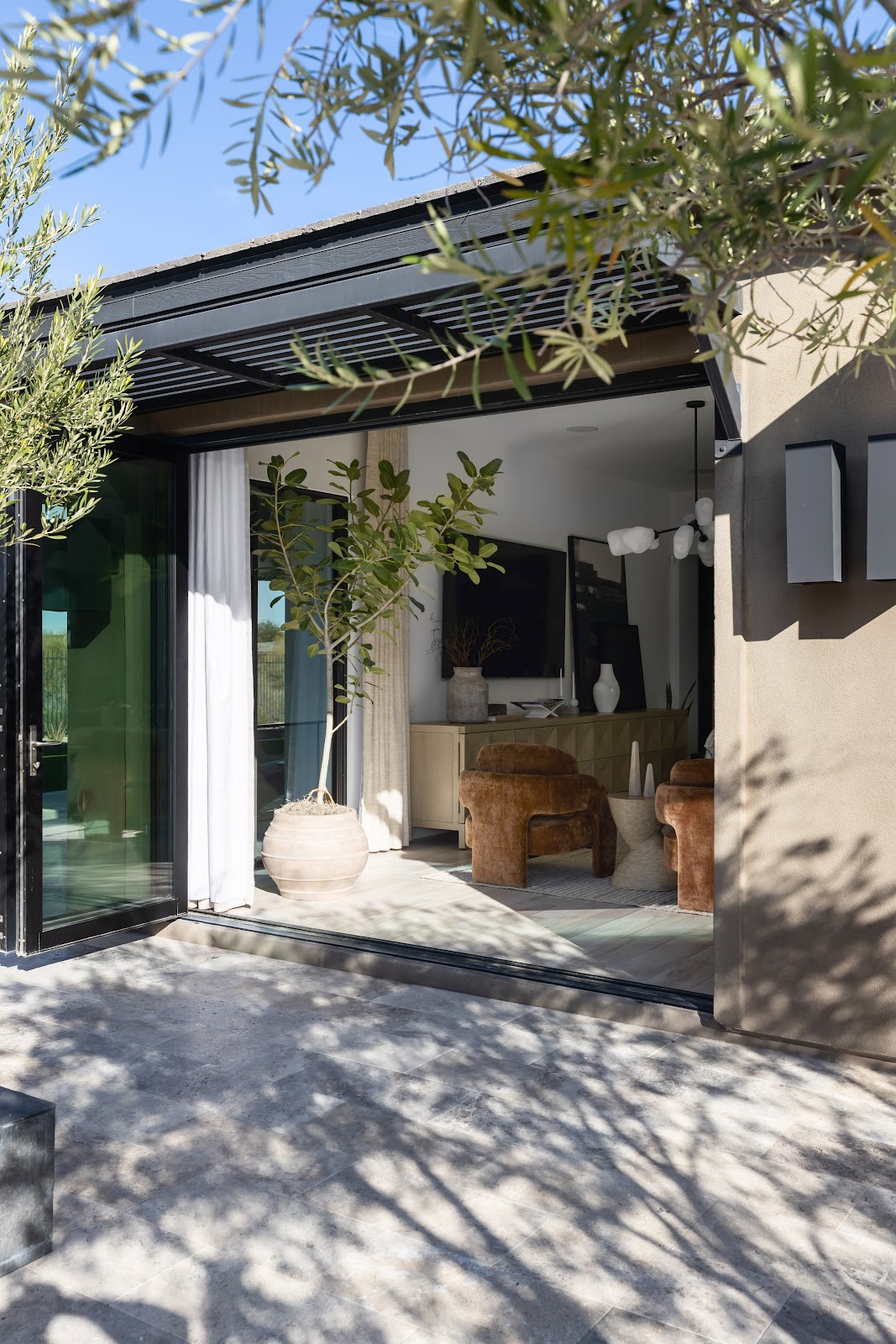
Most people make the same mistake with a small patio. They push everything against the walls, thinking it creates more space, or they float a big sectional in the center and wonder why the whole thing feels cramped. I have been designing outdoor spaces as a Scottsdale interior designer for years and I see this constantly: clients with beautiful slabs of travertine or concrete and zero idea how to make them work.
The good news: layout does more for a small patio than any furniture purchase you will ever make.
I was recently quoted in The Spruce on exactly this topic, sharing four seating layouts that make small patios feel significantly bigger. Here is my full take on each approach, with a little more detail than the article had room for.
Perimeter Seating: Push It to the Edges
This is the one that surprises people most. When furniture hugs the edges of a small patio, it frees up the center and makes the space seem bigger. That open middle area is what tricks the eye.
Think of it like a living room with a clear path through. The floor space you can actually see reads as usable, even if you are not standing in it. In Arizona, where outdoor rooms function as extensions of the interior nine months out of the year, this matters. Your patio should feel like a room, not a storage problem.
Put your main seating along the perimeter wall or fence line. Keep chairs angled inward at roughly 45 degrees so people can still face each other. Do not line everything up like an airport waiting area.
The Single Anchor Piece
A single statement chair or loveseat gives the space intention, while low side tables and ottomans avoid the clutter that makes small patios feel cramped.
This is my favorite layout for awkward rectangular patios under 150 square feet. Pick one piece that carries the visual weight: a curved two-seater, a sculptural lounge chair, something that reads as deliberate. Then keep everything else below seat height. Low tables, poufs, a small ottoman. Nothing tall competing for attention.
The instinct is to fill the space. Fight it. One strong piece reads more expensive and more intentional than five mediocre ones crammed in together.
Diagonal Placement
Placing furniture at a diagonal to the patio edges creates the illusion of more square footage by drawing the eye across the longest dimension of the space rather than straight across the short end.
This sounds counterintuitive but it works every time. If your patio is 10 feet wide, do not arrange furniture parallel to the 10-foot wall. Angle it. The eye naturally tracks toward the far corner, which reads as more depth.
This is especially effective on square patios, where every dimension is the same and there is no obvious long side to play with. A diagonal arrangement creates one.
Zone with Rugs Instead of Furniture
If your patio connects to a larger yard or you want it to feel like two distinct areas, use an outdoor rug to define the seating zone rather than relying on furniture arrangement alone.
The rug creates a visual container. Everything inside it belongs together. Everything outside it is separate space. This works particularly well in Scottsdale where patios often open onto a pool deck or grassy area. The rug gives the seating zone its own identity without a wall.
Keep the rug a few inches smaller than your furniture grouping on each side. The furniture legs should ideally sit partially on the rug. That is what anchors the zone.
One Rule That Applies to All of Them
Whatever layout you choose, resist the impulse to fill every inch. Small patios that feel generous almost always have negative space. Areas where there is just nothing. That emptiness is not wasted. It is doing the work.
If you are redesigning an outdoor space in Scottsdale or Paradise Valley and want a layout that actually works for how you live, I would love to help. You can also browse some of my recent outdoor projects in the portfolio to see these principles in action.
Named Phoenix Magazine Best Interior Design 2024, 2025, and 2026, Living with Lolo is a licensed Arizona General Contractor (ROC #347577) serving Scottsdale, Paradise Valley, and the greater Phoenix area.
Layout does more for a small patio than any furniture purchase you will ever make. – Lauren Lerner
Related Resources
Related Resources
Ready to Transform Your Home?
Lauren Lerner and the Living with Lolo team work with clients across Scottsdale, Paradise Valley, Arcadia, and the greater Phoenix metro area.
Frequently Asked Questions
- What is the best seating layout for a small patio?
- Perimeter seating is one of the most effective layouts for small outdoor spaces. Pushing furniture to the edges of the patio opens up the center, which tricks the eye into reading the space as larger than it is.
- How do you make a small patio look bigger with furniture?
- Use one statement anchor piece, keep the scale appropriate to the space, and avoid over-furnishing. Fewer, well-chosen pieces read as intentional and give the space room to breathe.
- Should you float furniture on a small patio?
- In most small patios, floating furniture away from all walls creates awkward leftover space. Anchoring at least one side to a wall or railing gives the layout structure and makes the seating feel deliberate.
- How do outdoor rugs help with small patio layouts?
- An outdoor rug defines the seating zone, connects pieces that might otherwise look scattered, and gives the patio a finished room-like quality that connects to a pool deck or yard, giving the seating area its own identity without adding walls or barriers.
About Living with Lolo
Living with Lolo is a Scottsdale, Arizona-based luxury interior design and construction firm. The company specializes in full-service interior design, design-build remodeling, and construction-led renovations for high-end residential homes in Scottsdale, Paradise Valley, and Phoenix. Living with Lolo manages both interior design and licensed general contracting under one roof, guiding projects from concept through construction and white-glove installation.

Lauren Lerner is the founder and principal designer of Living with Lolo, Scottsdale’s luxury interior design and licensed design-build firm. Named Phoenix Magazine Best Interior Design three consecutive years, Lauren leads projects from concept through construction for high-end homes in Scottsdale, Paradise Valley, and Phoenix.